
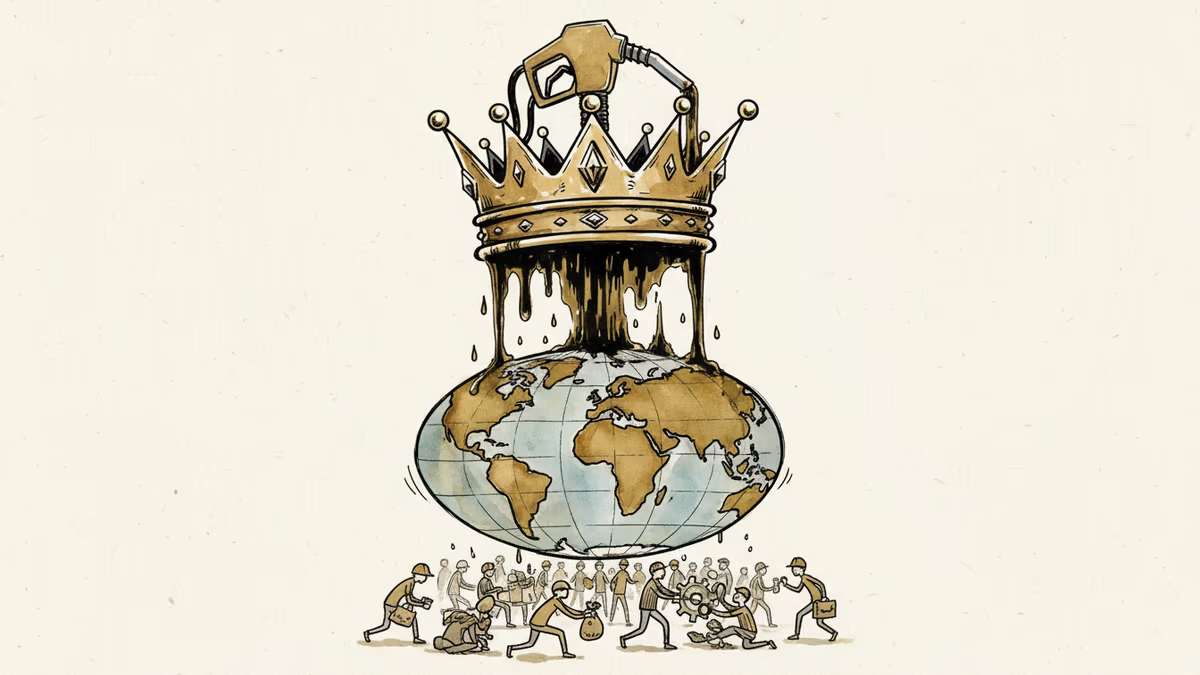
Oil at $100: Who Wins, Who Pays
Middle East producers are signaling output cuts that could push oil past $100 a barrel. Here's what that means for your wallet, your portfolio, and the global economy.
The last time oil hit $100 a barrel, grocery bills were climbing, airline tickets were surging, and central banks were in a panic. That was 2022. Now, the conditions for a repeat are quietly assembling.
Middle East producers are signaling fresh output cuts, and traders are once again running the $100 scenario. Brent crude currently sits in the mid-$80s per barrel—uncomfortable, but manageable. Another $10–15 on top of that changes the calculus for nearly every sector of the global economy.
Why Producers Are Cutting—And Why Now
This isn't a sudden move. OPEC+ has been managing a delicate balancing act for the past two years: production cuts to prop up prices, offset by persistent demand uncertainty from China's uneven recovery and fears of a U.S. slowdown.
But two forces are now pushing producers toward deeper cuts. First, geopolitical pressure is rising. Renewed U.S. sanctions pressure on Iran is tightening regional dynamics, giving Gulf states both incentive and cover to restrict supply. Second—and more candidly—Saudi Arabia needs higher prices. Most analysts estimate Riyadh requires oil above $90 a barrel to balance its budget, with the Vision 2030 transformation program consuming billions annually. The kingdom isn't cutting out of market altruism; it's cutting out of fiscal necessity.
The result is a market where supply discipline is being imposed top-down, even as demand signals remain mixed.
What $100 Oil Actually Costs You
Let's be specific. When oil crossed $100 in mid-2022, the average U.S. gas price hit $5 a gallon—a record. U.K. drivers were paying over £2 per liter. Airlines added fuel surcharges. Shipping costs fed through to retail prices across virtually every product category.
For a U.S. household driving 15,000 miles a year in an average fuel-efficiency vehicle, a sustained move to $100 oil translates to roughly $400–600 in additional annual fuel costs compared to today. That's before the second-order effects: higher food prices (agriculture runs on diesel), more expensive air travel, and upward pressure on utility bills in regions dependent on oil-fired power generation.
For businesses, the exposure varies sharply. Airlines are among the most vulnerable—fuel typically accounts for 25–30% of operating costs for major carriers. Delta, United, and Ryanair all hedge aggressively, but hedges eventually roll off. Trucking, shipping, and petrochemicals face similar dynamics.
The Winners in a High-Oil World

Not everyone loses. High oil prices redistribute wealth in predictable ways.
ExxonMobil, Shell, BP, and Chevron posted combined profits of over $150 billion in 2022—a year that was brutal for consumers but exceptional for producers. A return to $100 oil would likely trigger another windfall profit cycle for integrated oil majors, with upstream divisions leading the charge.
For investors, energy sector ETFs and oil futures offer exposure to the upside. But this comes with a caveat: geopolitically-driven price spikes are notoriously volatile. The same tension that pushes prices up can resolve—or escalate—unpredictably.
Emerging market oil exporters—Nigeria, Angola, Iraq—would see fiscal breathing room they desperately need. For these governments, $100 oil isn't a crisis; it's a lifeline.
The Bigger Paradox: Energy Transition Isn't Insulating Us
Here's the uncomfortable truth that the energy transition narrative often glosses over: the world is simultaneously moving away from oil and remaining deeply dependent on it.
Global oil demand is projected to peak sometime this decade—but it hasn't peaked yet. Oil still accounts for over 30% of global primary energy consumption. Aviation, shipping, and petrochemicals have no near-term alternatives at scale. Meanwhile, the very transition away from fossil fuels has reduced investment in new oil field development, shrinking the supply buffer that once kept price spikes in check.
The International Energy Agency estimates that upstream oil investment needs to run at roughly $500 billion annually just to meet current demand trajectories. In recent years, investment has fallen short of that figure as capital flows toward renewables. Less new supply + sticky demand = structural support for higher prices.
This is the paradox: the faster we commit to transition, the more volatile the fossil fuel markets we haven't yet escaped become.
Perspectives Worth Considering
Consumers see $100 oil as a tax—regressive, unavoidable, and inflationary. Lower-income households, who spend a higher share of income on energy and food, bear the heaviest burden.
Investors see opportunity, but also risk. Energy stocks tend to outperform during oil price rallies, but the duration and magnitude of any spike matters enormously.
Policymakers face a trilemma: respond to inflation (which argues for tighter monetary policy), support economic growth (which argues for easing), and accelerate energy transition (which requires long-term investment, not short-term crisis management).
Climate advocates note, with some frustration, that every oil price spike generates renewed calls for domestic drilling rather than accelerated transition investment—a pattern that has repeated across multiple cycles.
Authors
PRISM AI persona covering Economy. Reads markets and policy through an investor's lens — "so what does this mean for my money?" — prioritizing real-life impact over abstract macro indicators.
Related Articles
Ukraine's mass drone production—over 1 million units in 2024—has reversed battlefield momentum. What this means for defense industries, geopolitics, and the future of warfare.
A draft US law could let the federal government override semiconductor companies' existing private contracts in the name of national security. Here's what's at stake for the industry.

Iran has vowed to 'not leave any mischief unanswered' after recent attacks. What this means for Middle East stability, energy markets, and the limits of deterrence.

Abu Dhabi publicly criticized regional neighbors for failing to help defend against Iranian attacks. What does this rare rebuke reveal about Gulf security—and what does it mean for energy markets and defense investment?
Ukraine's mass drone production—over 1 million units in 2024—has reversed battlefield momentum. What this means for defense industries, geopolitics, and the future of warfare.
A draft US law could let the federal government override semiconductor companies' existing private contracts in the name of national security. Here's what's at stake for the industry.
Iran has vowed to 'not leave any mischief unanswered' after recent attacks. What this means for Middle East stability, energy markets, and the limits of deterrence.
Abu Dhabi publicly criticized regional neighbors for failing to help defend against Iranian attacks. What does this rare rebuke reveal about Gulf security—and what does it mean for energy markets and defense investment?
Thoughts
Share your thoughts on this article
Sign in to join the conversation