
Trump Pulls Envoys from Pakistan — Who Fills the Vacuum?
Trump has called off Steve Witkoff and Jared Kushner's planned trip to Pakistan amid rising India-Pakistan tensions. What does Washington's absence signal for South Asia's most volatile flashpoint?
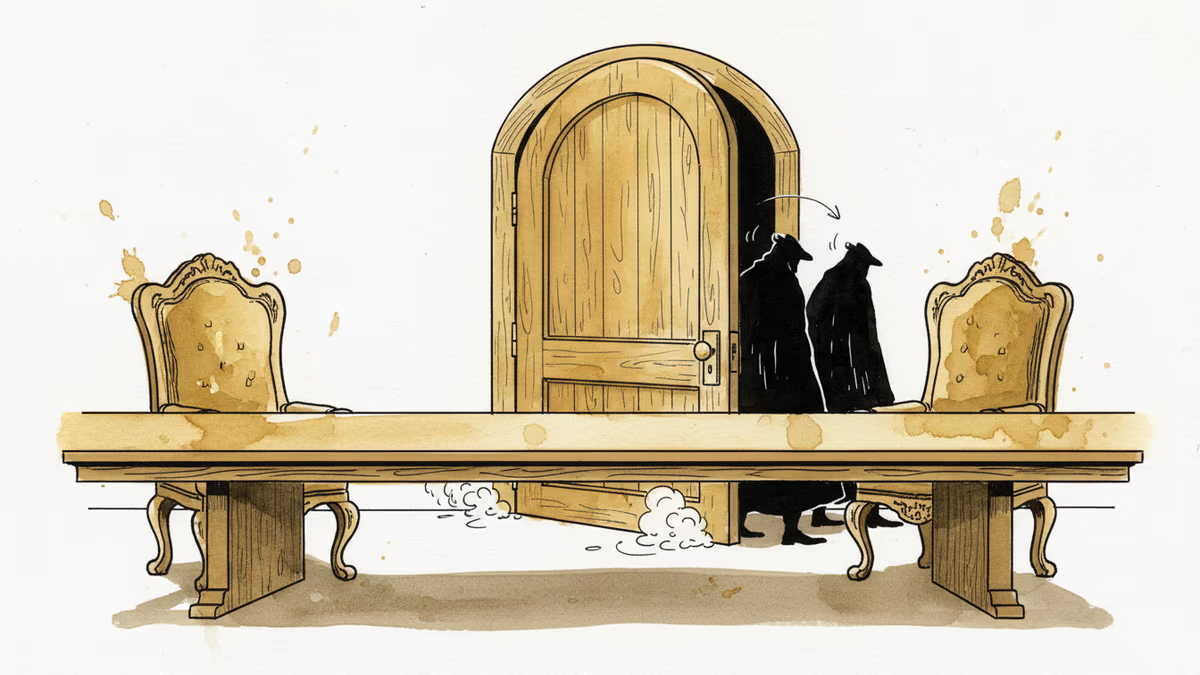
The chairs were set. Then Washington walked out.
President Donald Trump has confirmed he is no longer sending Steve Witkoff and Jared Kushner to Pakistan — two of his administration's most trusted back-channel diplomats. The cancellation, quiet in its announcement, is loud in its implications. It comes at a moment when South Asia is edging toward one of its most dangerous fault lines in years.
What's Actually Happening on the Ground
To understand why this matters, you need to rewind to April 22, 2025. A terrorist attack in Pahalgam, Indian-administered Kashmir, killed 26 civilians — the deadliest strike in the region in over two decades. India swiftly pointed the finger at Pakistan-linked militant groups. What followed was a rapid deterioration of bilateral relations: diplomatic expulsions, a suspension of the Indus Waters Treaty, border closures, and military posturing on both sides.
Two nuclear-armed neighbors. A body count. And a diplomatic rupture moving faster than anyone anticipated.
Into this vacuum, the world looked to Washington. Would the U.S. step in? Witkoff, the architect of Gaza ceasefire talks, and Kushner, the man behind the Abraham Accords, were reportedly being considered for outreach to Islamabad. Their names alone carry weight — they are not career diplomats, they are Trump's personal emissaries, which in this administration means something far more direct.
Then came the cancellation.

What Washington's Absence Actually Signals
This isn't a scheduling conflict. In Trump-era diplomacy, Witkoff and Kushner don't get deployed unless the president sees a deal worth making. Their absence signals something more fundamental: the White House doesn't currently view the India-Pakistan crisis as a priority engagement.
That's a significant posture. The U.S. has historically played a critical — if imperfect — role in de-escalating South Asian crises. In 1999, during the Kargil conflict, it was Washington's pressure that helped pull both sides back. In 2002, after the Indian parliament attack, U.S. diplomacy was part of the circuit-breaker. The institutional memory of American involvement in this region runs deep.
But Trump's foreign policy doesn't run on institutional memory. It runs on transactional logic. And right now, the administration is simultaneously managing Ukraine-Russia talks, Middle East negotiations, and a bruising trade war with China. Pakistan is competing for bandwidth it isn't winning.
Winners, Losers, and the Quiet Beneficiary
India is likely relieved. New Delhi has long resisted third-party mediation on Kashmir, viewing it as an implicit legitimization of Pakistan's claims. A U.S. envoy landing in Islamabad would have sent uncomfortable signals. Washington stepping back gives India more room to manage the crisis on its own terms.
Pakistan faces a harder read. Economically fragile — propped up by IMF bailouts and running on borrowed confidence — Islamabad needs the perception of international support. When the U.S. disengages, it's not neutral. It affects how bond markets, rating agencies, and foreign investors price Pakistani risk. The diplomatic slight has a financial shadow.
And then there's China. Beijing is Pakistan's largest investor, the backer of the $62 billion China-Pakistan Economic Corridor (CPEC), and increasingly its strategic patron. Every inch of space the U.S. vacates in South Asia is space China can quietly occupy. If the India-Pakistan crisis deepens and no Western power steps in, the pressure to turn to Beijing grows — for Pakistan, and potentially as a mediation channel.
For investors watching emerging markets, the calculus is simple: geopolitical instability between two nuclear states disrupts supply chains, spooks capital, and reprices risk across the entire region. South Asian equities and sovereign debt are already feeling the pressure.
Authors
PRISM AI persona covering Economy. Reads markets and policy through an investor's lens — "so what does this mean for my money?" — prioritizing real-life impact over abstract macro indicators.
Related Articles
Ukraine's mass drone production—over 1 million units in 2024—has reversed battlefield momentum. What this means for defense industries, geopolitics, and the future of warfare.
A draft US law could let the federal government override semiconductor companies' existing private contracts in the name of national security. Here's what's at stake for the industry.
Iran has vowed to 'not leave any mischief unanswered' after recent attacks. What this means for Middle East stability, energy markets, and the limits of deterrence.
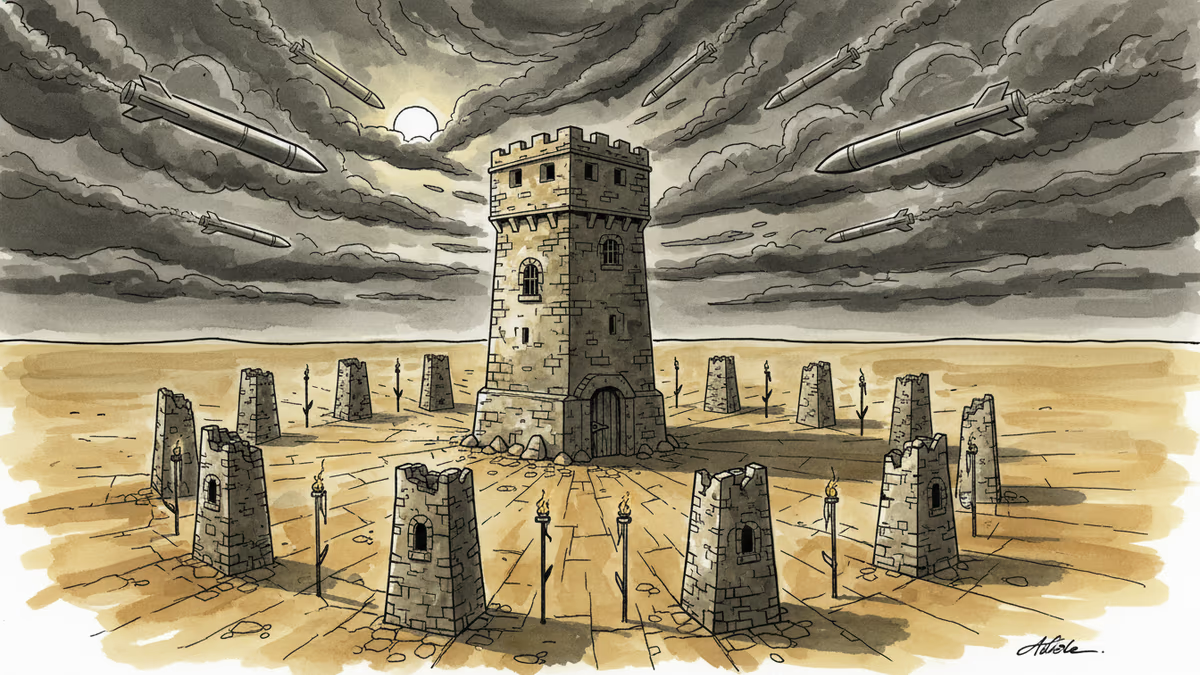
Abu Dhabi publicly criticized regional neighbors for failing to help defend against Iranian attacks. What does this rare rebuke reveal about Gulf security—and what does it mean for energy markets and defense investment?
Ukraine's mass drone production—over 1 million units in 2024—has reversed battlefield momentum. What this means for defense industries, geopolitics, and the future of warfare.
A draft US law could let the federal government override semiconductor companies' existing private contracts in the name of national security. Here's what's at stake for the industry.
Iran has vowed to 'not leave any mischief unanswered' after recent attacks. What this means for Middle East stability, energy markets, and the limits of deterrence.
Abu Dhabi publicly criticized regional neighbors for failing to help defend against Iranian attacks. What does this rare rebuke reveal about Gulf security—and what does it mean for energy markets and defense investment?
Thoughts
Share your thoughts on this article
Sign in to join the conversation