

Behind Nvidia's $68B Quarter Lies the Real 'Token Economy
Nvidia reported record $68B quarterly revenue as AI token demand explodes exponentially. But Chinese competitors and sustainability concerns are emerging challenges.
$68 billion. That's what Nvidia pulled in during its most recent quarter—a staggering 73% jump from last year. But CEO Jensen Huang's comment during the earnings call reveals something more intriguing: "The demand for tokens in the world has gone completely exponential. Even our six-year-old GPUs in the cloud are completely consumed and the pricing is going up."
Welcome to the token economy, where compute literally equals cash.
When Silicon Becomes Currency
Break down Nvidia's numbers and a fascinating structure emerges. Of that $68 billion quarterly haul, $62 billion came from data centers. That breaks down further: $51 billion in compute revenue (mostly GPUs) and $11 billion in networking products like NVLink.
"In this new world of AI, compute is revenue," Huang declared. "Without compute, there's no way to generate tokens. Without tokens, there's no way to grow revenues." It's a simple equation that's reshaping entire industries. Companies like OpenAI, Anthropic, and Google now charge customers based on token consumption—every AI interaction measured, metered, monetized.
But here's the trillion-dollar question: Is this token gold rush sustainable, or are we building a house of digital cards?
The Dragon in the Room
Despite recent U.S. export restriction relaxations, Nvidia reported zero revenue from China. CFO Colette Kress explained that while "small amounts of H200 products for China-based customers were approved by the U.S. government, they have yet to generate any revenue."

Then came the warning shot: "Our competitors in China, bolstered by recent IPOs, are making progress and have the potential to disrupt the structure of the global AI industry over the long term." That's a direct reference to companies like Moore Threads, which went public in December.
For American investors, this isn't just about market share—it's about strategic dependence. If Chinese firms crack the AI chip code, Nvidia's moat could evaporate faster than a crypto crash.
The $30 Billion Handshake
Huang also addressed Nvidia's rumored $30 billion investment in OpenAI. "We continue to work with OpenAI toward a partnership agreement. We believe we are close," he said, while name-dropping partnerships with Anthropic, Meta, and Elon Musk's xAI.
But the SEC filing told a different story: "no assurance" the investment would happen. Why the mixed signals?
Industry insiders suggest Nvidia isn't just buying into AI companies—it's building a vertical empire. From chips to models to applications, Nvidia wants to own the entire AI stack. That's either visionary strategy or dangerous overreach, depending on your perspective.
The Sustainability Question
Tech companies are burning through capital expenditures at unprecedented rates, all chasing AI supremacy. Huang addressed the elephant in the room: "We've reached the inflection point and we're generating profitable tokens that are productive for customers and profitable for cloud service providers."
But skeptics wonder: What happens when the token bubble bursts? When AI efficiency improves and token costs plummet? When regulation steps in?
Authors
Related Articles

Five stories from late September, traced to where the paper trail stops: Korea's export record, Nvidia's Hugging Face 8-K, a US-China AI channel, the UN on AI, and rising births.
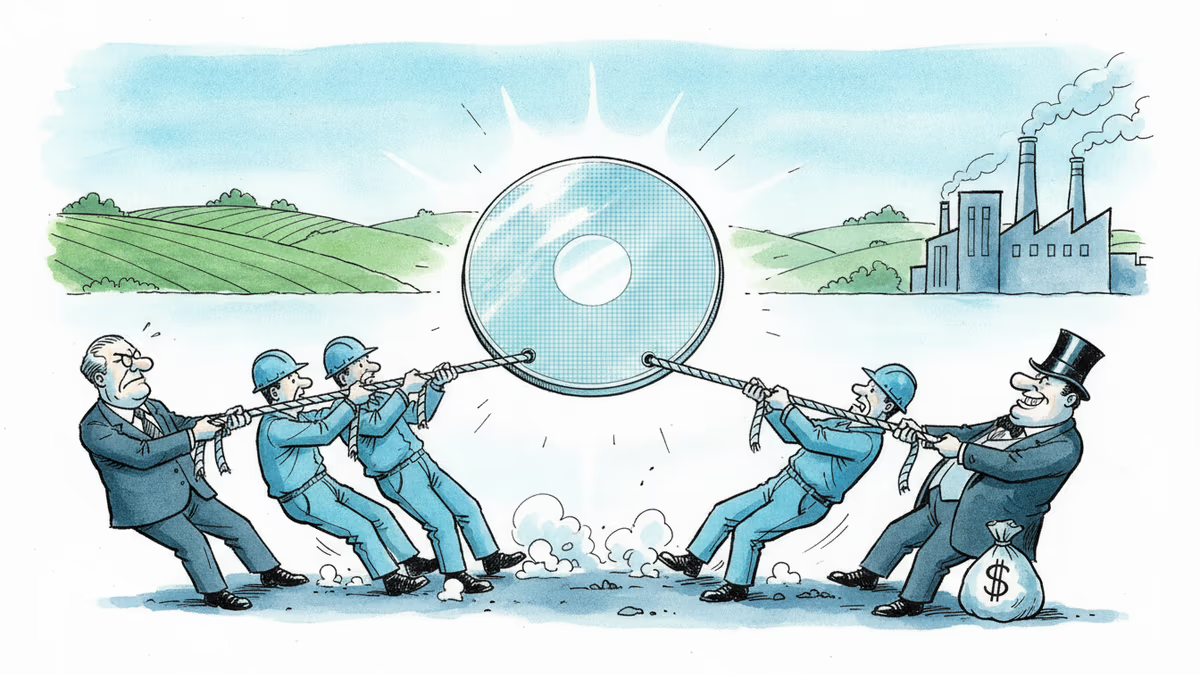
Samsung Electronics' union branch revealed that 84% of survey respondents oppose the government's roughly $290 billion (₩400 trillion) semiconductor megaproject in Gwangju. Government, management, the union and shareholders are all reading the same national project in sharply different ways.
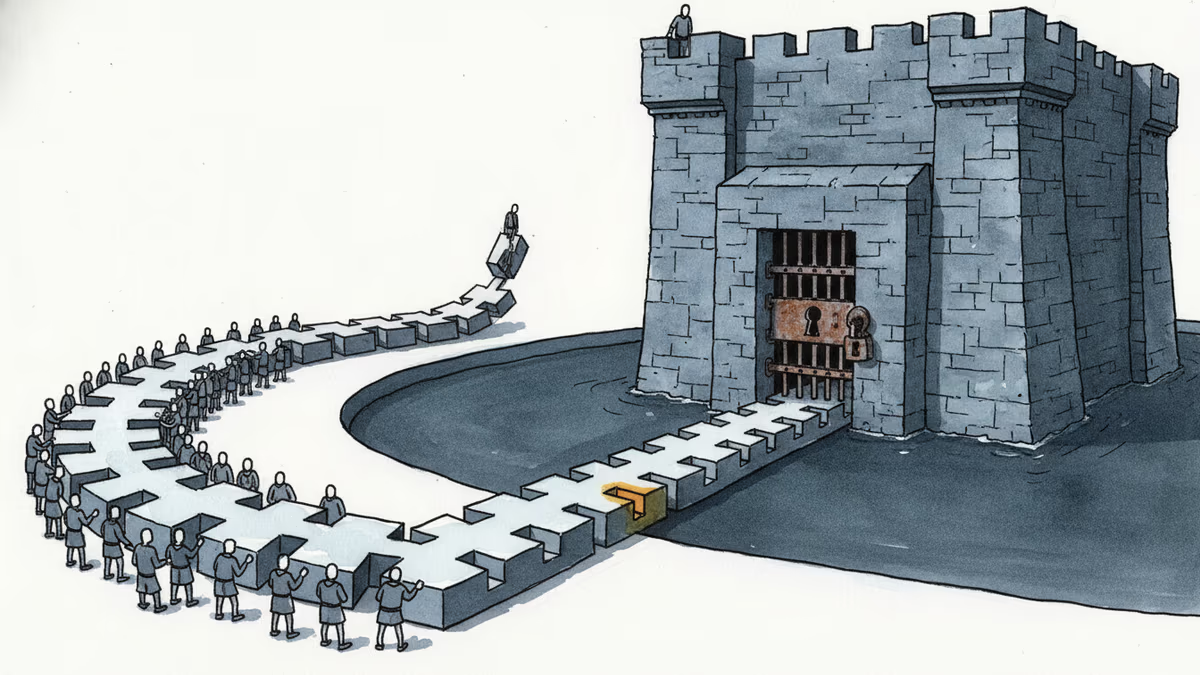
Nvidia shipped roughly a billion RISC-V cores in 2024, then announced it would run CUDA on the open standard. We break down how royalty-free instruction sets and open software stacks are trying to route around CUDA's lock-in. Part 2 of the Semiconductor Sovereignty series.

US AI-chip export controls split into three layers in the first half of 2026 — January easing, a May crackdown on circumvention, and a pending bill. Nvidia erased China from its guidance and still posted a record $81.6 billion quarter. A look at the export policy that both shields and cages it.
Five stories from late September, traced to where the paper trail stops: Korea's export record, Nvidia's Hugging Face 8-K, a US-China AI channel, the UN on AI, and rising births.
Samsung Electronics' union branch revealed that 84% of survey respondents oppose the government's roughly $290 billion (₩400 trillion) semiconductor megaproject in Gwangju. Government, management, the union and shareholders are all reading the same national project in sharply different ways.
Nvidia shipped roughly a billion RISC-V cores in 2024, then announced it would run CUDA on the open standard. We break down how royalty-free instruction sets and open software stacks are trying to route around CUDA's lock-in. Part 2 of the Semiconductor Sovereignty series.
US AI-chip export controls split into three layers in the first half of 2026 — January easing, a May crackdown on circumvention, and a pending bill. Nvidia erased China from its guidance and still posted a record $81.6 billion quarter. A look at the export policy that both shields and cages it.
Thoughts
Share your thoughts on this article
Sign in to join the conversation