
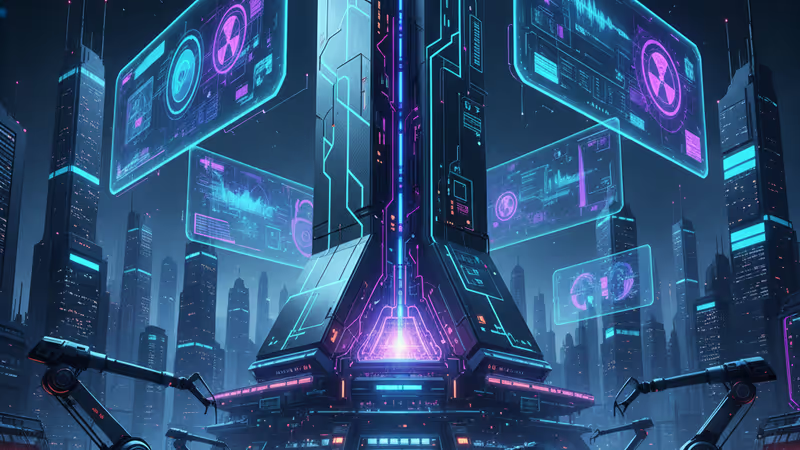
The $1.1 Billion Surge: US Nuclear Startups SMR Funding 2025 Analysis
Nuclear startups raised $1.1 billion in late 2025. Explore the shift toward SMRs and why manufacturing expertise is the biggest bottleneck for the U.S. nuclear renaissance.
In the closing weeks of 2025, investors showered nuclear startups with $1.1 billion in fresh capital. It's a massive bet on the belief that Small Modular Reactors (SMRs) will succeed where the traditional nuclear industry has recently stumbled.
Why US Nuclear Startups SMR Funding 2025 Matters
Traditional nuclear projects like Georgia's Vogtle 3 and 4 have become cautionary tales. They were 8 years late and over budget by more than $20 billion. According to TechCrunch, the new crop of startups aims to sidestep these pitfalls by shrinking the reactor. The goal is to apply mass production techniques to nuclear energy, treating reactors more like factory-built products than bespoke infrastructure.

The Manufacturing Reality Check
Money isn't the only hurdle. Milo Werner, general partner at DCVC and former Tesla manufacturing lead, points to a deeper issue: the loss of 'muscle memory' in the U.S. industrial sector. After 40 years of minimal industrial expansion, the U.S. lacks the seasoned human capital required to scale these complex facilities.
| Feature | Traditional Reactors | SMR Startups |
|---|---|---|
| Construction | On-site (Bespoke) | Factory-built (Modular) |
| Power Output | 1+ Gigawatt | Variable (Scaled by units) |
| Risk Profile | High budget/schedule risk | Iterative manufacturing risk |
Authors
Related Articles
Lucra Sports CEO Dylan Robbins landed Cathie Wood's ARK Invest as a Series B lead without building AI. The story behind his unconventional fundraising playbook.
SolarSquare is raising $55-60M at a $450-500M valuation, more than doubling its worth in 18 months. Here's what's driving investor conviction in India's residential solar market.

Indian venture capital has quietly displaced Silicon Valley in its own backyard. Only one American VC made India's top 10 investor list last year. Here's why that matters beyond India.
Cerebras Systems IPO yields a $5.3 billion return for Benchmark. Explore the 8.5-year journey from a reluctant first meeting to challenging Nvidia's AI dominance.
Lucra Sports CEO Dylan Robbins landed Cathie Wood's ARK Invest as a Series B lead without building AI. The story behind his unconventional fundraising playbook.
SolarSquare is raising $55-60M at a $450-500M valuation, more than doubling its worth in 18 months. Here's what's driving investor conviction in India's residential solar market.
Indian venture capital has quietly displaced Silicon Valley in its own backyard. Only one American VC made India's top 10 investor list last year. Here's why that matters beyond India.
Cerebras Systems IPO yields a $5.3 billion return for Benchmark. Explore the 8.5-year journey from a reluctant first meeting to challenging Nvidia's AI dominance.
Thoughts
Share your thoughts on this article
Sign in to join the conversation