
Hackers Hijacked Notepad++ for Months. Nobody Noticed.
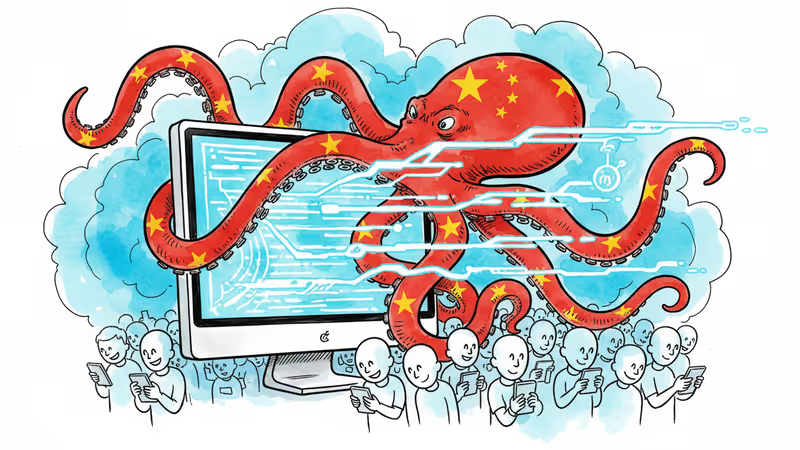
Chinese government-linked hackers compromised Notepad++ updates from June to December 2025, targeting organizations with East Asian interests. A wake-up call for open source security.
Tens of millions of users. Six months of compromise. Zero public warnings until now.
The developer behind Notepad++, one of the world's most popular text editors, dropped a bombshell Monday: Chinese government hackers had been hijacking software updates and delivering malware to users from June through December 2025. Most victims never knew they'd been targeted.
Don Ho, Notepad++'s creator, confirmed what security researcher Kevin Beaumont first discovered in December—a sophisticated supply chain attack that selectively targeted organizations "with interests in East Asia." The timing and precision suggest state-sponsored actors with specific intelligence objectives.
The Invisible Invasion
The attack was surgically precise. Hackers didn't need to break into individual computers. Instead, they compromised Notepad++'s shared hosting server and exploited a vulnerability to redirect certain users to malicious servers during routine update checks.
When targeted users clicked "update," they received tainted versions of the software that gave hackers "hands-on" access to their systems. The selection criteria remains murky, but the geographic and organizational focus points to espionage rather than financial gain.
Ho revealed that his team has logs showing hackers attempting to re-exploit fixed vulnerabilities even after the November patch—a sign of persistent, determined adversaries. The access was finally terminated in early December, but the damage assessment continues.
The Open Source Paradox
This incident exposes a fundamental tension in modern software development. Notepad++ represents everything we love about open source: 20+ years of continuous development, community-driven innovation, and free access to powerful tools. It's used by developers, system administrators, and government agencies worldwide.

Yet this popularity makes open source projects attractive targets. Unlike Microsoft or Google, most open source maintainers operate with minimal security infrastructure and limited resources to defend against nation-state actors.
The parallels to the 2019-2020 SolarWinds breach are striking. Russian hackers compromised that company's IT management tools, gaining access to multiple U.S. government agencies including Homeland Security and the Departments of Commerce, Energy, Justice, and State. Both attacks weaponized the trust users place in routine software updates.
The New Battlefield
Software updates have become the new frontline in cyber warfare. The very mechanism designed to keep us secure—automatic updates—has become an attack vector. Users face an impossible choice: skip updates and remain vulnerable to known exploits, or install updates and risk introducing unknown threats.
For cybersecurity professionals, this creates a nightmare scenario. How do you verify the integrity of updates from thousands of software vendors? How do you balance security with operational efficiency when every update could potentially be compromised?
Government agencies and enterprises are particularly vulnerable. They rely on diverse software ecosystems, often including open source tools like Notepad++, but lack the resources to audit every component. The attack surface keeps expanding while defensive capabilities struggle to keep pace.
Trust in the Age of Suspicion
The Notepad++ compromise forces uncomfortable questions about digital trust. We've built our computing infrastructure on the assumption that popular, long-running open source projects are inherently more secure due to community oversight and code transparency.
But transparency doesn't guarantee security. Malicious actors are increasingly sophisticated, and the sheer volume of code changes makes comprehensive review nearly impossible. Even security-conscious organizations can't audit every line of code in every tool they use.
The incident also highlights the geopolitical dimensions of software security. As tensions between major powers escalate, civilian software infrastructure becomes collateral damage in broader conflicts. Today it's Chinese hackers and Notepad++; tomorrow it could be any nation-state and any popular tool.
Authors
Related Articles
UK Visa Portal, a private immigration service mistaken for an official government site, has been exposing passport scans and selfies of over 100,000 applicants. The breach remains unpatched.
Okta CEO Todd McKinnon on why AI agents need identity management, the SaaSpocalypse threat, and why the kill switch might be the most important button in enterprise tech.
Iran and Israel are hacking civilian security cameras for military reconnaissance. How consumer surveillance devices became weapons of war.
A security researcher discovered he could access 7,000 DJI robot vacuums and peek into strangers' homes. This Valentine's Day revelation exposes the hidden privacy risks of our smart home obsession.
UK Visa Portal, a private immigration service mistaken for an official government site, has been exposing passport scans and selfies of over 100,000 applicants. The breach remains unpatched.
Okta CEO Todd McKinnon on why AI agents need identity management, the SaaSpocalypse threat, and why the kill switch might be the most important button in enterprise tech.
Iran and Israel are hacking civilian security cameras for military reconnaissance. How consumer surveillance devices became weapons of war.
A security researcher discovered he could access 7,000 DJI robot vacuums and peek into strangers' homes. This Valentine's Day revelation exposes the hidden privacy risks of our smart home obsession.
Thoughts
Share your thoughts on this article
Sign in to join the conversation