
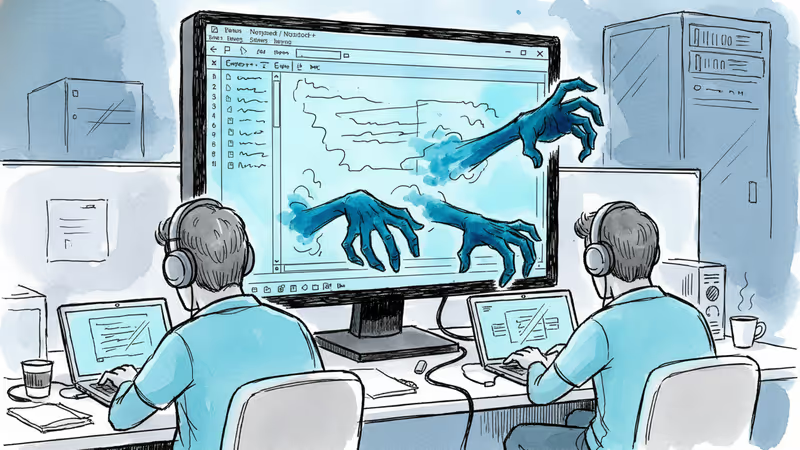
Notepad++ Users Unknowingly Downloaded Malware for Six Months
Popular code editor Notepad++ was compromised by Chinese state-sponsored hackers for six months, selectively targeting specific users with malicious updates through hijacked hosting servers.
Imagine discovering that your most trusted daily tool has been secretly working against you for half a year. That's exactly what happened to millions of Notepad++ users who unknowingly downloaded malicious updates between June and December 2025.
The Six-Month Silent Infiltration
Notepad++ developer Don Ho revealed on Monday that the popular text and code editor's shared hosting servers were hijacked by what he describes as "likely a Chinese state-sponsored group." But this wasn't a typical malware spray-and-pray operation. The attackers employed sophisticated targeting, selectively redirecting traffic from specific users to attacker-controlled servers while leaving others untouched.
The precision of this attack is what makes it particularly concerning. Rather than infecting everyone and risking early detection, the hackers carefully chose their victims, suggesting they had specific intelligence objectives rather than financial motives.
When Developer Tools Become Weapons
For millions of developers, cybersecurity professionals, and IT managers worldwide, Notepad++ isn't just software—it's an essential daily companion. It's the digital equivalent of a carpenter's hammer or a surgeon's scalpel. When such fundamental tools are compromised, the implications ripple far beyond individual users.
This attack represents an evolution in cyber warfare strategy. Instead of directly targeting high-value organizations, state-sponsored groups are now poisoning the wells that feed the entire tech ecosystem. By compromising widely-used developer tools, attackers can potentially gain access to countless downstream targets.

The Supply Chain Vulnerability
The Notepad++ incident highlights a growing vulnerability in our software ecosystem: the supply chain attack. The hackers didn't break into users' computers directly. Instead, they compromised the hosting infrastructure that users trusted to deliver legitimate updates.
This method is particularly insidious because it exploits our natural tendency to trust software updates. When Notepad++ prompts you to update, you click "yes" without hesitation—just as you would with updates from Microsoft, Google, or any other trusted vendor. That trust became a weapon.
The selective nature of this attack also suggests sophisticated intelligence gathering. The attackers likely knew exactly which users they wanted to target, possibly based on their employment, location, or other identifying factors. This level of precision indicates resources and coordination typically associated with nation-state actors.
The Broader Implications
This incident raises uncomfortable questions about the security of the entire open-source ecosystem. Notepad++ is free software maintained by a small team, yet it's used by professionals handling sensitive code and data across industries. How many other essential tools might be similarly vulnerable?
For organizations, this attack underscores the need to treat even seemingly innocuous software updates as potential security events. The days of automatic updates without verification may be ending, at least for security-conscious enterprises.
The Notepad++ compromise isn't just about one application—it's a preview of how cyber warfare is evolving in an age where our most basic tools can become our greatest vulnerabilities.
Authors
Related Articles
UK Visa Portal, a private immigration service mistaken for an official government site, has been exposing passport scans and selfies of over 100,000 applicants. The breach remains unpatched.
OpenAI launched a new $100/month plan directly targeting Anthropic's Claude Code. What does this pricing war mean for developers, enterprises, and the future of AI coding tools?
Okta CEO Todd McKinnon on why AI agents need identity management, the SaaSpocalypse threat, and why the kill switch might be the most important button in enterprise tech.
Iran and Israel are hacking civilian security cameras for military reconnaissance. How consumer surveillance devices became weapons of war.
UK Visa Portal, a private immigration service mistaken for an official government site, has been exposing passport scans and selfies of over 100,000 applicants. The breach remains unpatched.
OpenAI launched a new $100/month plan directly targeting Anthropic's Claude Code. What does this pricing war mean for developers, enterprises, and the future of AI coding tools?
Okta CEO Todd McKinnon on why AI agents need identity management, the SaaSpocalypse threat, and why the kill switch might be the most important button in enterprise tech.
Iran and Israel are hacking civilian security cameras for military reconnaissance. How consumer surveillance devices became weapons of war.
Thoughts
Share your thoughts on this article
Sign in to join the conversation