
The Hidden Bottleneck of the Space Economy Just Got $100M to Fix It
Northwood Space's massive funding round and government contract reveal why ground infrastructure, not satellites, might be the real constraint in our space-connected future.
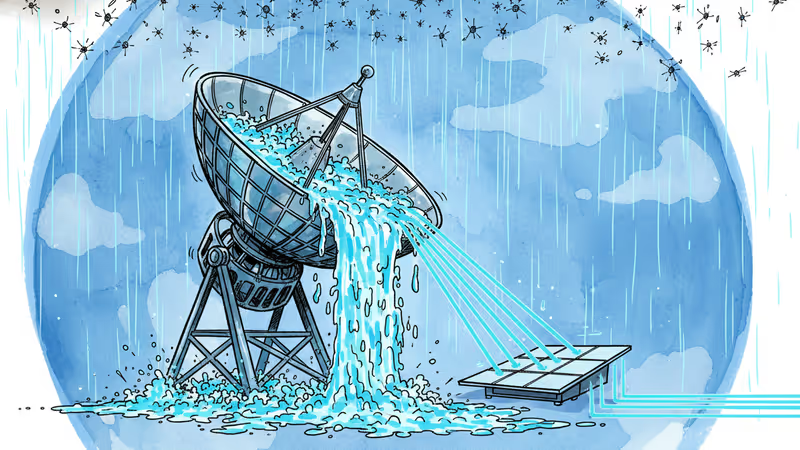
There are over 5,500 satellites orbiting Earth right now, and that number is growing fast. But here's the problem nobody talks about: there aren't nearly enough ground stations to handle all the data they're trying to beam down. That's why Northwood Space, a three-year-old startup, just closed a $100 million Series B and landed a $49.8 million Space Force contract in the same week.
The Real Space Race Is Happening on Earth
While everyone's watching rocket launches, the actual constraint in our satellite-powered future is happening much closer to home. "We get customers coming to us all the time requiring a ground solution," says founder and CEO Bridgit Mendler. "We don't want there to be a resource constraint that blocks us from being able to support that mission."
The math is simple but telling. Most satellite operators today have to rent capacity from third-party ground station providers, and availability isn't guaranteed when you need it. Companies like SpaceX and Amazon build their own ground infrastructure, but that's not realistic for smaller players trying to scale their satellite constellations.
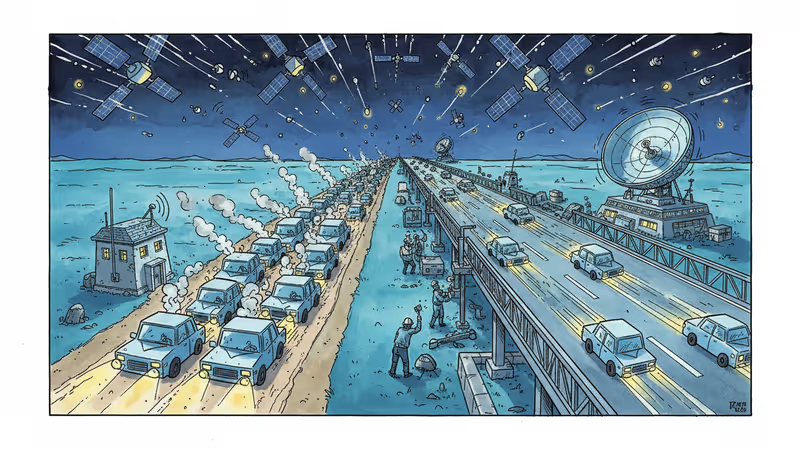
Northwood's approach is different. Instead of massive dish antennas, they're building smaller phased-array antenna systems that can handle multiple satellite connections simultaneously. Their current "portal" sites can manage eight satellite links, with plans to reach 10-12 connections per next-generation station by late 2027.
Why the Pentagon Came Calling
The Space Force contract isn't just about money—it's validation that ground infrastructure has become a national security issue. A 2023 Government Accountability Office report revealed that the Department of Defense has known about capacity issues with its satellite control network since 2011. This system handles GPS satellites and other critical space missions, and its limitations "could compromise their missions in the future."

Mendler describes the contract as helping upgrade infrastructure that "handles a huge variety of consequential space missions for our government." When the newest branch of the military is writing eight-figure checks to solve ground infrastructure problems, you know the bottleneck is real.
The Vertically Integrated Bet
What makes Northwood interesting isn't just their technology—it's their business model. "It's a hard thing to do," Mendler admits. "It requires a lot of risk, a lot of capital. It requires a lot of diverse skill sets to come together, to be able to really wrap your head around the entire ground problem."
Most companies in this space focus on either hardware or software. Northwood is betting that controlling the entire ground station stack—from antennas to software to network operations—will create more value than specialized solutions. It's a risky approach that requires significant capital, which explains why they raised money twice in one year.
CTO Griffin Cleverly expects their expanded capacity will be "most valuable to customers who are scaling into large constellations, so that may be going from like one or two satellites to dozens or more." By 2027, he projects their network will communicate with "hundreds" of satellites simultaneously.
The Infrastructure Nobody Sees
There's an irony here. As satellite internet becomes mainstream and space-based services proliferate, the most critical infrastructure remains invisible to most users. You can see a rocket launch, but you can't see the ground stations that make satellite communications actually work.
This invisibility might be Northwood's biggest advantage. While competitors fight over satellite manufacturing and launch services, Northwood is building the plumbing that makes everything else possible. It's less glamorous than space missions, but potentially more profitable.
The timing couldn't be better. With launch costs plummeting and satellite constellations growing exponentially, the demand for ground infrastructure is only increasing. Washington Harbour Partners and Andreessen Horowitz clearly see this as a structural opportunity, not just a hot sector play.
Authors
Related Articles
Northwood Space raises $100M and secures a $50M government contract, positioning itself to transform how space data flows to Earth. The ground infrastructure race has begun.

Five stories from late September, traced to where the paper trail stops: Korea's export record, Nvidia's Hugging Face 8-K, a US-China AI channel, the UN on AI, and rising births.

Huawei's CANN is open source under a license barring software for non-Ascend chips. Inside China's second CUDA, and the two links still outside it: pre-training compute and 5nm capacity.

Samsung Electronics' union branch revealed that 84% of survey respondents oppose the government's roughly $290 billion (₩400 trillion) semiconductor megaproject in Gwangju. Government, management, the union and shareholders are all reading the same national project in sharply different ways.
Northwood Space raises $100M and secures a $50M government contract, positioning itself to transform how space data flows to Earth. The ground infrastructure race has begun.
Five stories from late September, traced to where the paper trail stops: Korea's export record, Nvidia's Hugging Face 8-K, a US-China AI channel, the UN on AI, and rising births.
Huawei's CANN is open source under a license barring software for non-Ascend chips. Inside China's second CUDA, and the two links still outside it: pre-training compute and 5nm capacity.
Samsung Electronics' union branch revealed that 84% of survey respondents oppose the government's roughly $290 billion (₩400 trillion) semiconductor megaproject in Gwangju. Government, management, the union and shareholders are all reading the same national project in sharply different ways.
Thoughts
Share your thoughts on this article
Sign in to join the conversation