
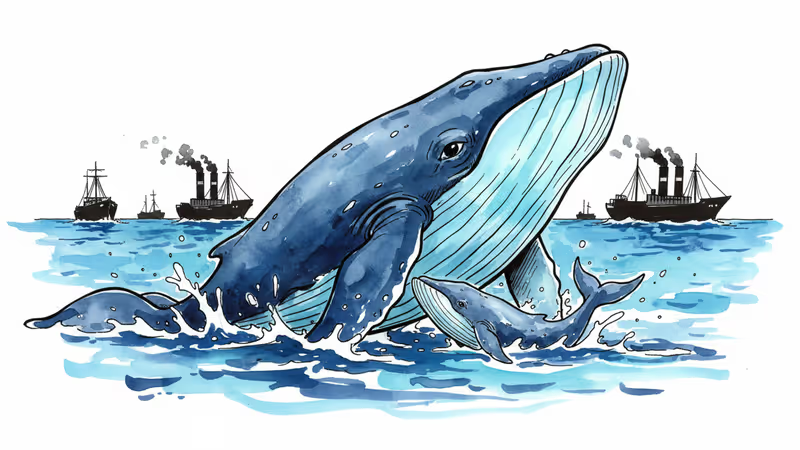
384 Whales Left: The Baby Boom That Could Save a Species
North Atlantic right whales welcomed 21 calves this season—their biggest baby boom in years. But with only 384 left alive, is it enough to pull them back from extinction?
384. That's how many North Atlantic right whales remain on Earth. But this winter, something remarkable happened: 21 baby whales have been born so far this calving season—the most promising baby boom these critically endangered giants have seen in years.
The species that once numbered in the thousands before commercial whaling nearly wiped them out in the 18th and 19th centuries just got a fighting chance. The question is: will it be enough?
The 19-Year Wait
Julie Albert had been waiting 19 years to see Callosity Back return as a mother. The director of the Right Whale Sighting Network first spotted this uniquely marked whale as a calf in 2007 off Florida's coast. Unlike other right whales, Callosity Back had distinctive white, rough tissue patches on her back—hence her name.
On New Year's Eve 2025, the call came in: an unidentified mother and calf had been spotted off Florida's central-eastern coast. Albert and her team raced to a beachside hotel's pool deck for a better view. It was her—Callosity Back had returned with a baby of her own.
"I've been waiting 19 years to see this mother," Albert recalls, watching the pair swim for hours until darkness fell.
Callosity Back herself was born a survivor. Her mother was one of only two North Atlantic right whales ever documented giving birth in cold northeastern waters, far from the usual warm calving grounds. It's a risky move—right whale calves are born without blubber, making cold water exposure potentially fatal in their first weeks of life.
An Unexpected Baby Boom
The 21 calves documented so far this season represent something special. Last year, researchers counted only 11. In the 1980s and 1990s, the count exceeded 18 just a handful of times.
Phil Hamilton, senior scientist at the New England Aquarium, is cautiously optimistic. "I'm hopeful that number might go up," he says. Multiple females who've given birth before but not in the last three years are currently in the calving grounds, suggesting the final tally could climb higher by spring.
But Hamilton stresses the bigger picture: since around 2010, the long-term population trend has been largely downward. High year-to-year variation is expected in such a small population—what matters is sustained recovery.

The Deadly Waters They Navigate
For all the celebration around new births, the threats remain stark. In 2017, 18 right whales died in just six months—a catastrophic loss that could easily repeat itself. Vessel strikes and fishing gear entanglements are the primary killers.
Just last December, a male whale called Division was spotted with fishing lines wrapped around his head and mouth, cutting into his blowhole. Rescue teams removed some gear, but Tonya Wimmer from Canada's Marine Animal Response Society warns that sea lice could infect the wounds. "He's getting thinner, so it's not a good picture for him."
Individual Stories, Collective Heartbreak
Researchers don't just track numbers—they know these whales as individuals. The New England Aquarium's North Atlantic Right Whale Catalog contains millions of records documenting decades of whale lives through photographs and observations.
Joel Cohen, a wildlife photographer and volunteer, experienced this intimacy with tragedy firsthand. In late 2022, he captured the first photos of a female calf born to a mother called Pilgrim. A year later, the young whale returned to Florida as a juvenile, "entertaining many people" who watched her swim close to shore.
Nine days after that joyful sighting, aerial surveyors found her carcass off Georgia's coast. A vessel strike had fractured her skull. Cohen attended the necropsy and still processes the loss. "I wake up, open the blinds, and there's a mom and calf dead on the beach," he describes his recurring nightmares.
Reasons for Cautious Hope
Yet there are encouraging developments beyond this year's baby boom. Canada has implemented "dynamic fishing management"—when whales are spotted, fishers are immediately pulled from the area. Torpedo-shaped ocean gliders now help track whale locations relative to shipping traffic, reducing vessel strikes.
Notably, no North Atlantic right whale deaths were recorded in 2025, though injuries occurred.
Conservationists emphasize that if ships slow down in whale-frequented areas and people maintain distance when spotting these animals, survival chances improve significantly.
The Resilience Factor
Despite losing Pilgrim's calf, Cohen remains more confident than ever about the species' potential recovery. He's witnessed individual whales lose calves only to birth new ones years later.
"You see this resilience," he explains his dedication to fighting for these whales. "That makes you want to fight even more."
Authors
Related Articles

Samsung Electronics' union branch revealed that 84% of survey respondents oppose the government's roughly $290 billion (₩400 trillion) semiconductor megaproject in Gwangju. Government, management, the union and shareholders are all reading the same national project in sharply different ways.

Nvidia shipped roughly a billion RISC-V cores in 2024, then announced it would run CUDA on the open standard. We break down how royalty-free instruction sets and open software stacks are trying to route around CUDA's lock-in. Part 2 of the Semiconductor Sovereignty series.

US AI-chip export controls split into three layers in the first half of 2026 — January easing, a May crackdown on circumvention, and a pending bill. Nvidia erased China from its guidance and still posted a record $81.6 billion quarter. A look at the export policy that both shields and cages it.
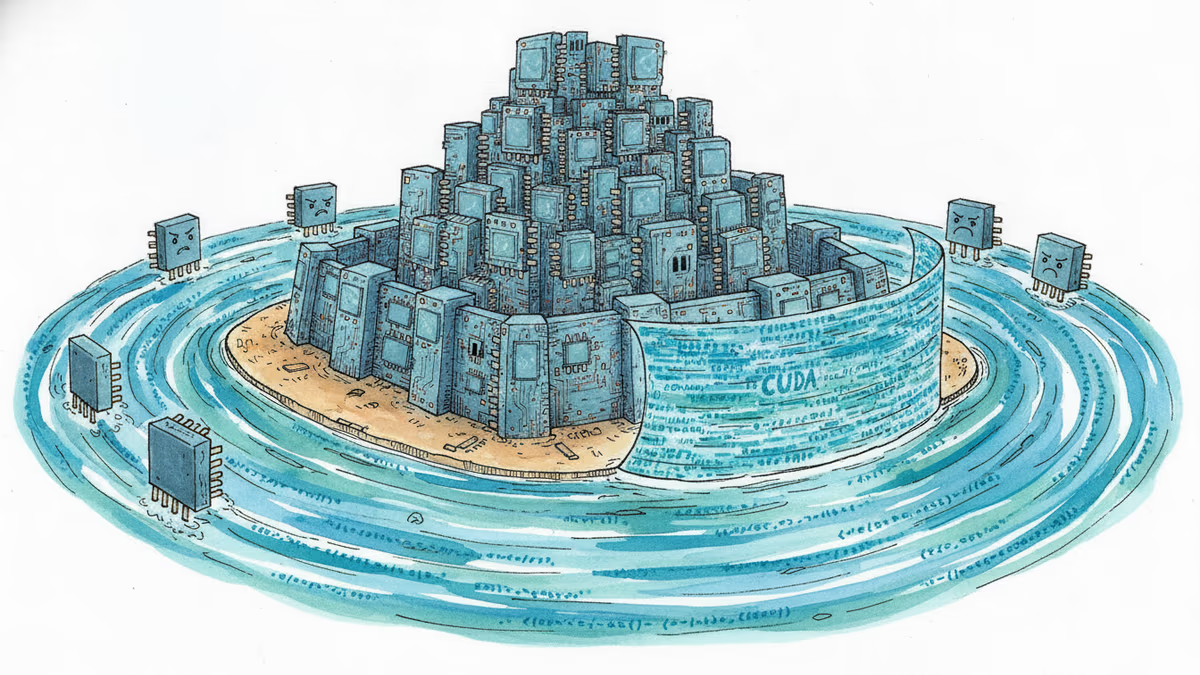
AMD's MI325X matches or beats Nvidia on memory and bandwidth — yet Nvidia's 86-92% share holds. The real moat is CUDA, 20 years in the making. Part 1 of 4.
Samsung Electronics' union branch revealed that 84% of survey respondents oppose the government's roughly $290 billion (₩400 trillion) semiconductor megaproject in Gwangju. Government, management, the union and shareholders are all reading the same national project in sharply different ways.
Nvidia shipped roughly a billion RISC-V cores in 2024, then announced it would run CUDA on the open standard. We break down how royalty-free instruction sets and open software stacks are trying to route around CUDA's lock-in. Part 2 of the Semiconductor Sovereignty series.
US AI-chip export controls split into three layers in the first half of 2026 — January easing, a May crackdown on circumvention, and a pending bill. Nvidia erased China from its guidance and still posted a record $81.6 billion quarter. A look at the export policy that both shields and cages it.
AMD's MI325X matches or beats Nvidia on memory and bandwidth — yet Nvidia's 86-92% share holds. The real moat is CUDA, 20 years in the making. Part 1 of 4.
Thoughts
Share your thoughts on this article
Sign in to join the conversation