
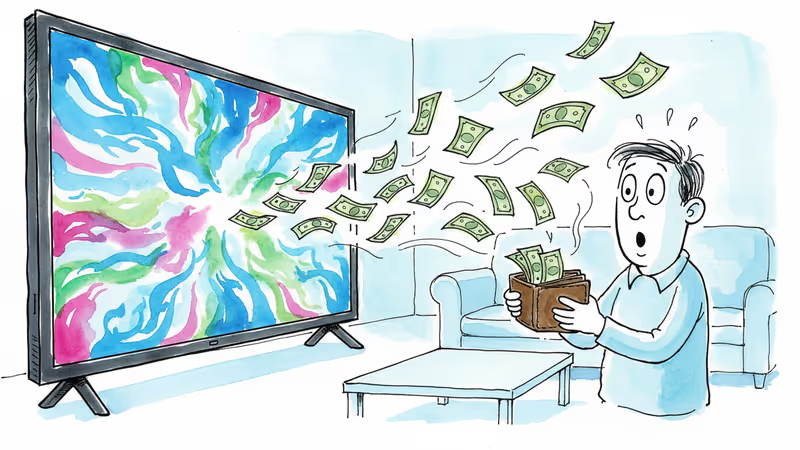
Samsung's S90F Proves Premium OLED Doesn't Need Premium Price
Samsung's S90F QD-OLED TV delivers flagship-level picture quality at a mid-tier price point, challenging the notion that you need to spend big for OLED excellence.
What if you could get 90% of flagship OLED performance for $1,400 instead of $4,000? Samsung's S90F QD-OLED TV makes that proposition a reality.
After weeks of rigorous testing, WIRED awarded the S90F a stellar 9/10 rating. Yet even the reviewer admitted something curious: despite near-flawless performance, the TV didn't immediately dazzle. That hesitation reveals something important about today's OLED market.
The Mid-Tier OLED Dilemma
Samsung and LG have been hoarding their most exciting OLED innovations for their priciest sets, leaving mid-range models feeling somewhat underwhelming. What used to be the OLED "sweet spot" now suffers from a relative lack of premium punch compared to flagships.
But the S90F challenges this dynamic. While it may not wow you during casual viewing, high-quality content reveals a TV that excels at the fundamentals: deep, nuanced contrast that LED TVs can't match, vivid yet naturalistic quantum dot colors, and exceptional processing that brings clarity to every detail.
With prices dropping from an original $2,500 to around $1,400, the value proposition becomes even more compelling.
Technical Excellence Without the Premium Tax
The S90F delivers where it matters most. Its contrast and black levels rival much pricier models, while screen uniformity tests revealed zero aberrations. Motion handling impressed even with challenging content, and the TV's shadow detail is so refined you might not need to adjust HDR tone mapping.

Perhaps most impressively, the S90F offers "among the best off-axis accuracy" the reviewer had ever tested. You can sit far off to the side with no noticeable reduction in color accuracy or brightness—a area where virtually all LED TVs struggle and even most OLEDs can't compete.
For gaming enthusiasts, four HDMI 2.1 ports with 144Hz VRR support make this a serious contender. Samsung's Game Hub continues to excel, offering multiple cloud gaming services alongside an accessible game bar for quick adjustments.
The Flagship Trade-offs
Of course, compromises exist. Peak brightness tops out at just over 1,000 nits—impressive for streaming content but noticeably dimmer than flagship models that can hit 4,000-5,000 nits. Flashy Blu-rays like Mad Max: Fury Road can look slightly muted in the brightest scenes.
The TV also lacks Samsung's latest matte anti-glare coating and continues to omit Dolby Vision support, focusing instead on HDR10 and HDR10+. Even the pedestal stand feels budget-friendly compared to premium alternatives.
Samsung's Tizen OS, while much improved, still has quirks. The system relentlessly pushes Samsung TV Plus, sometimes firing up content unprompted, though overall performance proved swift and reliable.
Market Implications
The S90F's success signals a shift in consumer expectations. If mid-tier OLEDs can deliver 90% of flagship performance at 60% of the price, how long before consumers question premium pricing altogether?
For videophiles seeking the absolute best, flagships like LG's G5 or Sony's Bravia 8 MK II still hold advantages. But for the vast majority of viewers, the S90F proves that "good enough" might actually be "excellent."
Authors
Related Articles

Samsung and SK unveiled a chip and AI investment package worth thousands of trillions of won on June 29. The headline number swings wildly by outlet, but the real contest isn't capital — it's water and power.
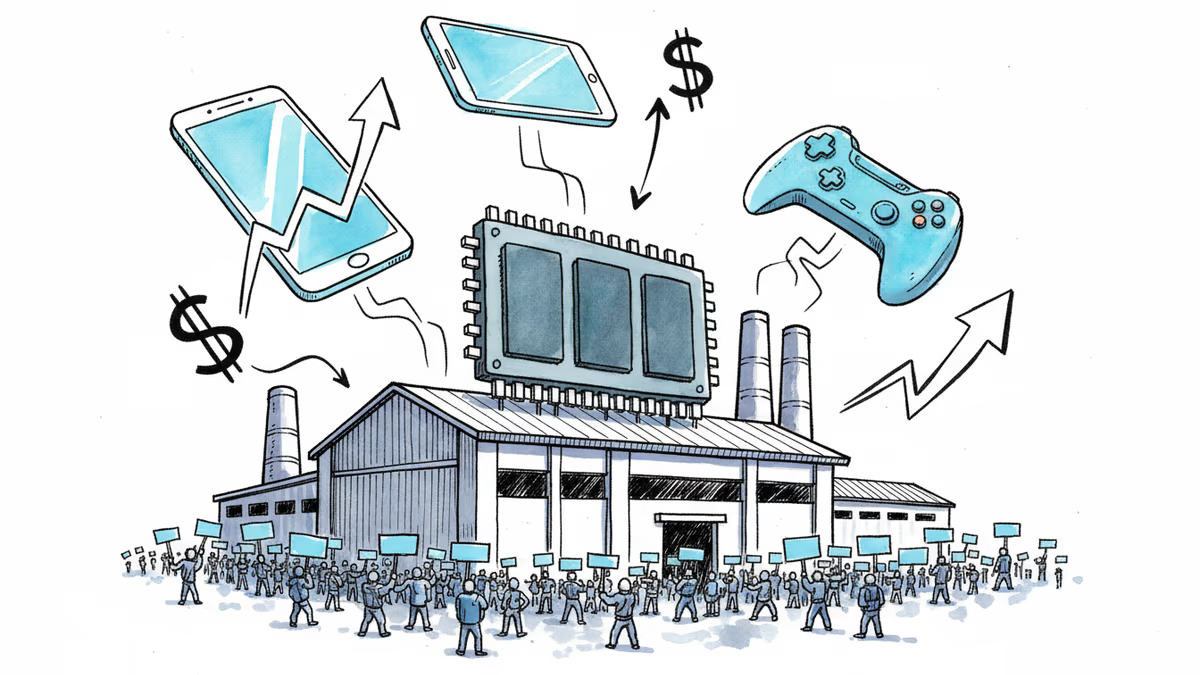
40,000 Samsung union workers rallied at its Pyeongtaek chip plant, threatening an 18-day strike over wages. With AI-driven RAM shortages already lifting consumer prices, the timing couldn't be worse.

Memory makers can't build fabs fast enough. By end of 2027, supply will cover just 60% of demand. Here's why the shortage could last until 2030—and what it means for AI, your devices, and the chip industry.

Samsung's Galaxy S26 now supports AirDrop through Quick Share, making cross-platform file sharing seamless. What does it mean when Android starts dismantling one of Apple's most beloved moats?
Samsung and SK unveiled a chip and AI investment package worth thousands of trillions of won on June 29. The headline number swings wildly by outlet, but the real contest isn't capital — it's water and power.
40,000 Samsung union workers rallied at its Pyeongtaek chip plant, threatening an 18-day strike over wages. With AI-driven RAM shortages already lifting consumer prices, the timing couldn't be worse.
Memory makers can't build fabs fast enough. By end of 2027, supply will cover just 60% of demand. Here's why the shortage could last until 2030—and what it means for AI, your devices, and the chip industry.
Samsung's Galaxy S26 now supports AirDrop through Quick Share, making cross-platform file sharing seamless. What does it mean when Android starts dismantling one of Apple's most beloved moats?
Thoughts
Share your thoughts on this article
Sign in to join the conversation