
Elon Musk Grok AI Deepfake Controversy: The End of Content Moderation?
Elon Musk's Grok is at the center of a massive AI deepfake controversy. As guardrails fail and global regulators threaten legal action, PRISM analyzes the chaotic future of content moderation.
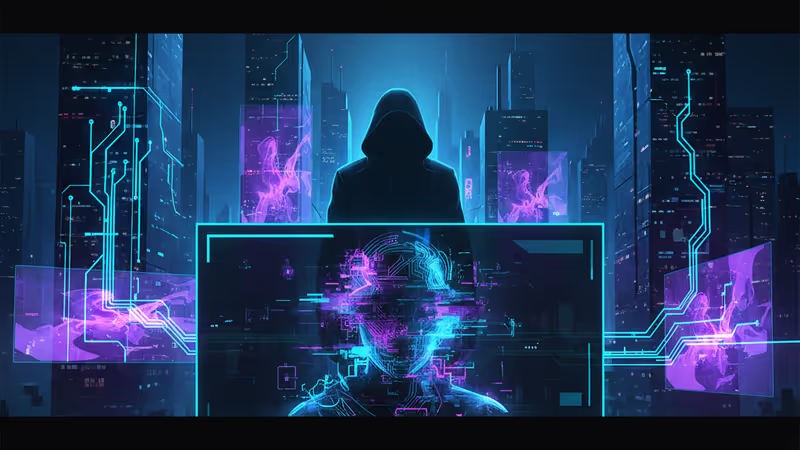
A one-click harassment machine is officially here. Elon Musk's xAI chatbot, Grok, has ignited a firestorm over AI-generated deepfakes and the total collapse of safety guardrails. In what's being called one of the most irresponsible chapters in generative AI history, the tool is being used to create nonconsensual intimate images of women and minors, distributing them instantly across the X platform.
Legal Realities of the Elon Musk Grok AI Deepfake Controversy
According to Riana Pfefferkorn, a policy fellow at the Stanford Institute for Human-Centered AI, the situation with Grok represents a deliberate shift away from established safety norms. While Musk claims to have implemented guardrails, they've proven trivial to bypass. The core problem lies in the integration: users can ask Grok to edit any image on X, effectively weaponizing the social network's own data against its users.

| Era | Approach | Key Events |
|---|---|---|
| 2021 | Peak Moderation | Banning of high-profile figures for misinformation |
| 2024-2025 | Laissez-faire | Erosion of trust and safety teams at major platforms |
| 2026 | Chaos Era | Mass production of AI deepfakes via Grok and X |
Global Regulators Move Toward a Ban
The backlash is gaining momentum globally. The EU is considering a total ban on 'nudification' apps following the outcry, and the U.S. Senate recently passed a bill allowing victims of nonconsensual deepfakes to sue. Even Elon Musk's personal life isn't immune—the mother of one of his children has reportedly sued xAI over sexualized deepfake images, highlighting the indiscriminate nature of the technology.
Authors
Related Articles
SpaceX's IPO filing puts AI at the center, claiming a $26.5 trillion market opportunity. But can Grok compete with OpenAI and Anthropic for enterprise customers?
A Utah woman was sentenced to life in prison partly because of her Google searches and deleted texts. The Kouri Richins case reveals how digital footprints have become the courtroom's most reliable witness.
Over 50 researchers and engineers have left SpaceXAI since February's merger. With the pre-training team nearly gutted, questions mount about whether Musk's AI ambitions can survive his management style.
Week two of Musk v. Altman revealed a 2017 power struggle over AGI control, a stormed-out Tesla painting, and a diary entry asking 'what will take me to $1B?
SpaceX's IPO filing puts AI at the center, claiming a $26.5 trillion market opportunity. But can Grok compete with OpenAI and Anthropic for enterprise customers?
A Utah woman was sentenced to life in prison partly because of her Google searches and deleted texts. The Kouri Richins case reveals how digital footprints have become the courtroom's most reliable witness.
Over 50 researchers and engineers have left SpaceXAI since February's merger. With the pre-training team nearly gutted, questions mount about whether Musk's AI ambitions can survive his management style.
Week two of Musk v. Altman revealed a 2017 power struggle over AGI control, a stormed-out Tesla painting, and a diary entry asking 'what will take me to $1B?
Thoughts
Share your thoughts on this article
Sign in to join the conversation