
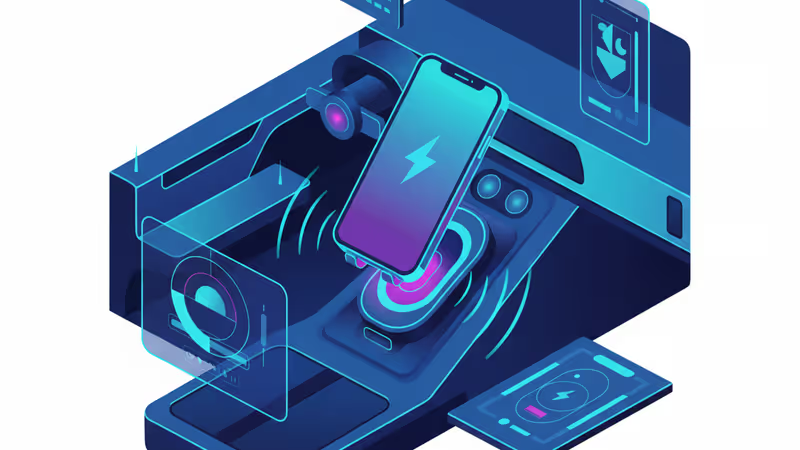
Nissan Becomes First US Automaker to Adopt Qi2 Magnetic Wireless Charging
Nissan is the first US carmaker to integrate Qi2 magnetic wireless charging, bringing MagSafe-like stability and speed to the driving experience.
Tired of your phone sliding off the charging pad every time you hit a bump? Nissan's got a solution. According to The Verge, Nissan announced last month that it'll be the first automaker in the US to offer wireless chargers with a magnetic mount. This move ensures that charging coils stay perfectly aligned for faster, more consistent power delivery, even while the vehicle is in motion.
The Evolution of the Nissan Qi2 Magnetic Wireless Charger
This innovation leverages the Wireless Power Consortium's Qi2 standard, which was finalized in late 2023. The standard specifies the use of magnets to help align wireless coils in both chargers and mobile devices. It's an idea that was originally pioneered by Apple with its MagSafe feature introduced on the iPhone 12 lineup.

By adopting this standard, Nissan is addressing a major pain point for modern drivers. Current flat-pad wireless chargers often fail to maintain a connection during spirited driving or on uneven roads. The magnetic mount locks the device in the 'sweet spot,' maximizing efficiency and reducing heat buildup.
Bridging the Gap Between Tech and Auto
While specific pricing and availability for individual models haven't been detailed yet, the implementation is expected to roll out across upcoming US models. This marks a significant step in the convergence of consumer electronics and automotive design, where seamless integration is becoming a primary selling point for tech-savvy buyers.
Authors
Related Articles
Mercedes-AMG's new GT 4-door coupe packs three YASA axial flux motors producing 1,153 hp and 1,475 lb-ft of torque. Here's what it means for the EV performance race—and who actually wins.
After 15 years of fragmented mobile messaging, Apple and Google are rolling out end-to-end encrypted RCS messaging between iPhones and Android devices. Here's what changed, why it took so long, and what it means for your privacy.
Apple agreed to pay $250 million to settle claims it misled iPhone 16 buyers about Apple Intelligence features. What this means for consumers, Big Tech marketing, and the AI industry.
Apple quietly removed the entry-level $599 Mac Mini, raising the starting price to $799 — just one day after Tim Cook warned of chip supply constraints on the earnings call.
Mercedes-AMG's new GT 4-door coupe packs three YASA axial flux motors producing 1,153 hp and 1,475 lb-ft of torque. Here's what it means for the EV performance race—and who actually wins.
After 15 years of fragmented mobile messaging, Apple and Google are rolling out end-to-end encrypted RCS messaging between iPhones and Android devices. Here's what changed, why it took so long, and what it means for your privacy.
Apple agreed to pay $250 million to settle claims it misled iPhone 16 buyers about Apple Intelligence features. What this means for consumers, Big Tech marketing, and the AI industry.
Apple quietly removed the entry-level $599 Mac Mini, raising the starting price to $799 — just one day after Tim Cook warned of chip supply constraints on the earnings call.
Thoughts
Share your thoughts on this article
Sign in to join the conversation