
Microsoft's New Gaming Chief Draws a Line in the AI Sand
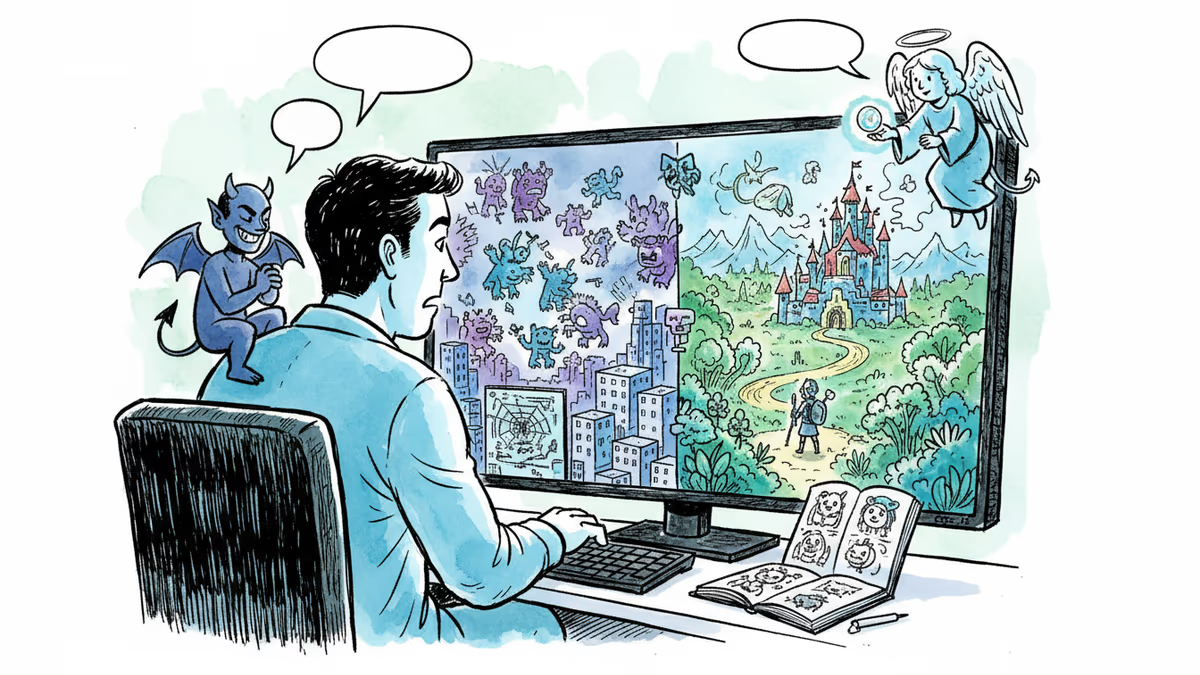
Asha Sharma, Microsoft's new gaming division head, declares war on 'soulless AI slop' in game development, sparking debate about AI's role in creative industries.
The $200 Billion Question About AI in Games
Microsoft's gaming division just got a new boss with strong opinions. Asha Sharma, stepping into Phil Spencer's shoes after his surprise departure, has declared she has "no tolerance for bad AI" in game development. Coming from someone who spent two years running Microsoft's CoreAI Product group, that's not just corporate speak—it's a battle cry.
In her first major interview with Variety, Sharma drew a clear line: "Great stories are created by humans." Her introductory memo was even more pointed: "We will not chase short-term efficiency or flood our ecosystem with soulless AI slop."
But here's the $200 billion question that's rattling the entire gaming industry: What exactly separates "bad AI" from the "innovative technology" she promises to provide?
The Developer Divide
The gaming world is splitting into camps faster than you can say "procedural generation." On one side, indie developers are using AI to cut production costs by 70%—a lifeline for small studios competing against AAA behemoths. On the other, veteran developers worry about losing the "soul" that makes games art, not just entertainment.
Epic Games CEO Tim Sweeney recently called AI-generated content "the fast food of gaming"—cheap, quick, but ultimately unsatisfying. Meanwhile, smaller studios argue that without AI assistance, they can't afford to compete with the big players who have 500-person development teams.

The irony? Sharma herself comes from Microsoft's AI division. She's not anti-AI—she's pro-good AI. But defining "good" versus "bad" AI in creative contexts is like trying to define art itself.
Players Speak With Their Wallets
Early data suggests gamers might be more pragmatic than purists expect. No Man's Sky, which uses extensive procedural generation (an early form of AI), has sold over 20 million copies. Players seem to care more about fun than the philosophical origins of their entertainment.
But there's a generational split emerging. Gamers over 30 show stronger preference for "human-crafted" experiences, while younger players are more open to AI-assisted content—as long as it's engaging.
The Competitive Reality
Sharma's stance puts Microsoft in an interesting position. While she's promising to avoid "AI slop," competitors like Sony and Tencent are doubling down on AI-assisted development. Sony's recent patent filings show they're developing AI systems for everything from dialogue generation to level design.
The risk? If Microsoft's human-first approach leads to longer development times and higher costs, will players wait? Or will they migrate to platforms offering faster, cheaper (if AI-generated) content?
Authors
Related Articles

Samsung and SK unveiled a chip and AI investment package worth thousands of trillions of won on June 29. The headline number swings wildly by outlet, but the real contest isn't capital — it's water and power.

Viral videos show 2026 graduates jeering executives who praise AI at commencement ceremonies. It's not just rudeness — it's a signal about who pays for technological optimism.

GitHub confirmed hackers stole data from 3,800 internal repositories via a poisoned VS Code extension. Here's why developer tools are now the most dangerous attack surface in tech.

Filipino virtual assistants using AI to ghost-manage LinkedIn profiles for executives is now a structured industry. 30 comments a day, fake engagement rings, and a platform struggling to tell real from fabricated.
Samsung and SK unveiled a chip and AI investment package worth thousands of trillions of won on June 29. The headline number swings wildly by outlet, but the real contest isn't capital — it's water and power.
Viral videos show 2026 graduates jeering executives who praise AI at commencement ceremonies. It's not just rudeness — it's a signal about who pays for technological optimism.
GitHub confirmed hackers stole data from 3,800 internal repositories via a poisoned VS Code extension. Here's why developer tools are now the most dangerous attack surface in tech.
Filipino virtual assistants using AI to ghost-manage LinkedIn profiles for executives is now a structured industry. 30 comments a day, fake engagement rings, and a platform struggling to tell real from fabricated.
Thoughts
Share your thoughts on this article
Sign in to join the conversation