
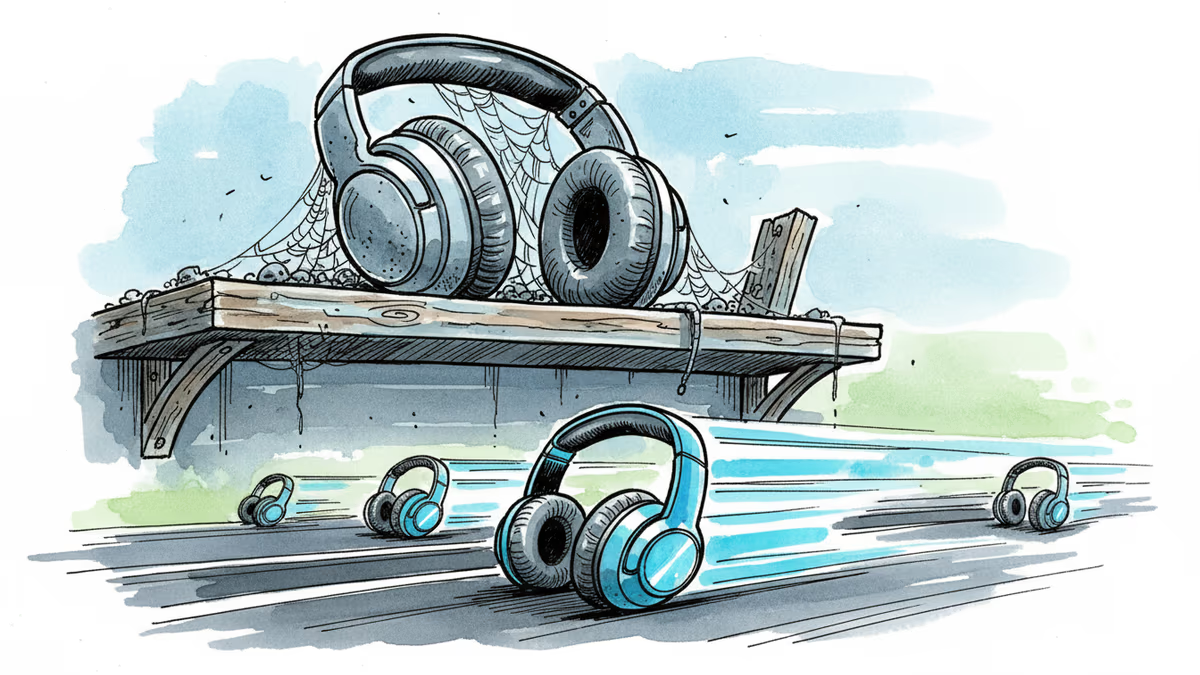
AirPods Max 2: Four Years Late, or Right on Time?
Apple quietly updated its flagship headphones after four years. The H2 chip brings real improvements, but is it enough to reclaim ground lost to Sony and Bose?
While Sony and Bose each launched multiple generations of flagship headphones, Apple's $549 over-ear headphones sat largely unchanged for four years. Then, two weeks after a splashy product event, a quiet press release appeared.
Apple officially announced the AirPods Max 2 on March 16, 2026. Orders open March 25, shipping begins in April. The price stays at $549. The design looks nearly identical. What changed is what's inside — and what Apple chose not to say.
What Actually Changed
The headline upgrade is the H2 chip — the same processor already powering the AirPods Pro 2 and AirPods Pro 3. Apple claims it delivers noise canceling that's 1.5x more effective than the original AirPods Max, alongside a new amplifier for cleaner sound and improved spatial audio.
The H2 also unlocks a suite of software features: Voice Isolation for cleaner call audio, Live Translation for real-time conversation interpretation, and adaptive listening modes like Conversation Awareness and Adaptive Audio that respond dynamically to your environment. Wired lossless audio is supported at up to 24-bit/48kHz with compatible devices.
What didn't change is equally telling. The heavy aluminum chassis remains. The polarizing rubberized pouch — criticized for offering minimal travel protection — is still there. No redesign. No new form factor. No mention of improved comfort for extended wear.
The Quiet Launch Speaks Volumes
Apple held a full product event earlier this month, unveiling the iPhone 17e and its most affordable laptop ever. AirPods Max 2 was absent. It arrived instead via a low-key news post, two weeks later, after the bigger announcements had time to settle.

That's a deliberate choice. Burying a product update after a major event typically signals one of two things: the company wants to avoid overshadowing its bigger releases, or it doesn't want the new product scrutinized alongside them. Given that the AirPods Max 2's centerpiece — the H2 chip — is a four-year-old processor already deployed in Apple's earbuds lineup, the muted rollout starts to make sense.
The Competition Didn't Wait
In the time since the original AirPods Max launched, Sony released multiple iterations of its WH-1000XM line, culminating in the XM6. Bose overhauled its flagship with the QuietComfort Ultra 2. Brands like Bowers & Wilkins and JBL have pushed annual or biannual updates, each one ratcheting up noise cancellation performance and portability.
At $549, the AirPods Max 2 sits in a price bracket where consumers have serious alternatives. The Sony WH-1000XM6 and Bose QuietComfort Ultra 2 are widely regarded as class leaders in active noise cancellation. Whether Apple's 1.5x improvement claim actually closes that gap — or merely catches up — won't be clear until independent testing.
The Ecosystem Argument (And Its Limits)
Here's where Apple defenders have a point. Raw specs don't tell the whole story. Seamless switching between iPhone, Mac, and iPad. Deep Siri integration. iCloud-synced settings. Live Translation that works natively within Apple's software stack. For someone already embedded in the Apple ecosystem, these aren't minor conveniences — they're daily frictions eliminated.
But that argument cuts both ways. If the primary reason to buy AirPods Max 2 is ecosystem lock-in rather than audio excellence, Apple is essentially charging a $549 platform tax. Consumers who prioritize sound quality over software integration have better options at lower prices. The question is how many buyers are making that calculation clearly.
What This Tells Us About Apple's Hardware Strategy
The AirPods Max's update cycle — or lack of one — reflects a broader pattern. Apple tends to let products age until a chipset upgrade enables a meaningful enough feature jump to justify a new SKU, rather than iterating on hardware design annually. It's a strategy that works when the product's debut performance is strong enough to remain competitive. The original AirPods Max largely held that line.
Whether the Max 2 can do the same for another four years is a harder bet, given how aggressively the competition has moved. The premium wireless headphone market in 2026 is not the same market it was in 2020.
Authors
Related Articles
After 15 years of fragmented mobile messaging, Apple and Google are rolling out end-to-end encrypted RCS messaging between iPhones and Android devices. Here's what changed, why it took so long, and what it means for your privacy.
Apple agreed to pay $250 million to settle claims it misled iPhone 16 buyers about Apple Intelligence features. What this means for consumers, Big Tech marketing, and the AI industry.
Apple quietly removed the entry-level $599 Mac Mini, raising the starting price to $799 — just one day after Tim Cook warned of chip supply constraints on the earnings call.
Expiring leases will flood the US used car market with over a million electric vehicles by 2028. Could this do what subsidies couldn't — make EVs genuinely affordable?
After 15 years of fragmented mobile messaging, Apple and Google are rolling out end-to-end encrypted RCS messaging between iPhones and Android devices. Here's what changed, why it took so long, and what it means for your privacy.
Apple agreed to pay $250 million to settle claims it misled iPhone 16 buyers about Apple Intelligence features. What this means for consumers, Big Tech marketing, and the AI industry.
Apple quietly removed the entry-level $599 Mac Mini, raising the starting price to $799 — just one day after Tim Cook warned of chip supply constraints on the earnings call.
Expiring leases will flood the US used car market with over a million electric vehicles by 2028. Could this do what subsidies couldn't — make EVs genuinely affordable?
Thoughts
Share your thoughts on this article
Sign in to join the conversation