
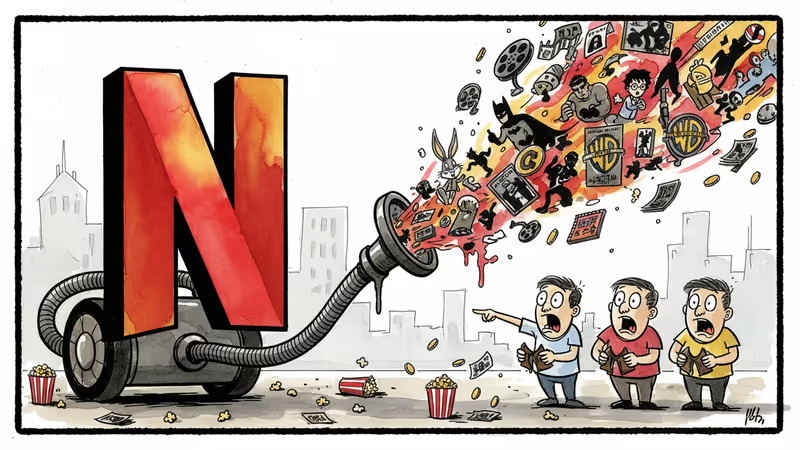
Netflix Promises 'More Content for Less' in Warner Bros Merger Defense
Netflix co-CEO Ted Sarandos tells Senate hearing that Warner Bros acquisition will lower prices and increase content, but monopoly concerns persist.
$82.7 billion. That's Netflix's enterprise value offer for Warner Bros. Discovery's streaming and studio assets. But subscribers have a simpler question: Will this make my monthly bill go up?
Ted Sarandos, Netflix's co-CEO, faced exactly that concern during a Senate antitrust hearing Tuesday. His answer? The opposite will happen. "We will give consumers more content for less," he promised lawmakers.
The Monopoly Question
Netflix already dominates streaming with 301.63 million subscribers worldwide. Warner Bros. Discovery ranks third with 128 million across HBO Max and Discovery+. Combined, they'd control roughly 21% of the streaming market—a concentration that has regulators nervous.
Sarandos tried to ease those concerns with an interesting statistic: 80% of HBO Max subscribers already pay for Netflix too. "Netflix and Warner Bros. both have streaming services, but they are very complementary," he argued. In other words, most people aren't choosing between the two—they're buying both.
But Senator Amy Klobuchar pressed harder. If Netflix just raised prices in January 2025 despite adding subscribers, how can it promise affordability post-merger? Sarandos fell back on the "one-click cancel" defense—if customers don't like the value, they can leave instantly.
The 35-Cent Strategy

Sarandos deployed an unusual metric to justify Netflix's pricing: cost per hour watched. Netflix subscribers pay roughly 35 cents per hour of content consumed, compared to 90 cents for Paramount+ users, according to his calculations.
This reveals streaming's new competitive battleground. It's not just about monthly subscription fees anymore—it's about engagement. The platform that keeps you watching longest can justify higher prices while claiming better value. Warner's HBO originals and DC movie library would significantly boost Netflix's "stickiness."
The Real Competition
Perhaps most tellingly, Sarandos identified the true threat: "deep-pocketed tech companies trying to run away with the TV business." He pointed to Google, Apple, and Amazon as Netflix's real rivals, not traditional media companies.
The data supports this view. Nielsen's December 2024 TV viewership rankings showed YouTube leading with 12.7% share, while Netflix managed just 9%. The streaming wars aren't just Netflix versus Disney+ anymore—they're platforms versus Big Tech.
What's Really at Stake
This merger represents more than content consolidation. It's about whether traditional entertainment companies can compete with tech giants' infinite war chests. Amazon loses billions on Prime Video to drive retail sales. Apple treats Apple TV+ as a rounding error in its services revenue. Can pure-play streamers like Netflix survive without scale?
The regulatory battle will likely drag on for months. Paramount has launched a hostile $108.4 billion counterbid for all of Warner Bros. Discovery, not just the streaming assets. Meanwhile, subscribers wait to see whether "more content for less" proves true or becomes another broken promise in the streaming age.
Authors
Related Articles
Netflix has hiked prices across all plans, including its ad-supported tier, just 14 months after its last increase. What this means for subscribers, competitors, and the future of streaming economics.
Streaming prices have doubled in a decade. Netflix, Disney, HBO Max — every platform is charging more and adding ads. Here's why, and what it means for you.
Days into his tenure, Disney CEO Josh D'Amaro faces simultaneous crises: OpenAI's Sora shutdown threatens a $1B AI deal, while Epic's layoffs cast doubt on a $1.5B metaverse plan.
A federal judge dismissed Musi's lawsuit against Apple with prejudice after the free music app was pulled from the App Store. What does it mean for developers, users, and platform power?
Netflix has hiked prices across all plans, including its ad-supported tier, just 14 months after its last increase. What this means for subscribers, competitors, and the future of streaming economics.
Streaming prices have doubled in a decade. Netflix, Disney, HBO Max — every platform is charging more and adding ads. Here's why, and what it means for you.
Days into his tenure, Disney CEO Josh D'Amaro faces simultaneous crises: OpenAI's Sora shutdown threatens a $1B AI deal, while Epic's layoffs cast doubt on a $1.5B metaverse plan.
A federal judge dismissed Musi's lawsuit against Apple with prejudice after the free music app was pulled from the App Store. What does it mean for developers, users, and platform power?
Thoughts
Share your thoughts on this article
Sign in to join the conversation