
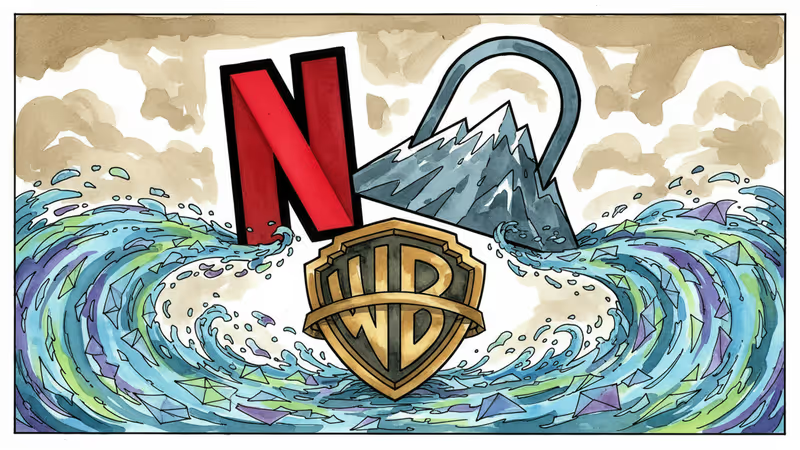
Netflix's $83B Warner Bros Deal Faces $108B Hostile Takeover Bid
Netflix's $83 billion Warner Bros acquisition faces a hostile $108 billion counterbid from Paramount Skydance, reshaping Hollywood's future in the streaming wars and AI content era.
$83 billion for a movie studio. $108 billion for the whole package. The bidding war over Warner Bros. Discovery has become Hollywood's biggest drama of 2026, and it's not just about money—it's about who controls entertainment's future.
Netflix, with its 325 million subscribers, won the initial bid for Warner Bros' movie studios, excluding cable channels. But Paramount Skydance, led by David Ellison (son of Oracle cofounder Larry Ellison), won't back down. The company launched a hostile takeover attempt worth $108 billion for everything, including those declining cable assets.
A Quarter-Century of Corporate Fumbling
HBO. CNN. Warner Bros. Pictures. These aren't just brands—they're cultural institutions with legendary franchises and world-class recognition. So how did they end up as acquisition targets?
The answer lies in 25 years of spectacular corporate mismanagement. AOL, Time Warner, AT&T—each owner somehow managed to fumble what should have been entertainment gold. Mergers, spin-offs, cost cuts, and strategic pivots have left these assets undervalued and underutilized.
Current Warner Bros. Discovery CEO David Zaslav continued this trend, focusing on cost-cutting over content investment. The result? A company worth less than the sum of its parts, ripe for acquisition.
Why Netflix Needs Warner
Netflix's math is straightforward. Subscriber growth is slowing as streaming markets mature. The company needs new growth engines, and Warner Bros' vast content library offers exactly that.
The DC Universe, Harry Potter, Lord of the Rings—these are the blockbuster franchises Netflix has always lacked. Unlike its original content strategy, which requires years of development and uncertain outcomes, Warner's proven IP offers immediate value.
But Netflix's $83 billion bid excludes cable channels. The streaming giant sees no future in traditional broadcasting, betting entirely on direct-to-consumer delivery.
The Ellison Empire's Hollywood Dreams

David Ellison's strategy feels ripped from Succession. Using his father's tech fortune and potential Trump administration support, he's attempting to build a media empire that bridges traditional and digital entertainment.
Unlike Netflix, Paramount wants everything—studios, streaming, and cable. Ellison believes there's value in owning the entire entertainment pipeline, even declining assets like cable channels.
The question is whether this approach makes sense when cord-cutting accelerates and traditional broadcasting faces existential challenges.
The Real Battle: Attention Wars
This bidding war reflects a deeper industry crisis. Entertainment companies aren't just competing with each other—they're fighting Fortnite, Roblox, TikTok, and YouTube for audience attention.
Short-form video, gaming, and social media have fundamentally changed how people consume content. Traditional Hollywood's two-hour movies and hour-long TV episodes suddenly seem antiquated compared to endless, algorithm-driven feeds.
Soon, AI-generated content could flood these platforms with cheap, personalized video. In this landscape, premium, human-created content might become either more valuable—or completely irrelevant.
Regulatory Headwinds
The FCC has already expressed "legitimate competition concerns" about Netflix's Warner Bros deal. Ted Sarandos, Netflix's co-CEO, will testify at antitrust hearings as regulators scrutinize the streaming giant's growing market power.
Netflix already dominates global streaming. Adding Warner Bros' content library could trigger regulatory pushback, especially under an administration increasingly skeptical of Big Tech consolidation.
Paramount's higher bid might face fewer regulatory hurdles, as it would combine two traditional media companies rather than expanding a tech platform's reach.
Investment Implications
For investors, this bidding war signals broader industry consolidation. Streaming wars have proven economically unsustainable—too many platforms chasing the same audiences with escalating content costs.
Whoever wins Warner Bros will likely need to demonstrate how they'll monetize these assets differently than previous owners. Netflix's data-driven approach offers one model; Paramount's integrated strategy offers another.
The loser might struggle to compete long-term, potentially becoming the next acquisition target.
Authors
Related Articles
Netflix has hiked prices across all plans, including its ad-supported tier, just 14 months after its last increase. What this means for subscribers, competitors, and the future of streaming economics.
Streaming prices have doubled in a decade. Netflix, Disney, HBO Max — every platform is charging more and adding ads. Here's why, and what it means for you.
The first full trailer for Denis Villeneuve's Dune: Part Three reveals Paul and Chani awaiting twins — a detail that carries enormous weight for fans of Frank Herbert's novels.
Netflix acquired Ben Affleck's AI company InterPositive, signaling a major shift in how streaming giants plan to revolutionize content production and compete in Hollywood.
Netflix has hiked prices across all plans, including its ad-supported tier, just 14 months after its last increase. What this means for subscribers, competitors, and the future of streaming economics.
Streaming prices have doubled in a decade. Netflix, Disney, HBO Max — every platform is charging more and adding ads. Here's why, and what it means for you.
The first full trailer for Denis Villeneuve's Dune: Part Three reveals Paul and Chani awaiting twins — a detail that carries enormous weight for fans of Frank Herbert's novels.
Netflix acquired Ben Affleck's AI company InterPositive, signaling a major shift in how streaming giants plan to revolutionize content production and compete in Hollywood.
Thoughts
Share your thoughts on this article
Sign in to join the conversation