
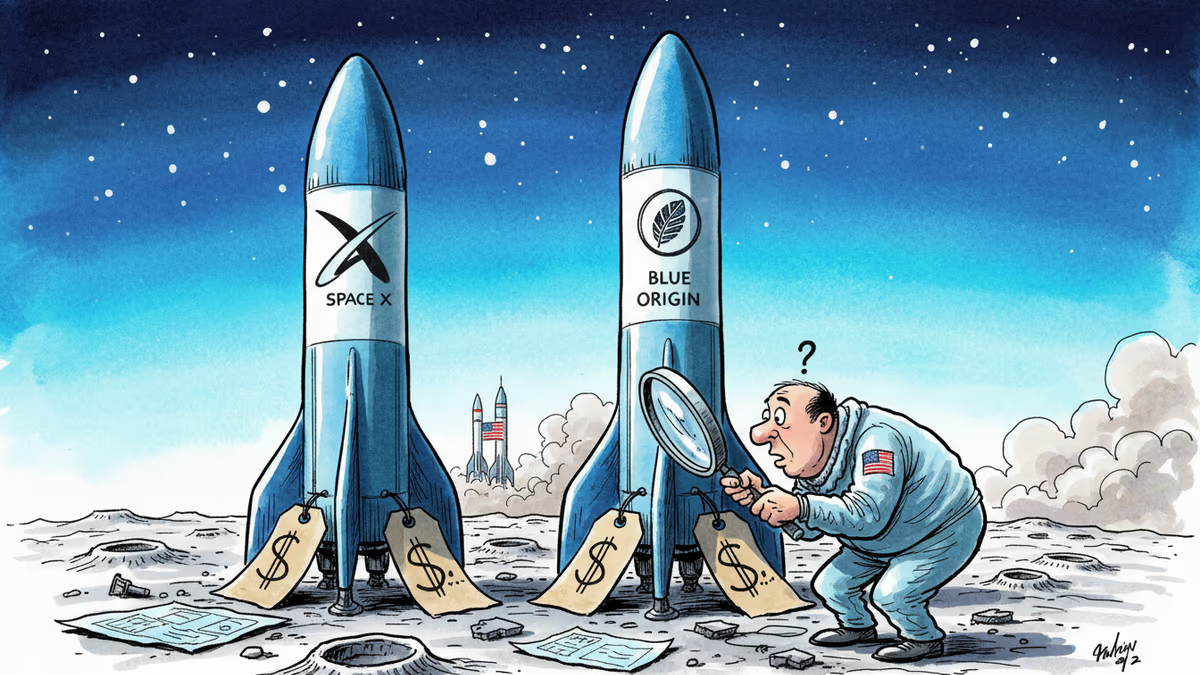
NASA's Moon Lander Bet on Private Industry Is Paying Off — But Questions Remain
NASA's inspector general says fixed-price contracts with SpaceX and Blue Origin for lunar landers are working. But the report also reveals how much we still don't know.
For decades, NASA handed out space contracts the old-fashioned way: spend what you need, send us the bill, and we'll add a profit margin on top. The results were predictable — cost overruns, schedule slips, and rockets that cost more per launch than some countries' annual science budgets.
So when NASA decided to hand the keys of its lunar lander program to SpaceX and Blue Origin under fixed-price contracts, it was a genuine experiment. This week, we got the first real look at how that experiment is going.
What the Inspector General Actually Found
On Tuesday, NASA's Office of Inspector General released a report examining how the agency has managed its Human Landing System (HLS) contracts — the vehicles that will carry astronauts from lunar orbit down to the Moon's surface and back. Senior official Robert Steinau signed the report.
The headline finding: the fixed-price contracting approach has been beneficial for NASA. In plain terms, locking companies into a set price — rather than reimbursing whatever they spend — is giving the agency better cost predictability and pushing contractors to innovate their way to savings rather than simply billing the government for inefficiency.
This matters because HLS isn't a side project. These landers are the linchpin of the Artemis program, which aims to put humans back on the Moon before the end of this decade and eventually establish a permanent lunar presence. Without functional landers, none of that happens.
SpaceX is developing a lunar variant of its Starship vehicle. Blue Origin is building the Blue Moon lander. Both companies have been notably tight-lipped about their progress — which is part of why this inspector general report drew attention. It offered a rare window into a program that has operated largely in the dark.
The Silence Has Been Deafening
Here's the uncomfortable context: for a program of this scale and ambition, the public has been told remarkably little. Neither NASA nor the two contractors have offered meaningful updates on technical milestones, development timelines, or how the money is actually being spent. The inspector general report fills in some of those gaps — but not all of them. Key details on schedules, technical status, and cost execution remain classified or simply unreported.

This opacity is partly by design. Fixed-price contracts give companies more latitude to manage their own development processes without government micromanagement. The tradeoff is transparency. When taxpayer money funds a program through a cost-plus contract, Congress and the public can scrutinize every line item. With fixed-price deals, the internal workings are largely the company's business.
For SpaceX, a company that has never been publicly traded and has no obligation to disclose financials, this is standard operating procedure. Blue Origin, similarly private, plays it close to the chest. The result is that humanity's next Moon landing is being built largely out of public view.
Three Ways to Read This Report
From NASA's perspective, this is a validation. The agency has spent years trying to shift away from the cost-plus model that ballooned the Space Launch System budget by billions. If fixed-price contracts work for lunar landers, it strengthens the case for applying the same approach to future programs.
From a policy analyst's perspective, the picture is more complicated. Fixed-price contracts transfer financial risk to contractors — but if SpaceX or Blue Origin runs into serious technical trouble, what happens? Does NASA have leverage to course-correct, or does it simply wait and hope? The report doesn't fully answer this.
From a taxpayer's perspective, the key question isn't whether the contracting model is theoretically sound — it's whether the landers will actually work, on time, and within the agreed price. On those questions, the report is largely silent.
The Bigger Shift Underway
Zoom out, and this story is about something larger than Moon landers. The United States government is in the middle of a deliberate transition: from being the primary builder of space infrastructure to being a customer that buys services from private companies.
SpaceX already carries astronauts to the International Space Station under a similar commercial services model. The Commercial Lunar Payload Services program is paying companies to deliver science experiments to the Moon. HLS is the next, more ambitious step in that chain.
If this model succeeds, it could reshape how space exploration is funded and governed globally — with implications for every country building its own space ambitions, from the European Space Agency to emerging programs in Japan, India, and the UAE.
But it also raises a question that the inspector general report doesn't touch: when private companies build the infrastructure that gets humans to the Moon, who ultimately controls what happens there?
Authors
Related Articles
American Airlines just signed Starlink for 500+ aircraft. It's not just about faster inflight internet — it's a calculated move in the run-up to what could be the largest IPO in history.

SpaceX's upgraded Starship V3 completed its first test flight, deploying 20 Starlink simulators but losing the Super Heavy booster. With an IPO weeks away, the stakes just got higher.
SpaceX's IPO filing puts AI at the center, claiming a $26.5 trillion market opportunity. But can Grok compete with OpenAI and Anthropic for enterprise customers?
SpaceX filed a nearly 400-page S-1 with the SEC, targeting an IPO as early as June 12. Here's what the filing reveals—and what it doesn't.
American Airlines just signed Starlink for 500+ aircraft. It's not just about faster inflight internet — it's a calculated move in the run-up to what could be the largest IPO in history.
SpaceX's upgraded Starship V3 completed its first test flight, deploying 20 Starlink simulators but losing the Super Heavy booster. With an IPO weeks away, the stakes just got higher.
SpaceX's IPO filing puts AI at the center, claiming a $26.5 trillion market opportunity. But can Grok compete with OpenAI and Anthropic for enterprise customers?
SpaceX filed a nearly 400-page S-1 with the SEC, targeting an IPO as early as June 12. Here's what the filing reveals—and what it doesn't.
Thoughts
Share your thoughts on this article
Sign in to join the conversation