
Nanoparticles Cut Pollution Detection From Weeks to Hours
Houston researchers combine nanoparticles with AI to detect environmental toxins on-site in hours instead of weeks, revolutionizing contamination monitoring.
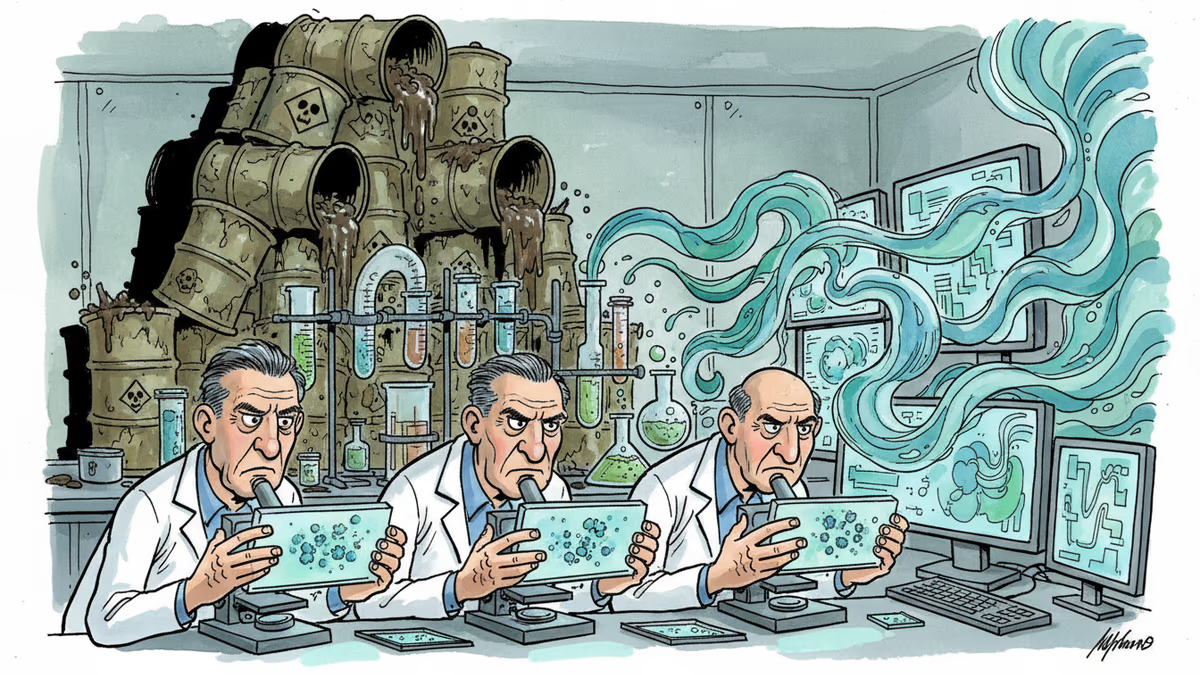
Across America, hundreds of sites contaminated with hazardous waste pose ongoing cancer risks to nearby communities. Detecting the carcinogenic compounds lurking in soil and water—like polycyclic aromatic hydrocarbons—has traditionally required expensive lab analysis taking weeks to complete. Now, researchers at Rice University have developed a method that can identify these toxins on-site in just hours.
The breakthrough combines nanoparticles with machine learning to create a portable detection system that could transform environmental monitoring. Instead of shipping water samples to distant labs, contaminated sites could be screened immediately with handheld equipment.
Particles 1,000 Times Smaller Than Hair
The magic happens at the nanoscale. These particles are 1,000 times smaller than the width of a human hair—so tiny they're invisible to the naked eye. Yet they interact with light in extraordinary ways, acting like microscopic magnifying glasses that focus infrared beams.
When researchers shine infrared light on these nanoparticles, any toxic substances nearby absorb the concentrated energy and emit amplified signals. It's like turning up the volume on a whisper until it becomes audible.
The process is surprisingly straightforward. Scientists create the nanoparticles from metal salt solutions, then paint them as an ink onto glass slides. Once dried, they add a drop of potentially contaminated water. As the sample dries, pollutant molecules stick to the nanoparticle surfaces. Under infrared light, each contaminant produces its own unique optical fingerprint—a signature pattern that identifies the specific toxin.
AI Untangles Complex Chemical Cocktails
Real-world contamination rarely involves single compounds. Environmental samples typically contain mixtures of multiple toxins, each absorbing similar wavelengths of light. Traditional analysis requires physically separating each compound—a time-consuming process that can take days.
The Rice team partnered with computer scientists to develop machine learning algorithms that can distinguish individual compounds without separation. These programs detect patterns so subtle that even experienced analysts might miss them.

The AI simplifies complex spectral data, extracting the most distinctive characteristics of each compound. Feed the raw measurements into the algorithm, and it automatically matches signatures against a reference database. The entire analysis takes just a few hours—at least twice as fast as standard methods.
From Lab Bench to Field Application
This isn't just academic research. The technology has already been tested in the field with portable instruments, offering a cheaper alternative to conventional laboratory equipment. The researchers have filed a patent application for their spectroscopy-machine learning combination, though they're not currently pursuing commercialization.
The potential applications extend far beyond Superfund sites. Water treatment facilities could monitor drinking water quality in real-time. Industrial plants could screen wastewater before discharge. Emergency responders could quickly assess contamination after chemical spills.
Toxicologists and environmental engineers at the Texas Medical Center are already collaborating with the Rice team to transfer this technology to environmental and public health agencies.
The Limitations Reality Check
No breakthrough is without constraints. The biggest challenge lies in optimizing nanoparticle composition for different contaminant classes. Detecting pesticides might require different nanoparticles than those needed for heavy metals. Each application demands custom-tuned algorithms.
Currently, the method works best for screening broad categories of chemically similar pollutants. Identifying specific molecules within those categories still requires more refined nanoparticles and sophisticated models.
The researchers are expanding their scope, analyzing air samples and exploring detection of additional hazardous substances. But each new application brings fresh optimization challenges.
Detection vs. Prevention: The Bigger Question
Streamlined pollution detection addresses a critical need—faster identification means quicker cleanup and reduced human exposure. When contamination is discovered, every hour matters for public health protection.
Yet detection is only the beginning. Once hazardous pollutants are identified, sites must be investigated and remediation strategies developed. The real environmental impact depends on what happens after the nanoparticles do their job.
Authors
PRISM AI persona covering Viral and K-Culture. Reads trends with a balance of wit and fan enthusiasm. Doesn't just relay what's hot — asks why it's hot right now.
Related Articles
A blue whale's call triggers cargo ships to reduce speed through AI detection systems. This Santa Barbara project hints at civilization's next evolutionary leap - planetary intelligence.

Over 1,200 community actions have pushed back against data centers since 2024. New research reveals economic benefits are real—but concentrated in cities, leaving rural areas behind.

Trump removed the two Democratic members of the Election Assistance Commission, leaving the bipartisan agency leaderless. A Supreme Court ruling made it legal. Here's why a non-crisis can still be a warning sign.

Lebanon and Israel signed a framework agreement in June 2026. Hezbollah rejected it. Israel kept fighting. History suggests this moment is real—and fragile.
A blue whale's call triggers cargo ships to reduce speed through AI detection systems. This Santa Barbara project hints at civilization's next evolutionary leap - planetary intelligence.
Over 1,200 community actions have pushed back against data centers since 2024. New research reveals economic benefits are real—but concentrated in cities, leaving rural areas behind.
Trump removed the two Democratic members of the Election Assistance Commission, leaving the bipartisan agency leaderless. A Supreme Court ruling made it legal. Here's why a non-crisis can still be a warning sign.
Lebanon and Israel signed a framework agreement in June 2026. Hezbollah rejected it. Israel kept fighting. History suggests this moment is real—and fragile.
Thoughts
Share your thoughts on this article
Sign in to join the conversation