
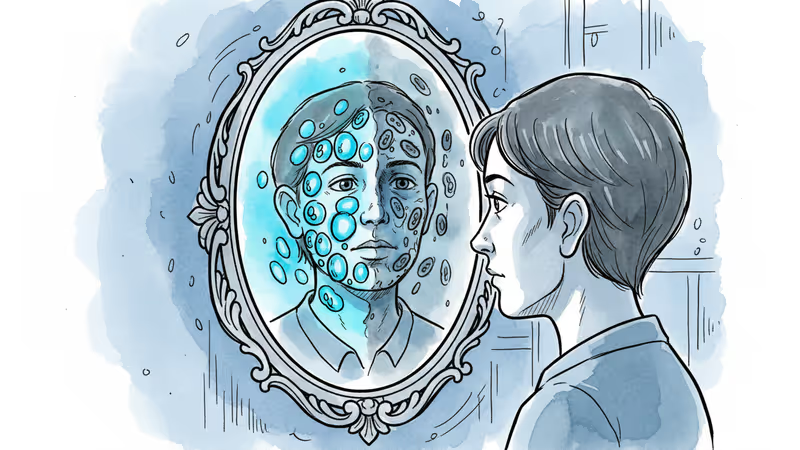
NAD+ Supplements: The $2 Billion Bet on Cellular Energy
From Gwyneth Paltrow to Joe Rogan, everyone's talking NAD+. But can these supplements really slow aging, or are we chasing another wellness mirage?
Your cells are running out of juice. By age 40, you've lost roughly half of your body's natural NAD+ levels—a critical coenzyme that powers cellular energy production. That's the pitch driving a $2 billion supplement industry that has everyone from Gwyneth Paltrow to Joe Rogan talking about NAD+.
But here's what makes this trend different from typical wellness fads: NAD+ isn't just another anti-aging promise. It represents a fundamental shift in how we approach health—from treating symptoms after they appear to preventing cellular decline before it starts.
The Energy Courier Your Body Can't Live Without
NAD+ (nicotinamide adenine dinucleotide) isn't some exotic compound discovered in a lab. Your body produces it naturally, and it's essential for converting the food you eat into ATP—the energy currency that powers every cell. Think of NAD+ as an energy courier, shuttling electrons to your mitochondria where the real work happens.
The process is elegantly simple: NAD+ picks up electrons, becomes NADH, delivers them to create energy, then converts back to NAD+ to repeat the cycle. When this process slows down, everything else follows. Neurons can't fire properly. Muscles fatigue faster. Skin loses its elasticity.
Beyond energy production, NAD+ activates sirtuins—proteins that regulate DNA repair, inflammation, and cellular aging. It's also involved in limiting "zombie cells" (cellular senescence) that accumulate as we age and contribute to chronic disease.
The problem? NAD+ is constantly being consumed. Every time your cells produce energy, some NAD+ is lost. While your body has recycling pathways, it can't keep up with demand as you age.
Why Everyone's Talking About It Now
The NAD+ craze isn't happening in a vacuum. It's part of a broader cultural shift toward "healthspan"—the number of years you live in good health, not just total lifespan. Research shows that many aging-related changes begin in our thirties and forties, long before we notice symptoms.
Amanda Khan, a board-certified internist and longevity specialist, sees patients in their twenties reporting brain fog, fatigue, and chronic inflammation, especially post-COVID. "Throughout any decade of life, people want to function at what they see as their optimal level," she explains.
This desire for optimization has pushed attention toward compounds that support basic cellular processes. NAD+ precursors—like NR (nicotinamide riboside) and NMN (nicotinamide mononucleotide)—offer what Rachele Pojednic, who studies NAD at Stanford, calls "an easy lift." They're accessible, appear safe, and could potentially have long-term effects.

The Science Behind the Hype
Most human studies focus on NAD+ precursors rather than NAD+ itself, since the molecule has poor bioavailability when taken orally. The most studied precursors include NR, NMN, and various forms of vitamin B3. All have been shown to increase intracellular NAD+ levels, though they haven't been compared head-to-head in large trials.
NR supplements have the most robust safety data, studied in doses from 1,000 to 3,000 milligrams per day in healthy adults with minimal side effects. NMN faced regulatory hurdles when the FDA temporarily classified it as a drug in 2022, but that decision was reversed in 2025.
In Khan's clinical experience, patients report improvements in energy, mental clarity, migraines, and sleep patterns, especially during periods of high stress. Fitness enthusiasts say they recover better from intense workouts and injuries.
Early research is exploring NAD+'s role in neurodegenerative diseases, inflammatory pain, and addiction, though much of this work remains preliminary. For people with existing conditions like Parkinson's or sarcopenia, NAD+ precursors may help slow decline. What's unclear is whether starting supplementation can prevent disease or significantly alter aging trajectories in healthy individuals.
The IV Infusion Question Mark
Despite the popularity of NAD+ IV infusions at longevity clinics, the science doesn't support their effectiveness. NAD+ can't easily cross from the bloodstream into cells—there's no known transporter for this process. When NAD+ appears in blood, your body treats it as a sign of cellular damage and works to eliminate it.
"Your liver and kidneys start to work, and you're peeing most of it out," explains Pojednic. Patients frequently report side effects including nausea, chest tightness, and sudden diarrhea—possibly due to an immune response triggered by NAD+ appearing where it doesn't belong.
For most healthy adults, oral precursors remain the simplest and best-studied option.
The Regulatory Gray Areas
Because supplements are loosely regulated, quality varies wildly. Products from unverified retailers can be contaminated or mislabeled. Animal studies have raised concerns that extremely high doses could potentially promote tumor growth, leading clinicians to exercise caution in cancer patients.
Pregnancy remains another gray area—most doctors recommend avoiding NAD+ supplements due to lack of safety data, though some evidence suggests NAD+ may support fertility and egg quality before conception.
No human clinical trials have shown increased cancer risk from oral NAD+ precursors. Some researchers even hypothesize that NAD+ may support genomic stability and cancer surveillance. Still, long-term data are limited.
Authors
Related Articles
From Gisele's Instagram to your medicine cabinet, functional mushrooms have exploded into a massive industry. But as the hype grows, where does science end and marketing begin?
Former fintech founder Bryan Johnson sells immortality program for $1M annually. Only three spots available. The ultra-wealthy longevity craze examined.

The Vitalism movement, which considers death humanity's core problem, is gaining political influence in the US government, pushing for policy changes to advance longevity research and experimental drug access.
A radical movement is gaining momentum with one goal: making death obsolete. But are we ready for the consequences of defeating mortality itself?
From Gisele's Instagram to your medicine cabinet, functional mushrooms have exploded into a massive industry. But as the hype grows, where does science end and marketing begin?
Former fintech founder Bryan Johnson sells immortality program for $1M annually. Only three spots available. The ultra-wealthy longevity craze examined.
The Vitalism movement, which considers death humanity's core problem, is gaining political influence in the US government, pushing for policy changes to advance longevity research and experimental drug access.
A radical movement is gaining momentum with one goal: making death obsolete. But are we ready for the consequences of defeating mortality itself?
Thoughts
Share your thoughts on this article
Sign in to join the conversation