
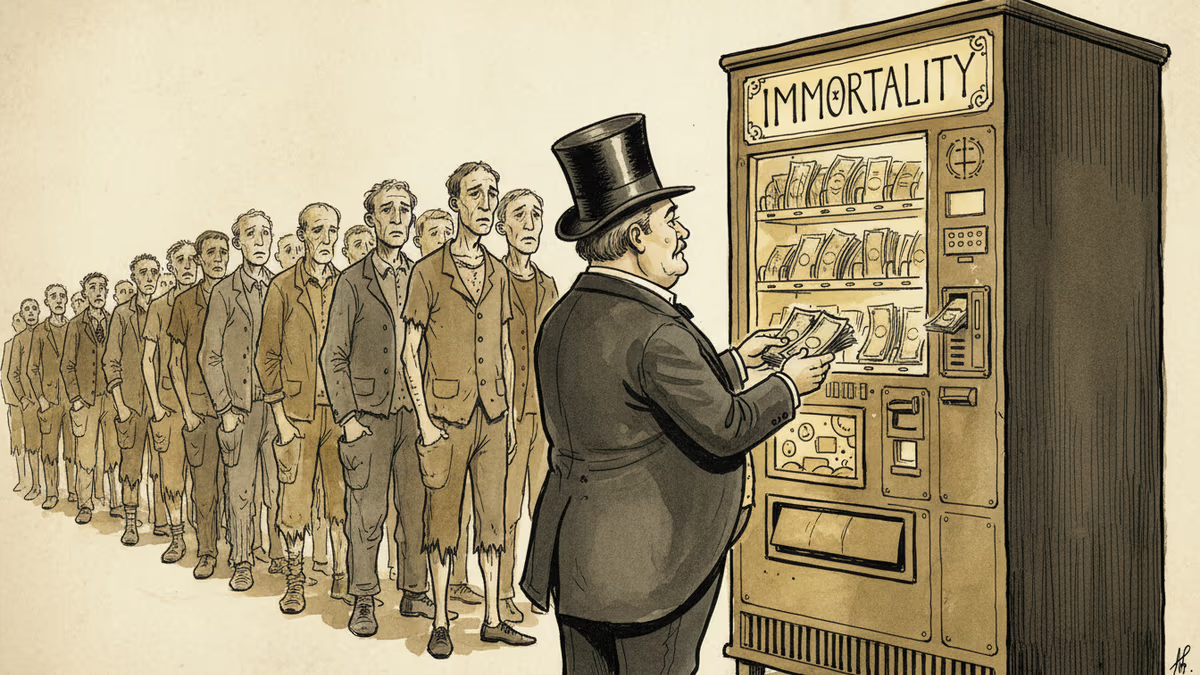
The $1 Million Immortality Scam That Rich People Will Actually Buy
Former fintech founder Bryan Johnson sells immortality program for $1M annually. Only three spots available. The ultra-wealthy longevity craze examined.
When Death Becomes a Premium Service
Former fintech founder Bryan Johnson just announced he'll sell access to his "immortality secrets" for $1 million per year. Only three spots available. This is the same man who gets botox injections in his genitals and receives blood transfusions from his teenage son. The question isn't whether his program works—it's whether the ultra-wealthy care.
Johnson, 47, claims his "biological age" has reversed to his twenties through a regimen of 100 daily pills, strict dieting, and what he calls "the exact protocol I've followed for the last five years." His new "Immortals" program promises a dedicated concierge team, 24/7 AI assistance, and access to "millions of biological data points."
For those without seven figures lying around, there's a "supported tier" for a mere $60,000. How generous.
The Longevity Gold Rush
Johnson isn't alone in monetizing mortality anxiety. The longevity industry has exploded into a multi-billion dollar market targeting the wealthy's greatest fear: being ordinary enough to die.
John Hering, who's backed Elon Musk with billions, co-founded Biograph, charging $15,000 annually for premium preventative health services. Fountain Life raised $108 million for its "ultimate longevity program" at $21,500 per year. Suddenly, Johnson's pricing doesn't seem so outrageous—it's just the luxury tier of an already exclusive market.
The scarcity marketing is brilliant. Only three spots create artificial urgency among people who've never experienced genuine scarcity. It's the Hermès Birkin bag of not dying.

The Science Behind the Spectacle
Here's what Johnson's million-dollar program doesn't guarantee: proof that he'll outlive anyone else born in 1977. His "biological age reversal" claims rely on biomarkers that can be improved through conventional healthy living—adequate sleep, exercise, and nutrition that doesn't require a personal chef and unlimited resources.
Harvard longevity researcher Dr. David Sinclair has noted that individual extreme interventions often don't translate to population-level benefits. Johnson's approach combines legitimate health optimization with theatrical elements that make for better social media content than peer-reviewed studies.
The real innovation isn't in Johnson's protocol—it's in his ability to package basic wellness as revolutionary technology and charge accordingly.
Death as the Ultimate Inequality
The deeper issue isn't whether Johnson's program works, but what happens when longevity becomes another luxury good. We're already seeing a 15-year life expectancy gap between America's richest and poorest. Add personalized longevity treatments to the mix, and we're looking at a future where death itself becomes a class issue.
This isn't just about living longer—it's about fundamentally altering the human experience. If the wealthy can buy decades of additional life, what happens to social mobility, inheritance patterns, and political power structures? We could be witnessing the emergence of a literally immortal ruling class.
The Musk Connection
Johnson's timing isn't coincidental. His announcement comes as Elon Musk claims that saving for retirement is pointless because AGI will create such abundance that poverty becomes obsolete. Both men are selling the same fantasy: that technology will solve humanity's fundamental constraints, available first to those who can afford early access.
It's the ultimate tech bro promise—transcendence through consumption.
Authors
Related Articles

A $7M quantum computing competition is testing whether today's noisy, limited quantum machines can actually help human health—before the powerful ones we've been promised ever arrive.

New research shows DMT can treat depression in 15 minutes without hallucinations. Could this fast-acting psychedelic revolutionize mental healthcare and challenge Big Pharma's dominance?

From Gwyneth Paltrow to Joe Rogan, everyone's talking NAD+. But can these supplements really slow aging, or are we chasing another wellness mirage?

The Vitalism movement, which considers death humanity's core problem, is gaining political influence in the US government, pushing for policy changes to advance longevity research and experimental drug access.
A $7M quantum computing competition is testing whether today's noisy, limited quantum machines can actually help human health—before the powerful ones we've been promised ever arrive.
New research shows DMT can treat depression in 15 minutes without hallucinations. Could this fast-acting psychedelic revolutionize mental healthcare and challenge Big Pharma's dominance?
From Gwyneth Paltrow to Joe Rogan, everyone's talking NAD+. But can these supplements really slow aging, or are we chasing another wellness mirage?
The Vitalism movement, which considers death humanity's core problem, is gaining political influence in the US government, pushing for policy changes to advance longevity research and experimental drug access.
Thoughts
Share your thoughts on this article
Sign in to join the conversation