

Meet the Vitalists Who Believe Death Is Simply 'Wrong
A radical movement is gaining momentum with one goal: making death obsolete. But are we ready for the consequences of defeating mortality itself?
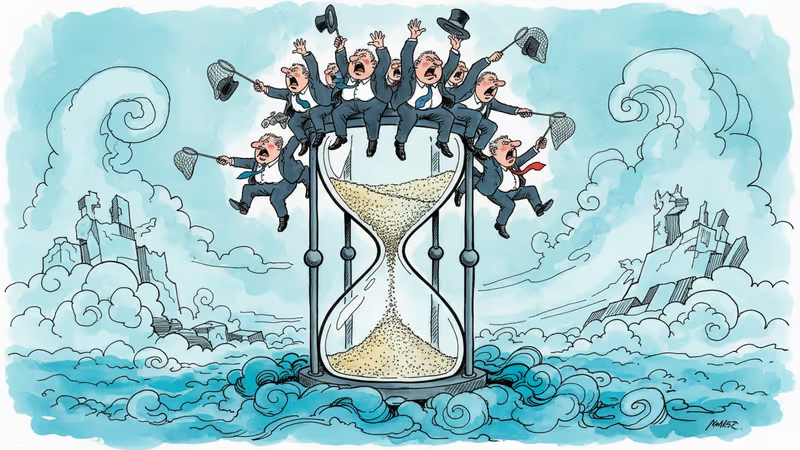
What if living to 120 isn't ambitious enough? What if the real goal should be living forever?
Last April, a crowd of true believers gathered in Berkeley, California, for the Vitalist Bay Summit—a three-day manifesto against mortality itself. Unlike typical longevity conferences focused on adding healthy years to life, this event had a more radical mission: spreading the gospel of Vitalism, a movement that considers death not just unfortunate, but fundamentally wrong.
Beyond Anti-Aging: The Death Abolition Movement
Nathan Cheng and Adam Gries didn't set out to create just another wellness trend. Their Vitalist movement represents something far more extreme—a philosophy demanding nothing short of total devotion to defeating death.
While mainstream longevity research aims to extend healthy lifespan by 20-30 years, Vitalists are playing a different game entirely. They're not interested in graceful aging or dignified death. They want to eliminate death altogether, viewing it as humanity's greatest enemy and most urgent problem to solve.
The movement's core belief is stark: if you're not dedicating your life to defeating death, you're not taking mortality seriously enough. It's longevity maximalism—and it's gaining momentum.
The Science Behind the Philosophy
Vitalists aren't just philosophical dreamers. They're betting on real scientific advances: telomere extension, cellular reprogramming, genetic therapies, and cryonic preservation. Recent breakthroughs in aging research have shown that biological clocks can be reversed, damaged cells can be rejuvenated, and lifespans can be significantly extended in laboratory settings.

But here's where mainstream scientists part ways with Vitalists. Most researchers see aging as a complex biological process that might be slowed or partially reversed. Vitalists see it as an engineering problem with a definitive solution.
OpenAI and other tech companies are already pouring resources into AI-assisted drug discovery for aging. Google's Calico division has invested billions in longevity research. The question isn't whether science will extend human lifespans—it's whether we can achieve the Vitalists' ultimate goal of making death optional.
The Uncomfortable Questions
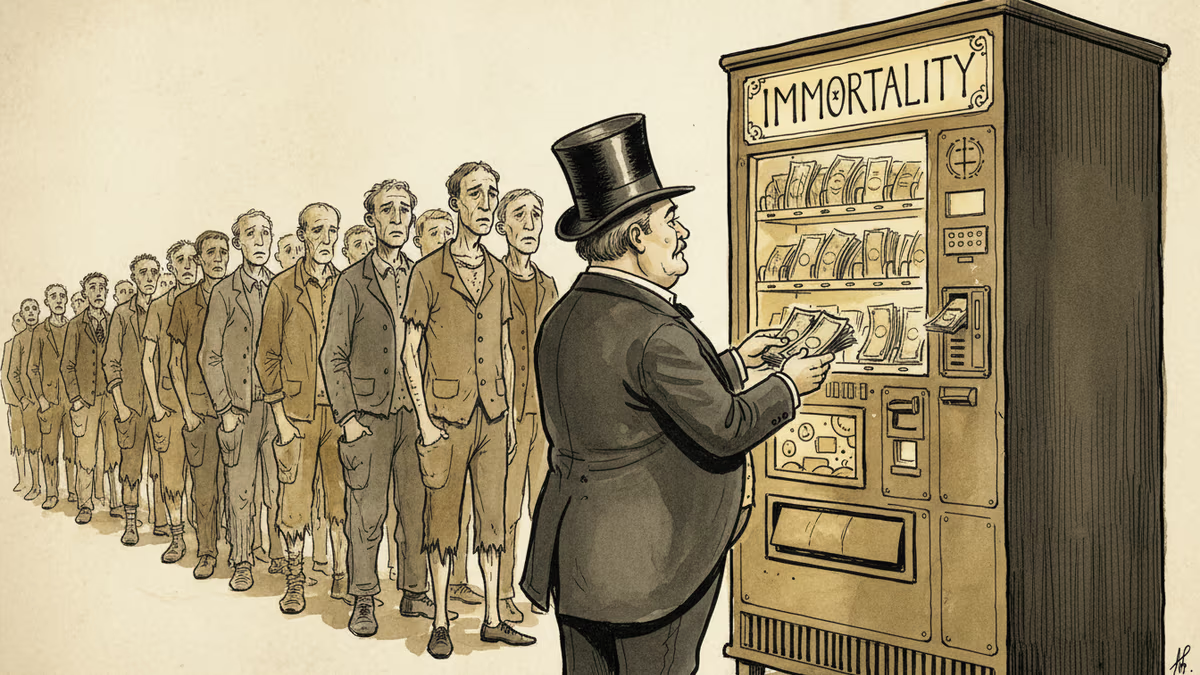
If Vitalists succeed, who gets to live forever? The technology will likely be expensive initially, creating a new form of inequality: the mortal and the immortal. Will death become a luxury only the poor can afford?
Consider the economic implications. Social Security, Medicare, retirement planning—entire systems built on the assumption of finite lifespans would collapse. If people work for 200 years instead of 40, how do we structure careers, education, and social mobility?
Then there's the philosophical puzzle: if death gives life meaning through scarcity, what happens to human motivation, creativity, and growth when time becomes infinite? Would immortal humans still innovate, take risks, or change their minds?
The Resistance to Radical Life Extension
Not everyone in the longevity space embraces the Vitalist vision. Many researchers worry that promising to defeat death entirely undermines more achievable goals like extending healthy lifespans or treating age-related diseases.
Religious and ethical concerns run deep. Many belief systems view death as natural, meaningful, or even sacred. Vitalists directly challenge these worldviews, arguing that accepting death is a form of moral failure.
There's also the resource question: should humanity's top priority really be keeping current humans alive indefinitely, or should we focus on ensuring future generations have a habitable planet?
Authors
Related Articles
Former fintech founder Bryan Johnson sells immortality program for $1M annually. Only three spots available. The ultra-wealthy longevity craze examined.

From Gwyneth Paltrow to Joe Rogan, everyone's talking NAD+. But can these supplements really slow aging, or are we chasing another wellness mirage?
The Vitalism movement, which considers death humanity's core problem, is gaining political influence in the US government, pushing for policy changes to advance longevity research and experimental drug access.

How the Vitalism movement is infiltrating US politics and biotech. Are these immortality seekers gaining real power?
Former fintech founder Bryan Johnson sells immortality program for $1M annually. Only three spots available. The ultra-wealthy longevity craze examined.
From Gwyneth Paltrow to Joe Rogan, everyone's talking NAD+. But can these supplements really slow aging, or are we chasing another wellness mirage?
The Vitalism movement, which considers death humanity's core problem, is gaining political influence in the US government, pushing for policy changes to advance longevity research and experimental drug access.
How the Vitalism movement is infiltrating US politics and biotech. Are these immortality seekers gaining real power?
Thoughts
Share your thoughts on this article
Sign in to join the conversation