
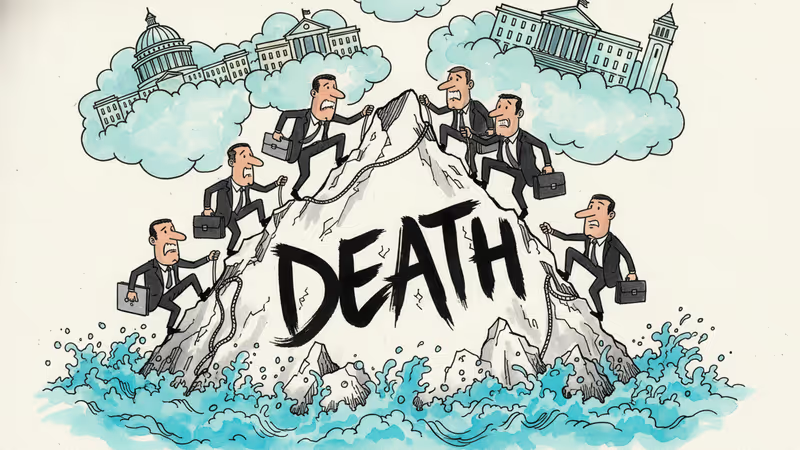
The Death-Deniers Taking Over Silicon Valley
How the Vitalism movement is infiltrating US politics and biotech. Are these immortality seekers gaining real power?
"Who here believes involuntary death is a good thing?"
Nathan Cheng's provocative question hung in the air as 80 people stared back at him. What followed was a pitch that death is bad—and defeating it should be humanity's number one priority, above everything else in our social and political hierarchy.
At April's Vitalist Bay Summit in Berkeley, California, Cheng and co-founder Adam Gries introduced 300 attendees to their movement: Vitalism. It's not your grandfather's life extension—it's a political revolution disguised as a biotech crusade.
Revolution, Not Evolution
Vitalism's core philosophy sounds deceptively simple: death is bad, life is good. But the execution strategy is anything but simple. They want to reshape government budgets, rewrite policies, and fundamentally alter how society prioritizes resources.
"The idea is to change the systems and priorities of society at the highest levels," Gries explained. This isn't about selling supplements or opening longevity clinics. It's about political transformation.
Gries, a tech entrepreneur who made a 50-fold return betting against companies during early COVID, used his newfound wealth to pursue what he calls life's purpose: "Life is the purpose of life." Cheng dropped out of a physics PhD after an "existential crisis" and pivoted to "radical longevity."
Both were inspired by Aubrey de Grey's 2005 TED talk predicting people could live to 1,000. That presentation, with 4.8 million views, became what Cheng calls "the OG longevity-pilling YouTube video."
From Lobbyists to Federal Officials
Here's where Vitalism gets interesting—and potentially concerning. They're not just recruiting billionaires and biotech CEOs. They're infiltrating government.
Mark Hamalainen, a science and engineering advisor at ARPA-H (the federal health research agency), openly identifies as a Vitalist. Jim O'Neill, deputy secretary of health and human services, previously served as CEO of a longevity foundation and represented Peter Thiel on its board.
"You don't have to convince the mainstream," Hamalainen says matter-of-factly. "Stalinism started small too. Sometimes you just have to convince the right people."

Their lobbying efforts are already paying off. Montana became the first state allowing experimental medical treatments after just preliminary safety tests—no proof they actually work required. New Hampshire expanded similar laws, with three more bills under consideration.
Gries claims "many people at [Health and Human Services], including all agencies, have a longevity-positive view." They're actively seeking federal positions that would control billions in funding.
The Money and Influence Game
Vitalism targets individuals with $10 million+ net worth as "high-leverage" people. Gries believes they only need to convert 3-4% of society—still hundreds of millions of people—to trigger revolution.
Their Vitalism International Foundation recruits "mobilized Vitalists" for $29+ monthly contributions. 16 biotech companies are now certified "Vitalist organizations"—with certification revoked if they "adopt apologetic narratives that accept aging or death."
AgelessRx CEO Anar Isman boasts "$60+ million in annual revenue" selling purported longevity drugs. He sees each customer as an opportunity to "evangelize" about "radical life extension." His goal? Living "at least 100 more" years.
Shift Bioscience, another certified Vitalist company, uses CRISPR to identify aging-reversal genes. Co-founder Daniel Ives keeps a countdown on his computer: "my days till death"—about 22,000 left.
The Regulatory Rollback
What makes Vitalism potentially dangerous isn't just their ambitions—it's their success in weakening oversight. Montana's new law lets clinics sell experimental treatments after basic safety tests, regardless of efficacy.
Ethicists worry about selling "treatments" without knowing if they help patients. But Vitalists frame this as bodily autonomy and hope Montana is "just the start."
The movement's influence extends beyond fringe conferences. Last year's Aging Research and Drug Discovery conference—the field's most important meeting—was sponsored partly by Vitalist organizations.
The Philosophical Problem
Beyond regulatory concerns lies a deeper question: Should we even want to defeat death?
Sergio Imparato, a Harvard medical ethicist, argues death gives life meaning. "Our actions have value precisely because our time is limited," he says. Vitalists are "ultimately seeking to change what it means to be human—a decision that should involve all members of society."
Alberto Giubilini from Oxford agrees: "Death is a defining feature of humanity. Our psychology, cultures, rituals, societies are built around coping with death."
Gries seems aware of the stigma, instructing Vitalists to avoid words like "eternity," "radical," and "forever." He's also dropped public references to Vitalism as a "moral" movement, though the underlying philosophy remains unchanged.
Authors
Related Articles
Indian venture capital has quietly displaced Silicon Valley in its own backyard. Only one American VC made India's top 10 investor list last year. Here's why that matters beyond India.

After two weeks of witnesses calling him a liar, OpenAI CEO Sam Altman testified in his own defense, claiming Elon Musk tried to kill the company twice.
OpenAI CEO Sam Altman's San Francisco residence was attacked twice in three days — first a Molotov cocktail, then a shooting. What does this say about tech power, public anger, and the real-world risks facing AI leaders?

In CA-17, tech founder Ethan Agarwal is challenging five-term incumbent Ro Khanna — backed by billionaires opposed to a wealth tax. It's already getting dirty.
Indian venture capital has quietly displaced Silicon Valley in its own backyard. Only one American VC made India's top 10 investor list last year. Here's why that matters beyond India.
After two weeks of witnesses calling him a liar, OpenAI CEO Sam Altman testified in his own defense, claiming Elon Musk tried to kill the company twice.
OpenAI CEO Sam Altman's San Francisco residence was attacked twice in three days — first a Molotov cocktail, then a shooting. What does this say about tech power, public anger, and the real-world risks facing AI leaders?
In CA-17, tech founder Ethan Agarwal is challenging five-term incumbent Ro Khanna — backed by billionaires opposed to a wealth tax. It's already getting dirty.
Thoughts
Share your thoughts on this article
Sign in to join the conversation