
Musk's Moon Factory Plan: Genius Pivot or Expensive Distraction?
After xAI-SpaceX merger, Elon Musk wants to build AI satellites on the moon and shoot them into deep space. Is this the future of computing or just good PR?
$4 Billion Changed Everything
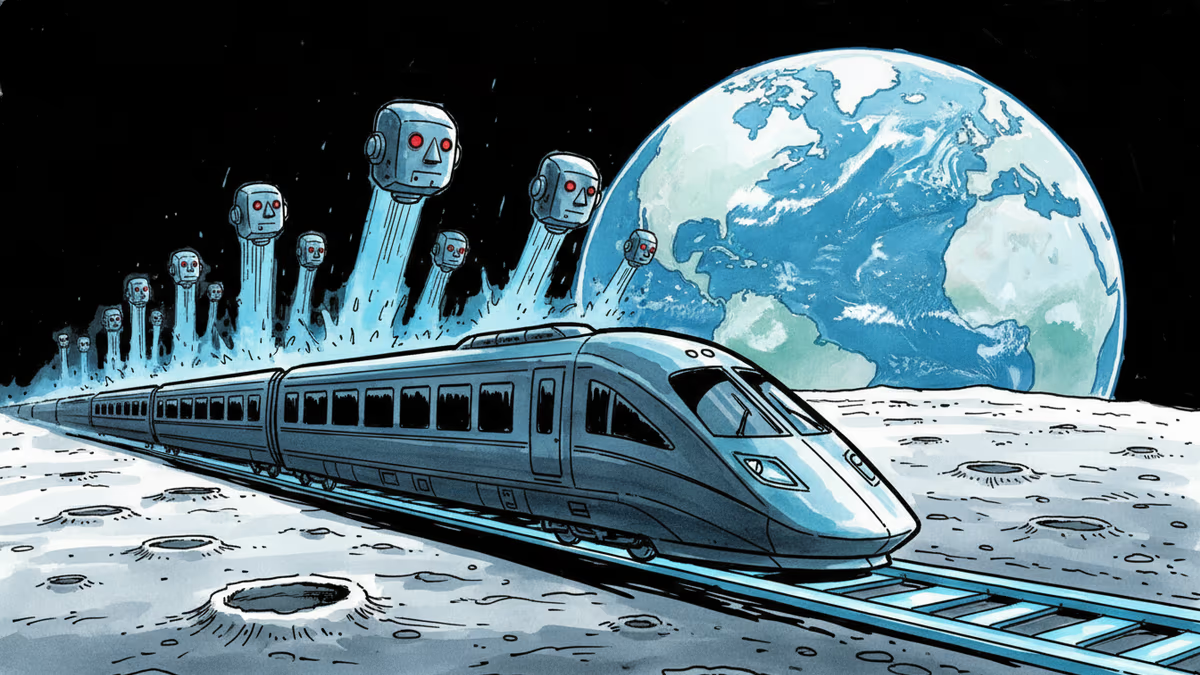
"Join xAI if the idea of mass drivers on the Moon appeals to you," Elon Musk told his staff yesterday. Not AGI breakthroughs. Not disrupting Google. Moon-based railguns shooting AI satellites into deep space. After xAI's merger with SpaceX and ahead of their combined IPO, Musk has a new recruitment pitch that sounds ripped from a sci-fi novel.
But here's the thing: The man who once promised Mars colonies by 2024 has quietly shifted focus. The clue? SpaceX's $4 billion NASA contract to land astronauts on the moon. Mars doesn't pay the bills. The moon does.
From Red Planet Dreams to Lunar Reality
Remember 2016? Musk unveiled Starship as humanity's Mars taxi, complete with "Occupy Mars" merch and grand visions of interplanetary civilization. Fast forward to 2025: Mars landing plans were scrapped due to technical challenges and costs. Starship now focuses on profitable ventures—Starlink satellite deployments and NASA's lunar missions.
The shift became obvious in Musk's latest presentation. Gone were the Mars colony renderings that used to cap every SpaceX pep talk. In their place: moon base concept art and talk of the Kardashev Scale—a 1960s framework measuring civilizations by their energy consumption.
"What if you want to go beyond a mere terawatt per year?" Musk asked his team. "To do that, you have to go to the moon." His vision: Harness "maybe even a few percent of the sun's energy" to train AI models of unprecedented scale.
The Economics of Cosmic Computing
Musk's moon factory isn't pure fantasy. Experts believe space-based chip manufacturing could become viable in the 2030s. Microgravity environments offer advantages for precision components, and several startups are already experimenting with orbital manufacturing.

But the math is daunting:
- Current launch costs: $10,000+ per kilogram to lunar orbit
- Raw materials must be sourced on the moon or shipped from Earth
- A "self-sustaining city" requires massive infrastructure investment
- Mass drivers need significant power generation and construction
Even Musk admits this is a "stretch goal" requiring dramatically cheaper space access—the holy grail his own company has been chasing for decades.
Why Investors Should Pay Attention
As one departing xAI executive noted: "All AI labs are building the exact same thing, and it's boring." Solar system-scale supercomputers? Definitely not boring. And definitely not the same thing.
This matters for SpaceX's upcoming IPO. Tesla's valuation has always been about vision over fundamentals—investors bought the electric future, not just car sales. Now SpaceX needs its own compelling narrative beyond satellite internet and government contracts.
The timing makes sense. AI demand is exploding while Earth-based data centers face power grid constraints and cooling challenges. Orbital data centers could solve both problems, especially if launch costs continue falling. The moon base? That's the 10x vision that separates SpaceX from Boeing.
Three Perspectives on Musk's Lunar Gambit
Engineers: Mixed reactions. Some are energized by technically challenging problems that push boundaries. Others worry about resource allocation—shouldn't SpaceX perfect Mars missions before tackling lunar manufacturing?
Investors: Cautiously optimistic. The xAI merger creates potential synergies, and space-based computing addresses real market needs. But execution risk is enormous, and Musk's timeline predictions have been... optimistic.
Competitors: Watching closely. Amazon's Blue Origin and Microsoft's cloud ambitions suddenly look conservative. If Musk succeeds, he could dominate both space launch and AI computing markets.
Authors
Related Articles
American Airlines just signed Starlink for 500+ aircraft. It's not just about faster inflight internet — it's a calculated move in the run-up to what could be the largest IPO in history.
SpaceX's upgraded Starship V3 completed its first test flight, deploying 20 Starlink simulators but losing the Super Heavy booster. With an IPO weeks away, the stakes just got higher.
SpaceX's IPO filing puts AI at the center, claiming a $26.5 trillion market opportunity. But can Grok compete with OpenAI and Anthropic for enterprise customers?
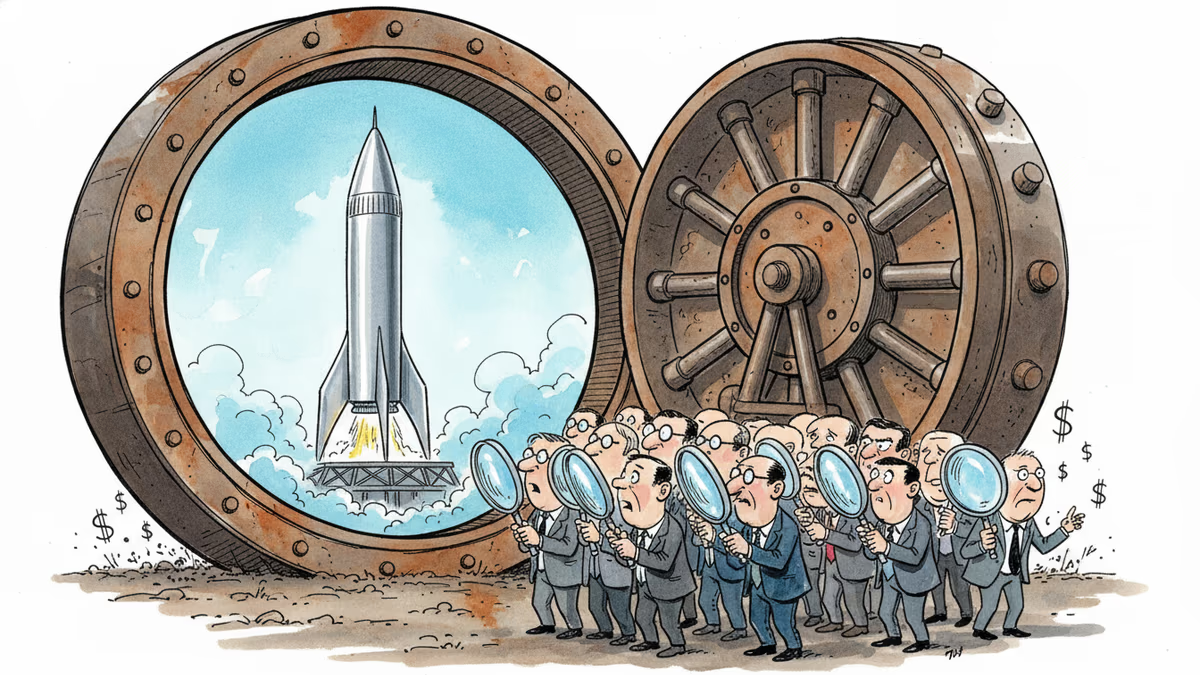
SpaceX filed a nearly 400-page S-1 with the SEC, targeting an IPO as early as June 12. Here's what the filing reveals—and what it doesn't.
American Airlines just signed Starlink for 500+ aircraft. It's not just about faster inflight internet — it's a calculated move in the run-up to what could be the largest IPO in history.
SpaceX's upgraded Starship V3 completed its first test flight, deploying 20 Starlink simulators but losing the Super Heavy booster. With an IPO weeks away, the stakes just got higher.
SpaceX's IPO filing puts AI at the center, claiming a $26.5 trillion market opportunity. But can Grok compete with OpenAI and Anthropic for enterprise customers?
SpaceX filed a nearly 400-page S-1 with the SEC, targeting an IPO as early as June 12. Here's what the filing reveals—and what it doesn't.
Thoughts
Share your thoughts on this article
Sign in to join the conversation