
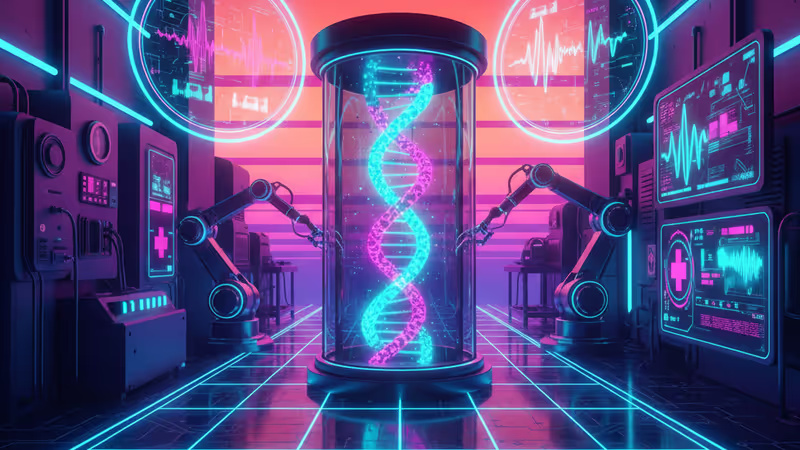
Moderna Merck mRNA Cancer Vaccine Results: 50 Percent Risk Reduction
Moderna and Merck's mRNA cancer vaccine combined with Keytruda reduced melanoma recurrence risk by 50% in a 5-year study. Read the latest Phase 2 trial insights.
The fight against cancer just took a massive leap forward. Moderna and Merck recently shared updated data from a small clinical trial showing their customized mRNA cancer vaccine reduced the risk of recurrence or death by nearly 50% over 5 years. It's a significant milestone for the experimental therapy known as mRNA-4157 (V940).
Analyzing the Moderna Merck mRNA Cancer Vaccine Results
The Phase 2 trial focused on 157 patients with Stage 3 or Stage 4 melanoma. These individuals faced a high risk of the cancer returning even after surgical removal. According to the companies, the latest results align with earlier data collected at the two-year and three-year marks, suggesting the vaccine's benefits are durable over the long term.

How mRNA-4157 Works with Keytruda
The treatment combines the customized vaccine with Merck's immunotherapy drug, Keytruda. While Keytruda unmasks cancer cells so the immune system can attack them, the mRNA vaccine goes a step further. It's tailored to the specific genetic mutations of a patient's tumor, essentially training T-cells to recognize and destroy those unique targets. This dual-action approach is what makes the results so promising.
Authors
Related Articles
FDA refuses to review Moderna's mRNA flu vaccine application, marking a shift in vaccine policy under RFK Jr's leadership

Five stories from late September, traced to where the paper trail stops: Korea's export record, Nvidia's Hugging Face 8-K, a US-China AI channel, the UN on AI, and rising births.

Huawei's CANN is open source under a license barring software for non-Ascend chips. Inside China's second CUDA, and the two links still outside it: pre-training compute and 5nm capacity.
Samsung Electronics' union branch revealed that 84% of survey respondents oppose the government's roughly $290 billion (₩400 trillion) semiconductor megaproject in Gwangju. Government, management, the union and shareholders are all reading the same national project in sharply different ways.
FDA refuses to review Moderna's mRNA flu vaccine application, marking a shift in vaccine policy under RFK Jr's leadership
Five stories from late September, traced to where the paper trail stops: Korea's export record, Nvidia's Hugging Face 8-K, a US-China AI channel, the UN on AI, and rising births.
Huawei's CANN is open source under a license barring software for non-Ascend chips. Inside China's second CUDA, and the two links still outside it: pre-training compute and 5nm capacity.
Samsung Electronics' union branch revealed that 84% of survey respondents oppose the government's roughly $290 billion (₩400 trillion) semiconductor megaproject in Gwangju. Government, management, the union and shareholders are all reading the same national project in sharply different ways.
Thoughts
Share your thoughts on this article
Sign in to join the conversation