
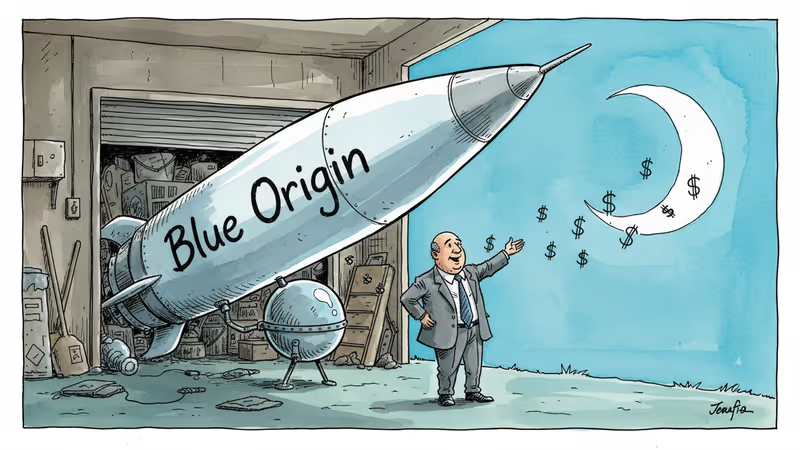
Why Jeff Bezos Just Hit Pause on Space Tourism
Blue Origin halts space tourism for two years to focus on moon missions. Can Bezos catch up to SpaceX in the new space race? What this shift means for the industry.
Jeff Bezos just made a bet that could define his space legacy. Blue Origin announced Friday it's suspending space tourism flights for "no less than two years" to focus entirely on moon missions—abandoning a program that's been its primary revenue source for half a decade.
The timing isn't coincidental. With President Trump pushing for lunar landings before his term ends, the space industry's priorities are shifting fast.
The Numbers Behind the Pivot
Blue Origin's New Shepard rocket has completed 38 flights, carrying 98 humans past the Kármán line and delivering over 200 scientific payloads. For 10 years, it held the distinction of being the first rocket to reach space and land safely back on Earth.
But here's the limitation that's been haunting Bezos: unlike SpaceX's Falcon 9, New Shepard can't reach Earth orbit. Its passengers get just four minutes of weightlessness before coming back down. That's a tough sell when your competitor is launching astronauts to the International Space Station.
The program also faced a year-long grounding after a booster explosion in 2022. While no humans were aboard and the capsule safely ejected, the incident highlighted the challenges of maintaining consistent operations in the space tourism business.
Trump's Moon Shot Changes Everything
The political landscape has shifted dramatically since Trump's return to office. His administration's aggressive push for lunar missions has opened doors for companies beyond SpaceX to compete for lucrative government contracts.

"The decision reflects Blue Origin's commitment to the nation's goal of returning to the Moon and establishing a permanent, sustained lunar presence," the company stated. Translation: government contracts are more reliable than billionaire tourists.
Blue Origin's robotic lunar lander is currently undergoing testing at NASA's Johnson Space Center in Texas, though it's not yet ready for the upcoming New Glenn rocket launch in late February.
The Strategic Calculus
This move reveals something crucial about the space industry's evolution. Space tourism, while glamorous, remains a niche market with high costs and limited capacity. Meanwhile, lunar missions represent billions in potential government contracts and the foundation for long-term space infrastructure.
For Bezos, who's poured over $1 billion annually into Blue Origin, this isn't just about business—it's about legacy. His vision of moving heavy industry off Earth to preserve the planet requires serious space infrastructure, not joy rides for the wealthy.
The decision also reflects harsh competitive realities. While Blue Origin was perfecting suborbital tourism, SpaceX was revolutionizing orbital launches, satellite deployment, and crew missions. Bezos is essentially admitting he needs to catch up where it matters most.
What This Means for Space Tourism
The pause leaves Virgin Galactic as the primary player in suborbital space tourism, though that company has faced its own operational challenges. The broader question is whether space tourism will remain a viable business model or become a footnote in space industry history.
For the 98 people who've flown on New Shepard, they may have experienced something that becomes increasingly rare—at least from Blue Origin. The company hasn't ruled out returning to tourism, but two years in the space industry is an eternity.
Authors
Related Articles
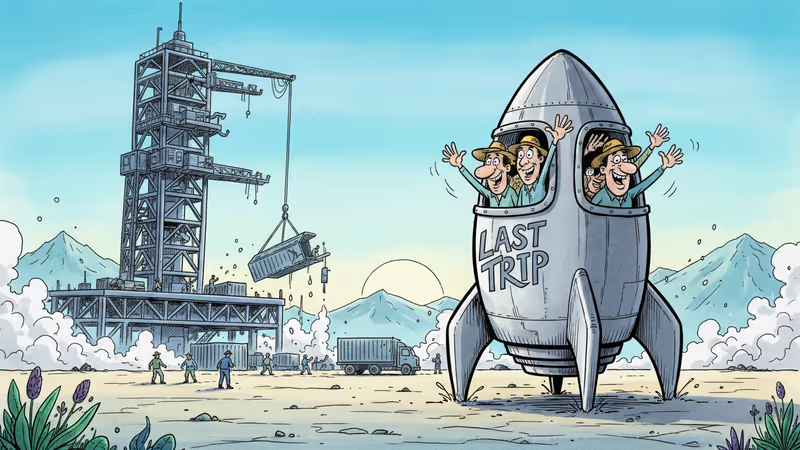
Jeff Bezos' Blue Origin pauses New Shepard space tourism program for two years, marking likely end of 25-year-old company's longest-running initiative
NASA Administrator Jared Isaacman has declared full confidence in the Orion heat shield after a rigorous safety review, greenlighting upcoming lunar missions.

Five stories from late September, traced to where the paper trail stops: Korea's export record, Nvidia's Hugging Face 8-K, a US-China AI channel, the UN on AI, and rising births.

Huawei's CANN is open source under a license barring software for non-Ascend chips. Inside China's second CUDA, and the two links still outside it: pre-training compute and 5nm capacity.
Jeff Bezos' Blue Origin pauses New Shepard space tourism program for two years, marking likely end of 25-year-old company's longest-running initiative
NASA Administrator Jared Isaacman has declared full confidence in the Orion heat shield after a rigorous safety review, greenlighting upcoming lunar missions.
Five stories from late September, traced to where the paper trail stops: Korea's export record, Nvidia's Hugging Face 8-K, a US-China AI channel, the UN on AI, and rising births.
Huawei's CANN is open source under a license barring software for non-Ascend chips. Inside China's second CUDA, and the two links still outside it: pre-training compute and 5nm capacity.
Thoughts
Share your thoughts on this article
Sign in to join the conversation