
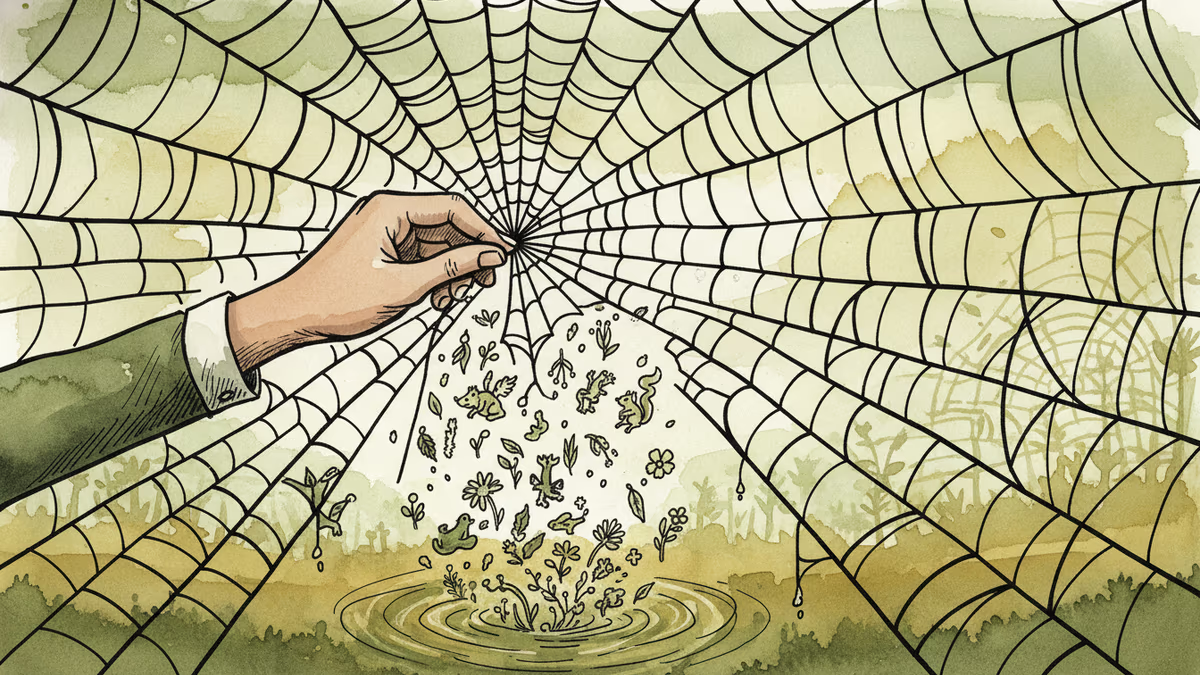
15 Ways Humans Accidentally Rewired Nature
From wolves changing rivers to light pollution scrambling sea turtles, the unintended consequences of human activity reveal how deeply—and unpredictably—we've altered the natural world.
In 1995, wildlife managers released 14 wolves into Yellowstone National Park. Nobody planned to reroute a river. But that's exactly what happened.
One Pull, a Thousand Ripples
The wolves reduced elk populations near riverbanks. With less grazing pressure, vegetation recovered. Plant roots stabilized eroding banks. Rivers literally changed course. Scientists now call this a trophic cascade—a chain reaction so counterintuitive it reads like a nature documentary plot twist. It's also one of the cleaner examples of how human intervention, even well-intentioned restoration, produces outcomes nobody mapped in advance.
The messier examples run in the other direction. Cats have lived alongside humans for nearly 10,000 years, but feral populations in Australia and New Zealand became ecological wrecking balls. New Zealand's feral cats kill an estimated 1 billion native animals per year. The beloved household companion is, in another ecosystem, an invasive predator driving endemic birds toward extinction. Context determines everything.
Then there's light pollution—the quietest disruption on the list. Artificial lighting has thrown off migratory bird navigation, altered coral reef spawning cycles, and sent newly hatched sea turtles crawling toward highway streetlights instead of the ocean. The night sky that guided hundreds of millions of years of evolution has, in roughly a century, been functionally erased for large portions of the planet's surface.
The Numbers Behind the Stories
These aren't isolated curiosities. The scale is measurable.
Approximately 75% of Earth's land surface has been significantly altered by human activity. Freshwater species populations have declined by 83% since 1970. In parts of Europe and North America, flying insect biomass has dropped by up to 75% over the past few decades—a figure that matters because insects underpin most terrestrial food webs.

Agricultural nitrogen is a case study in second-order consequences. The synthetic fertilizers that enabled the 20th century's food production surge also leached into waterways at scale. The resulting algae blooms strip oxygen from water, creating dead zones where marine life cannot survive. The Gulf of Mexico's dead zone has reached roughly 20,000 km² in peak years. The same chemistry that feeds billions quietly suffocates ocean floors downstream.
DDT offers perhaps the starkest historical example. Deployed aggressively in the 1940s and '50s to combat malaria, it saved millions of lives—and simultaneously bioaccumulated up the food chain, thinning the eggshells of raptors and pushing bald eagles and peregrine falcons toward extinction. Rachel Carson documented the mechanism in 1962. The science was available. The course correction took decades.
The Pattern Underneath
What connects wolves and DDT and nitrogen runoff and light pollution isn't carelessness. In almost every case, humans acted with clear, rational goals: protect livestock, prevent disease, grow food, extend productive hours. The problem is that natural systems don't honor the boundaries of human intent.
Ecologists call this the law of unintended consequences, but that framing can make it sound like bad luck. It's more structural than that. Complex systems—ecological, economic, social—have feedback loops that aren't visible until they're triggered. The more powerful the intervention, the longer and less predictable the chain of effects.
Climate change sits at the extreme end of this spectrum. No industrialist in 1850 was trying to acidify the oceans or bleach coral reefs. They were trying to power looms and heat homes. The consequences now unfolding are the largest unintended experiment in human history—and unlike the Yellowstone wolves, there's no obvious lever to pull to reverse it.
Who Pays the Cost?
The economic dimension is worth naming directly. The ecological services that healthy ecosystems provide—pollination, water filtration, flood control, carbon sequestration—are estimated to be worth $125–140 trillion per year globally, roughly 1.5 times global GDP. When those services degrade, the costs don't disappear; they get redistributed, usually onto the people least able to absorb them: subsistence farmers, coastal communities, low-income populations dependent on fisheries.
The companies and industries that generate the disruptions rarely bear those costs directly. That gap—between who causes the damage and who pays for it—is arguably the central unresolved problem in environmental economics.
This content is AI-generated based on source articles. While we strive for accuracy, errors may occur. We recommend verifying with the original source.
Related Articles
OpenAI CEO dismisses water usage claims as "fake" while comparing AI energy consumption to human training costs. Is the AI-human efficiency debate missing the point?
Brazilian researchers reveal a disturbing trend as deforestation forces mosquitoes to increasingly target humans, raising disease transmission risks worldwide.
The Bank of Korea lifted its benchmark rate a quarter-point to 2.75%, its first increase in three and a half years. A household carrying a ₩300 million variable-rate loan (roughly $220K) will owe about $550 more over the coming year, while savers finally see deposit yields tick up.
Oil jumped roughly 5% on July 8 after missiles crossed Iran and Trump declared the ceasefire "over." Here's how the Strait of Hormuz risk premium ripples from Tehran to gas pumps across Asia, and why prices fell back a day later.
OpenAI CEO dismisses water usage claims as "fake" while comparing AI energy consumption to human training costs. Is the AI-human efficiency debate missing the point?
Brazilian researchers reveal a disturbing trend as deforestation forces mosquitoes to increasingly target humans, raising disease transmission risks worldwide.
The Bank of Korea lifted its benchmark rate a quarter-point to 2.75%, its first increase in three and a half years. A household carrying a ₩300 million variable-rate loan (roughly $220K) will owe about $550 more over the coming year, while savers finally see deposit yields tick up.
Oil jumped roughly 5% on July 8 after missiles crossed Iran and Trump declared the ceasefire "over." Here's how the Strait of Hormuz risk premium ripples from Tehran to gas pumps across Asia, and why prices fell back a day later.
Thoughts
Share your thoughts on this article
Sign in to join the conversation