
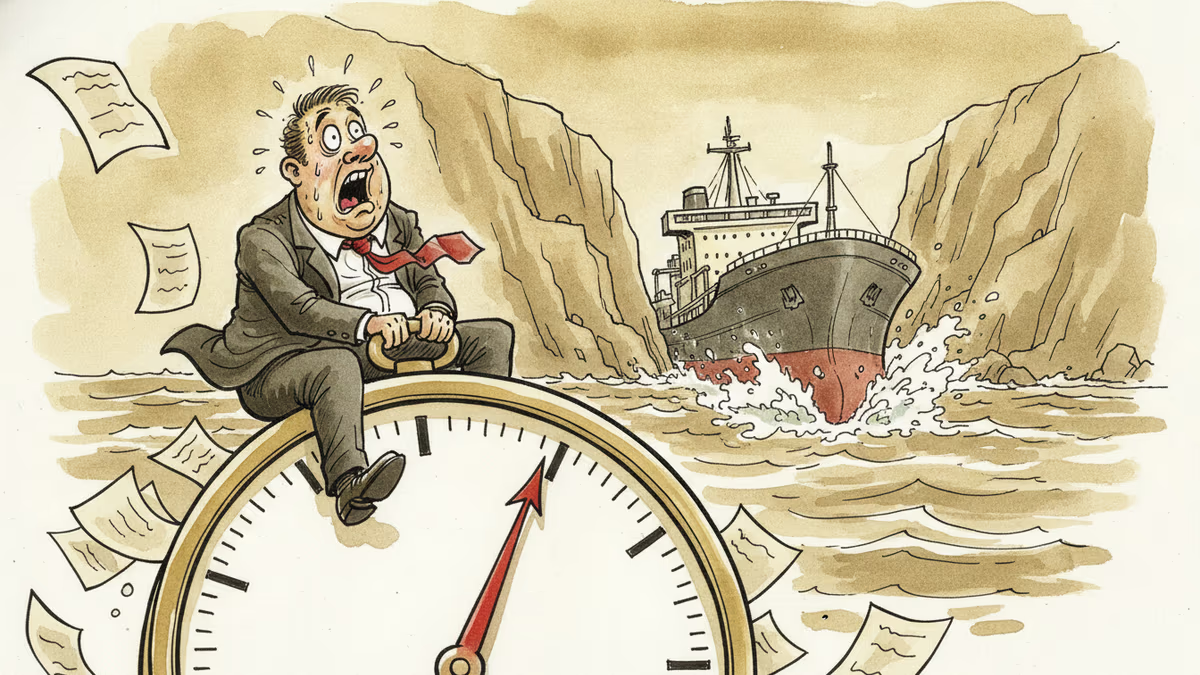
Why a Night of Missiles Over Iran Moved Gas Prices from Seoul to Tokyo
Oil jumped roughly 5% on July 8 after missiles crossed Iran and Trump declared the ceasefire "over." Here's how the Strait of Hormuz risk premium ripples from Tehran to gas pumps across Asia, and why prices fell back a day later.
Why a Night of Missiles Over Iran Moved Gas Prices in Seoul
Missiles crossed Iranian skies on the night of July 8. Thousands of kilometers east, the number that moved fastest was the one on gas-station price boards in Seoul and Tokyo.
On July 8, 2026, crude oil spiked in a single session. Brent settled 5.2% higher at $78.02 a barrel, and West Texas Intermediate (WTI) rose 4.4% to $73.52 (July 8 settlement, per CNBC data). At one point during the day, Brent traded around $80, roughly 8% above the previous close. Markets have run this play before, every time gunfire echoes in the Middle East. What made this round different was the trigger.
The Chokepoint That Carries a Fifth of the World's Oil
It comes down to one point on the map: the Strait of Hormuz, the narrow passage linking the Persian Gulf to the Gulf of Oman.
According to the US Energy Information Administration (EIA), roughly 20% of global oil consumption passes through this thin waterway, along with 25% to 27% of all seaborne crude. That single bottleneck carries a fifth of the world's daily supply, which is why traders in London and New York track it as closely as refiners in Asia do.
And the bottleneck is already tightening. Traffic through Hormuz ran about 20.9 million barrels a day before the war; by the first quarter of 2026 it had fallen to 14.6 million (EIA), a drop of nearly 30%. The strait is not blocked. But the market tenses at the mere possibility that it could be.
The surge on July 8 came with a political trigger layered on top. At a NATO summit in Turkey, US President Donald Trump declared that the ceasefire with Iran was "over" (as reported by CNN and The Washington Post). A day earlier, on July 7, the US Treasury had revoked licenses for the sale of Iranian oil (per CNN and CNBC). Signals of tightening supply hit the market one after another.
The scale of the military clash is disputed. US Central Command (CENTCOM) said it had struck about 90 targets inside Iran, but that figure has not been independently verified. Iran claimed it had retaliated against 85 sites in Bahrain and Kuwait. Underneath it all run rumors of the death of Supreme Leader Ali Khamenei; his reported likely successor, Mojtaba, is said to have stayed out of public view recently, though the succession itself remains officially unconfirmed. For all that intrigue, the spike traced back to something physical rather than political: the flow of oil through Hormuz.
The Strait Never Closed. Prices Jumped Anyway.

Hormuz was never blockaded, and prices climbed anyway. That gap is the whole story.
No tanker was turned back and no cargo went missing; traders were paying up for a scenario, and the scenario carried a number. The next day made the point. As expectations spread that a wider war could be avoided, oil gave back most of its July 8 gain on July 9. Nothing in the physical supply picture had changed overnight, only the market's estimate of how likely escalation was. Some analysts think the initial move overshot whatever real disruption was ever on the table.
Saul Kavonic, an analyst at MST Financial, expects Iran to spend the coming weeks tightening its grip on Hormuz (as reported by Al Jazeera). As long as whoever controls the strait keeps the option to throttle traffic on the table, the risk premium will not fade easily.
One Strait, Different Shocks: How Exposed Asia's Big Three Are
The same chokepoint lands differently in each economy. Line up how much Asia's major importers lean on Hormuz and the gap is stark.
| Country | Hormuz dependence | Buffer |
|---|---|---|
| Japan | Over 90% of crude imports | Weak yen amplifies the shock (up to 2.2x, by one estimate) |
| South Korea | ~68% (estimated) | ~200 days of strategic reserves; 34.4% of naphtha sourced from the Middle East |
| China | ~40–50% (estimated) | ~1.4 billion barrels in total reserves; yuan-settled shipments add a cushion |
Japan is the most exposed. More than 90% of its crude imports pass through Hormuz, and with a weak yen on top, the same oil-price rise gets amplified up to 2.2 times in local-currency terms, according to estimates from Japan's Nomura Research Institute and Dai-ichi Life. South Korea's dependence is estimated at around 68%, but roughly 200 days of strategic petroleum reserves buy it time. The catch: 34.4% of its naphtha, a core petrochemical feedstock, comes from the Middle East (per Korea's KIEP), so the shock can spread into industrial costs too. China's dependence is comparatively lower, and with reserves of about 1.4 billion barrels (per Columbia University's Center on Global Energy Policy, among others) and yuan-settled shipments, its buffer is the thickest of the three. (Dependence and reserve figures are a mix of estimates that vary by institution.)
The Winner Across the Pacific: US Shale
Not everyone loses when oil climbs. Across the Pacific, US shale sits on the winning side of the trade.
Its breakeven price generally runs around $62 to $70 a barrel, and WTI at $73.52 clears that comfortably. Above breakeven, producers have a reason to pump more, so while Asian refiners absorb higher input costs, American drillers start pricing out the next well. The lag is the problem: a drilling decision takes months to become actual barrels. Shale cannot cool today's risk premium; it answers a slower clock.
Two Forces Pulling Oil Both Ways
Two forces now pull oil in opposite directions. One is the risk premium on a Hormuz blockade. The other is the combination of hopes that escalation gets contained and the spare capacity of US shale. July 8 and July 9 were the opening round of that contest.
As long as traffic stays pinned near 70% of pre-war levels, a single Hormuz headline can still swing the price. And the tremor reaches the price boards in Seoul and Tokyo within hours of leaving Tehran.
This content is AI-generated based on source articles. While we strive for accuracy, errors may occur. We recommend verifying with the original source.
Related Articles
Crude prices stabilized on hopes of a deal to reopen the Strait of Hormuz. Here's what's really at stake, who wins, who loses, and why the calm may not last.
Oil prices are whipsawing on mixed signals about the Strait of Hormuz. With 20% of global seaborne oil flowing through a 39km chokepoint, here's what's actually at stake—and for whom.

Korea logged 24,275 births in July. Taiwan and China fell by double digits; Japan reads two ways. We ask whether the rebound is cohort size or policy.
Trump said South Korea will invest up to $200 billion. The joint US-Korea fact sheet prices two projects, gas power and nuclear. Alaska LNG has no figure.
Crude prices stabilized on hopes of a deal to reopen the Strait of Hormuz. Here's what's really at stake, who wins, who loses, and why the calm may not last.
Oil prices are whipsawing on mixed signals about the Strait of Hormuz. With 20% of global seaborne oil flowing through a 39km chokepoint, here's what's actually at stake—and for whom.
Korea logged 24,275 births in July. Taiwan and China fell by double digits; Japan reads two ways. We ask whether the rebound is cohort size or policy.
Trump said South Korea will invest up to $200 billion. The joint US-Korea fact sheet prices two projects, gas power and nuclear. Alaska LNG has no figure.
Thoughts
Share your thoughts on this article
Sign in to join the conversation