
AI Capex Bubble? Big Tech Free Cash Flow Heads to Zero
Epoch AI says Big Tech's combined free cash flow hits zero by Q3 2026 as AI capex outpaces cash. Compare the bubble and bull case—and check your 401(k).
Big Tech Is Spending Cash Three Times Faster Than It Earns It — The Summer Free Cash Flow Heads Toward Zero
If your paycheck grows but your spending grows three times faster, when does the account hit zero?
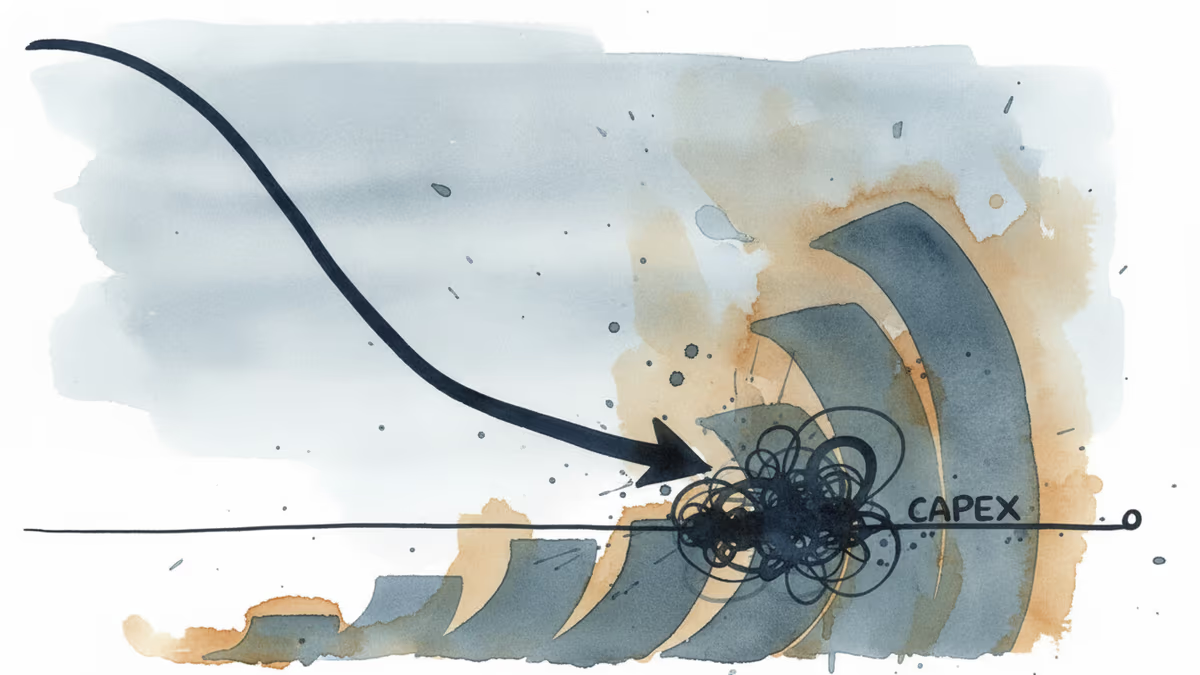
On June 16, the research group Epoch AI put a date on it: the third quarter of this year. Working from the SEC quarterly filings (10-Qs) of the five biggest hyperscalers — Microsoft, Amazon, Alphabet, Meta and Oracle — Epoch fit two trend lines. Operating cash flow is climbing roughly 23% a year. Capital spending on AI data centers and GPUs is climbing roughly 70% a year. Extend those lines at that pace, and the group's combined free cash flow (FCF) touches zero sometime in Q3 2026. The report landed right as a late-June selloff swept global markets, and suddenly a wonky question — "Is AI infrastructure spending sustainable?" — was sitting in the middle of the trading floor.
Let's clear up one thing first. "Combined FCF hits zero" is not five companies running out of cash at once. Epoch's figure is a trend estimate for the net free cash of the five added together, not for any single firm. In reality only Oracle and Amazon have actually crossed the line where spending outruns cash generation. By Epoch's crossover estimates, Oracle is already past it, Amazon is roughly at it now, Alphabet gets there around Q1 2027, Meta around Q3 2027, and Microsoft not until Q3 2028. So the accurate read isn't "Big Tech's cash has dried up." It's "the center of gravity of the combined line is drifting toward zero."
The bear case: the capital lands before the demand is proven
For the people warning about a bubble, the core issue is how the spending gets funded. Until recently, Big Tech paid for its investments out of the cash its core businesses threw off. But once the capex curve passes the cash curve, the gap has to come from somewhere. Epoch put it plainly: to keep this up, these companies would have to "draw down cash reserves or raise money by other means, such as borrowing or issuing new shares." In other words, they've started building data centers with debt and dilution instead of retained earnings.
The numbers get sharper up close. Amazon's trailing-twelve-month FCF is reckoned to have fallen from around $38 billion to roughly $1.2 billion — a drop of about 95%. Morgan Stanley pegs Amazon's full-year 2026 FCF at negative $17 billion; Barclays sees Meta's 2026 FCF falling about 90% (these are broker estimates, not company figures). And Sequoia Capital's David Cahn — who calculated an annual "$600 billion revenue gap," the shortfall between the revenue needed to justify all this AI spending and the revenue actually showing up — argues that in 2026 the gap is widening rather than closing.
Bears point to the late-June selloff as Exhibit A. Earnings themselves beat consensus, yet the market sold anyway, fixated on payback — how long before the money comes back. After reporting, Meta slid about 6% and Microsoft about 2.5%. When good results still knock the stock down, it means the market is watching cash, not profit.
The bull case: customers are actually paying

The other side pushes back: this money isn't being sprayed into thin air. Their evidence is the measured growth in cloud revenue. On Q1 2026 results, AWS was running at roughly $150 billion annualized, up about 28% year over year — its fastest growth in 15 quarters. Google Cloud grew 63%. Microsoft's Azure AI business hit a run-rate near $37 billion, growing 123%. Microsoft says more than 65% of the Fortune 500 were using its Azure OpenAI service as of early 2026, and backlogs — contracted-but-not-yet-recognized revenue — keep climbing. If that isn't demand, bulls ask, what is?
There's a "this isn't the dot-com bust" argument too. Unlike the telecom carriers that blew up in 2000, today's hyperscalers are profitable, cash-generating giants, and data centers carry long lead times — so the capex being poured in now is really pre-buying three to five years of future capacity. C.C. Wei, chairman of Taiwan's TSMC (the contract chipmaker that fabricates most of the world's advanced AI silicon), said that after talking with the major cloud providers, "concrete data" confirmed AI was genuinely helping their businesses. He also added, "honestly, I'm very nervous too." Even the people defending the demand can't fully shake the unease.
The bulls' strongest defensive card is accounting itself. Capex doesn't hit the books as an expense the moment it's spent. It's depreciated over several years. So even when FCF collapses, net income doesn't necessarily fall at the same speed. "FCF got cut in half" and "the company swung to a loss" are two very different sentences — a distinction that often goes missing in selloff coverage.
Same AI boom, opposite metabolism — TSMC as the control group
Here's the intriguing part: some companies riding the exact same AI boom have the opposite cash-flow metabolism. TSMC guided to $52–56 billion of capex for 2026 — hardly small change. Yet from 2021 to 2025 it spent more than TWD 5 trillion (about $155 billion) on capex while generating over TWD 8 trillion in operating cash flow, leaving cumulative FCF of TWD 2.97 trillion in the black. It covers its spending and still has cash left over.
If the hyperscalers are the "spending outruns cash" camp, the equipment makers and foundries that earn revenue from that spending are the "cash more than covers the spending" camp. Same wave, opposite ballast. That asymmetry is the backdrop to Wei's line about his customers: "They're very wealthy — wealthier than TSMC."
Don't pin the whole selloff on FCF
The late-June selloff was big. Over the week the Nasdaq lost about 4.6% and the S&P 500 about 2%. On June 23, Korea's KOSPI plunged 8.07%, triggering its fourth circuit breaker of the year. In Japan, SoftBank fell 12–14% intraday on June 26, closing at ¥6,226.
But blaming all of those drops on FCF and capex worries would be a misread. The KOSPI crash was tangled up with a plunge in memory-chip names like Samsung and SK Hynix plus domestic policy jitters, and the main trigger for SoftBank's slide was a report that OpenAI was weighing a delay to its IPO. Worries about cash-flow sustainability were one strand of the June selling, not the whole rope. The moment you pull a single cause out of a messy selloff, narrative is running ahead of the data.
The question that's still open
Here's the thing: bulls and bears are looking at the same two numbers — operating cash flow up 23%, capex up 70%. What splits them is the reading. Bulls see the 70% as front-loaded investment that revenue will vindicate. Bears see proof deferred and the bill due now. Which side is right comes down to whether the next few quarters of cloud revenue and backlog actually close that $600 billion gap. That answer isn't in yet.
Two things are clear. First, Big Tech has entered a phase where its funding is shifting from retained earnings to outside capital. Second, that shift isn't somebody else's story — it touches the premise of the very index accounts most people are quietly holding. As the telecom, railroad and fiber-optic booms all showed, the bill for an infrastructure build usually gets settled not the next quarter but several years later. How that invoice prints, nobody can say for certain yet. </content> </invoke>
This content is AI-generated based on source articles. While we strive for accuracy, errors may occur. We recommend verifying with the original source.
Related Articles
Korea logged 24,275 births in July. Taiwan and China fell by double digits; Japan reads two ways. We ask whether the rebound is cohort size or policy.
Trump said South Korea will invest up to $200 billion. The joint US-Korea fact sheet prices two projects, gas power and nuclear. Alaska LNG has no figure.
Chinese tourists to Japan fell by 3.8 million in Jan-Aug 2026. Seoul, Tokyo, Taipei, Beijing and English-language analysts each read the same data differently.
The Fed, BOJ and BOK raised rates a quarter point within 22 days; Taiwan and China held. What each said, plus the impact on Korean borrowers and the won.
Korea logged 24,275 births in July. Taiwan and China fell by double digits; Japan reads two ways. We ask whether the rebound is cohort size or policy.
Trump said South Korea will invest up to $200 billion. The joint US-Korea fact sheet prices two projects, gas power and nuclear. Alaska LNG has no figure.
Chinese tourists to Japan fell by 3.8 million in Jan-Aug 2026. Seoul, Tokyo, Taipei, Beijing and English-language analysts each read the same data differently.
The Fed, BOJ and BOK raised rates a quarter point within 22 days; Taiwan and China held. What each said, plus the impact on Korean borrowers and the won.
Thoughts
Share your thoughts on this article
Sign in to join the conversation