
Supreme Court FTC Ruling Overturns 90-Year Precedent
The Supreme Court's FTC ruling upheld commissioner removals, toppling a 90-year precedent. Here's what it means for M&A, antitrust, and SEC enforcement.
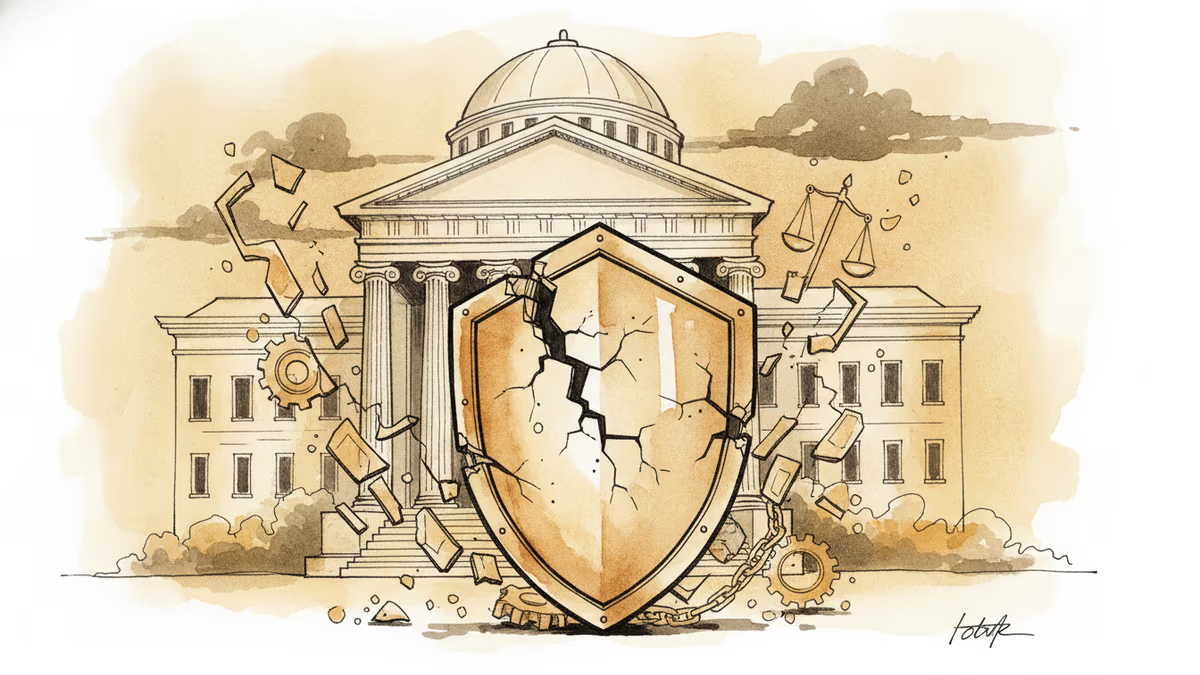
The Regulator's Shield Just Cracked — Why a Supreme Court Ruling Is Rewriting the Corporate M&A Calendar
One administration fired two FTC commissioners and left their seats empty for more than a year. On June 29, 2026, the U.S. Supreme Court ruled that those firings were lawful. And with that, a quiet assumption baked into nearly every merger blueprint — that regulatory review standards don't flip overnight just because the White House changes hands — suddenly stopped holding.
The Court ruled 6-3 that the "for-cause" removal protection shielding Federal Trade Commission members is unconstitutional (Trump v. Slaughter, No. 25-332). The rule had barred a president from firing a commissioner without grounds like neglect of duty or malfeasance. The majority found that constraint clashes with the separation of powers and with a president's control over the executive branch. In the process, the Court overturned Humphrey's Executor — the 1935 precedent that had propped up the independent-agency system for 90 years. SCOTUSblog, CBS, NPR and others reported the majority and dissenting opinions the day the decision came down. One caveat: the verbatim quotes below come from those secondary reports and still need to be checked against the original PDF on supremecourt.gov.
The Line Roberts Drew: FTC on One Side, the Fed on the Other
Start with the point that's easiest to get wrong. The very same day, in a separate case — Trump v. Cook (No. 25A312) — the Court ruled 5-4 to block President Trump's attempt to remove Lisa Cook from the Federal Reserve Board, letting her keep her seat while the litigation plays out.
Chief Justice Roberts wrote both opinions, and he put the Fed in a category of its own — a "distinct historical tradition" of central-bank independence. According to SCOTUSblog, he wrote that for the Fed, not just the fact of independence but the appearance of independence is key. In other words, this ruling did not expand presidential control over the Fed. If anything, it reaffirmed the wall that keeps monetary policy insulated from political swings. The FTC's shield came down; the Fed's stayed up.
The split in the vote counts matters too. The FTC case was 6-3; the Fed case, 5-4. Justice Thomas dissented even from the Fed exception, calling the order that blocked Cook's removal — per SCOTUSblog — the first injunction against a president's removal of an executive officer in the Constitution's 237-year history. That's a signal that even within the majority, there's no consensus on how far the Fed carve-out should stretch.
Two Logics: Accountability vs. Predictability
To grasp where the ruling's weight really falls, you have to hold two opposing arguments side by side.
The majority stands on the unitary executive theory. Roberts wrote that a president may remove his subordinates at will (per an Ogletree client alert). Because the FTC writes rules, runs its own in-house tribunals, and sues on behalf of the United States, the majority reasoned, that work is the very essence of executing the law — so whoever does it must answer to the elected president. Roberts wrote that the Humphrey's framework hadn't withstood the test of time, and that whatever was left of it, the Court was overruling. The core of the case for the ruling is accountability: the will of voters flows into the direction of regulation, and responsibility for regulatory failure traces cleanly back to the president.
Justice Sotomayor's dissent flagged the other axis — the one markets will watch. She wrote that the decision reshapes the government, and that dozens of independent commissions are now likely to become purely executive agencies (per SCOTUSblog). The exact number of agencies in the blast radius hasn't been pinned down by any primary source; most outlets report "dozens" or "more than 20." Sotomayor also argued the majority hands the president a power unknown even to the English Crown. Constitutional scholar Erwin Chemerinsky told NPR that agency independence is now gone.

The practical worry sits less in the firing than in what comes next. In March 2025, the Trump administration removed two Democratic FTC commissioners — Slaughter and Bedoya — and then didn't fill the seats, leaving the commission entirely Republican. Fire the opposition's members and leave the chairs empty, and the pluralistic deliberation that defines a bipartisan regulator effectively collapses. The risk is regulation that tilts hard in one party's direction.
What Companies Have to Recalculate
Here's why this doesn't stay filed under political news. The speed of the law-firm response is the tell. Ogletree, Faegre Drinker, Fisher Phillips, Ward and Smith, and the American Bar Association's antitrust section all pushed out client alerts within days. Ward and Smith framed the decision as a possible turning point for agency independence; the ABA's antitrust section saw a "rough journey ahead" for the FTC.
What they all warned about was the amplitude and speed of the policy swings. On merger review, consumer-protection probes, privacy and advertising rules, and rulemaking, direction could now lurch harder and faster every time an administration changes. Bloomberg and others reported that the removal logic may reach beyond the FTC to commissioners at the Securities and Exchange Commission and the Commodity Futures Trading Commission. For companies, that means stacking long-horizon deals and data policies on top of a regulatory assumption with a four-year shelf life. That's not an abstraction for U.S. firms alone — any multinational structuring a cross-border acquisition that clears U.S. antitrust review, or any foreign issuer eyeing a U.S. listing, is building on the same shifting ground.
What about reviews and lawsuits already underway? Even the practitioner alerts held back here, saying it's a wait-and-see. Retroactive effects and the continuity of pending cases are still open questions.
Why It Matters Well Beyond Washington
This isn't a purely domestic U.S. story. The texture of the concern just varies by region.
For investors across Asia, the shockwaves land on the balance sheet, not the ballot. In Korea, volatility in U.S. antitrust policy translates directly into regulatory risk for exporters and dealmakers like Samsung, SK, and Hyundai as they pursue U.S. acquisitions — while the logic sparing the Fed maps naturally onto Korea's own debates over central-bank independence. Korean outlets led with worries about the "politicization of regulation," framing the day as a split decision.
For Japanese investors, the defense of Fed independence reads more like reassurance. In a market acutely sensitive to the yen-dollar rate and U.S. interest rates, a signal that monetary policy stays walled off from politics is welcome. Nikkei covered both faces of the day — Cook's removal blocked, the president's removal power expanded. Still, for outbound Japanese firms like Sony and SoftBank, politicized FTC and SEC oversight becomes a fresh source of uncertainty around merger and listing rules.
Taiwanese outlets landed on a balanced frame. United Daily News tallied it as one win and three losses for Trump; The News Lens noted that the Court backed Fed independence in one case while expanding presidential power in another. And that's accurate — around the same stretch, Trump lost other cases touching on election administration and defamation. Which is exactly why "the Court has become a rubber stamp for the executive" is too neat to be true.
The Questions Still Open
Zoom out on the timeline, and this ruling isn't a sudden break. It's the endpoint of a trend: Seila Law in 2020 and Collins v. Yellen in 2021 steadily widened removal power at single-director agencies, and now that reach has stretched to multi-member commissions and swept away Humphrey's Executor.
How far the decision will redraw the regulatory map, though, isn't something the data can confirm yet. Three things stay especially open: whether the "historical tradition" logic the Fed exception leans on gets challenged down the road; how the legitimacy of pending merger reviews and antitrust suits gets sorted out; and whether the empty-seat tactic spreads to other agencies. Until those three variables settle, a hard-to-erase question mark hangs over the corporate regulatory calendar.
This content is AI-generated based on source articles. While we strive for accuracy, errors may occur. We recommend verifying with the original source.
Related Articles
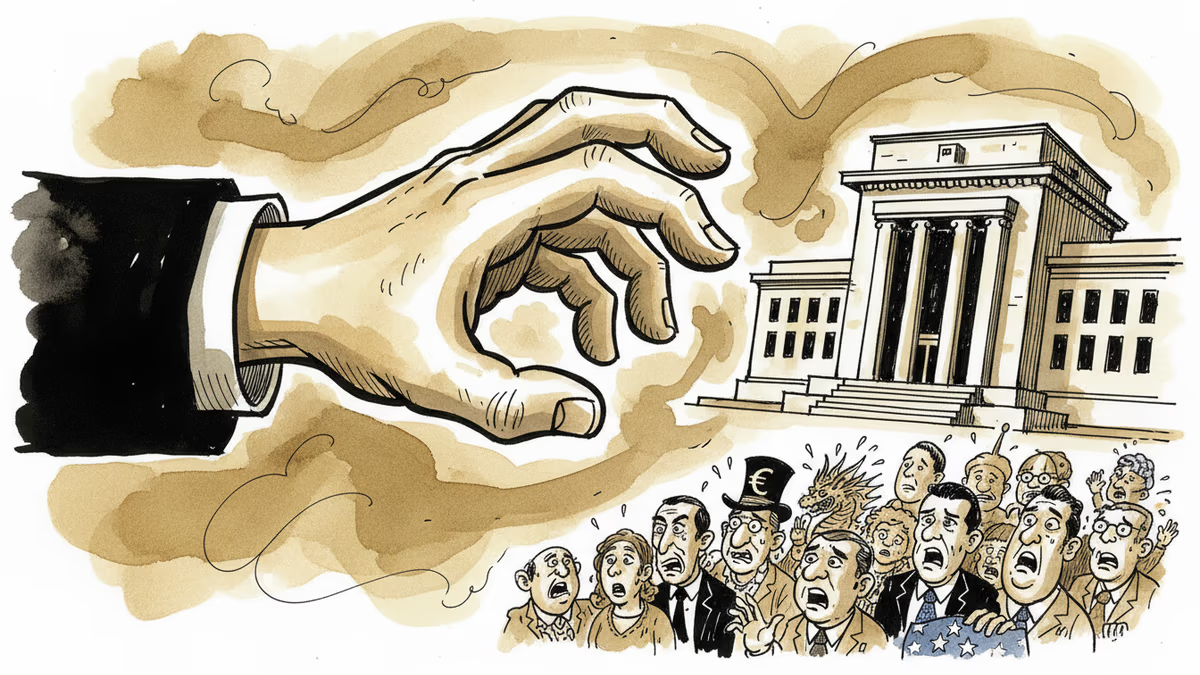
Germany's Bundesbank warns that threats to Fed independence could trigger worldwide inflation. What this means for global markets and economic stability.
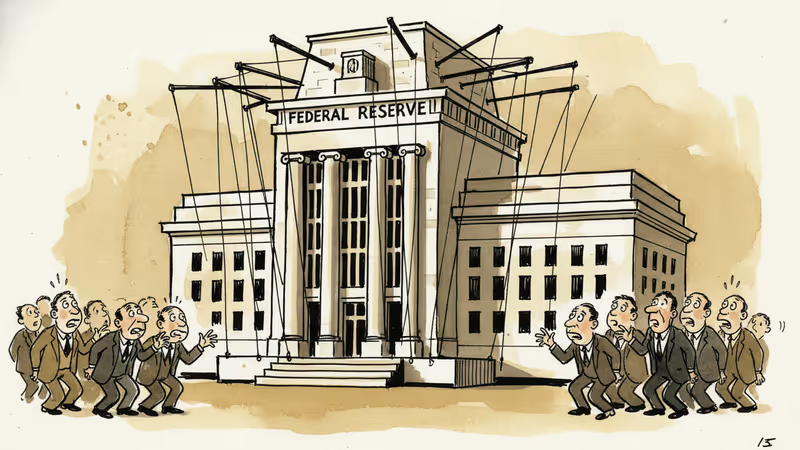
Bank of Canada Governor warns that threats to Federal Reserve independence are increasing economic uncertainty globally, raising concerns about monetary policy credibility and market stability.

Trump's unprecedented attacks on Fed independence may backfire, potentially strengthening central bank autonomy through Supreme Court backing and institutional rallying. What this means for investors.

Legal experts suggest the Supreme Court would likely avoid ruling on Trump's potential attempt to fire Fed Governor Lisa Cook, leaving fundamental questions about Fed independence unresolved.
Germany's Bundesbank warns that threats to Fed independence could trigger worldwide inflation. What this means for global markets and economic stability.
Bank of Canada Governor warns that threats to Federal Reserve independence are increasing economic uncertainty globally, raising concerns about monetary policy credibility and market stability.
Trump's unprecedented attacks on Fed independence may backfire, potentially strengthening central bank autonomy through Supreme Court backing and institutional rallying. What this means for investors.
Legal experts suggest the Supreme Court would likely avoid ruling on Trump's potential attempt to fire Fed Governor Lisa Cook, leaving fundamental questions about Fed independence unresolved.
Thoughts
Share your thoughts on this article
Sign in to join the conversation