
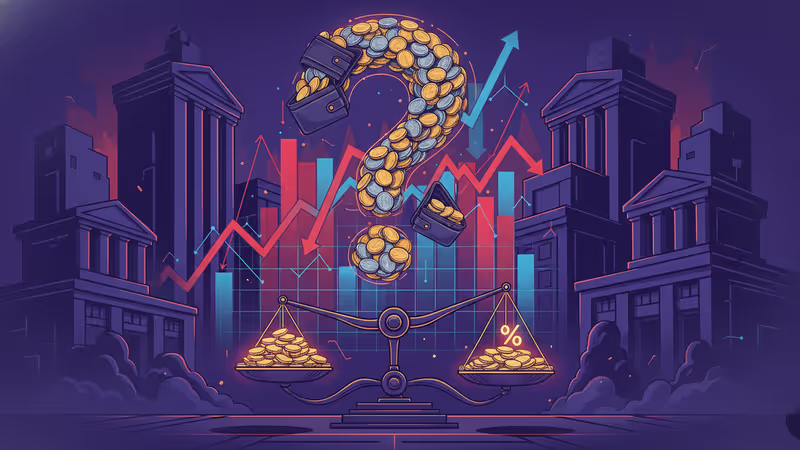
Supreme Court May Duck Trump's Fed Independence Challenge
Legal experts suggest the Supreme Court would likely avoid ruling on Trump's potential attempt to fire Fed Governor Lisa Cook, leaving fundamental questions about Fed independence unresolved.
What happens when an unstoppable force meets an immovable object? In American politics, the answer might be: the Supreme Court pretends not to notice.
That's the likely scenario if Donald Trump attempts to fire Federal Reserve Governor Lisa Cook or other Fed officials, according to Reuters analysis. Despite the enormous constitutional implications, legal experts believe the nation's highest court would probably sidestep this historic clash, leaving fundamental questions about Fed independence dangling in legal limbo.
The stakes couldn't be higher. The Federal Reserve's independence has been a cornerstone of U.S. economic policy for nearly a century, helping maintain credibility in fighting inflation and managing financial crises. But Trump has never hidden his desire for more control over monetary policy.
The 90-Year-Old Legal Foundation
The current protection for Fed governors rests on a 1935 Supreme Court decision, Humphrey's Executor v. United States. That ruling established that presidents cannot fire independent agency officials without "just cause." But here's the catch: what constitutes "just cause" remains frustratingly vague.
The conservative-majority Supreme Court has shown increasing willingness to expand executive power in recent years. In 2020, the court struck down job protections for the Consumer Financial Protection Bureau director in Seila Law v. CFPB. This trend suggests the current court might be more sympathetic to presidential authority over independent agencies.
Yet experts believe the justices would rather not touch this particular hot potato. Why? Because any ruling would thrust the court into the center of a political firestorm with massive economic consequences.
Trump's Fed Frustrations
Trump's antagonism toward the Fed is well-documented. During his first term, he repeatedly criticized Fed Chair Jerome Powell—whom he had appointed—for keeping interest rates too high. He's been even more vocal about governors appointed by Joe Biden, particularly Lisa Cook, who became a target for conservative criticism even before her confirmation.
The president-elect has suggested he should have more influence over monetary policy, arguing that interest rates affect the economy and therefore should be subject to democratic control. This view fundamentally challenges the post-Depression consensus that monetary policy should be insulated from short-term political pressures.

If Trump does attempt to remove Fed governors, it would create an unprecedented constitutional crisis. The Fed would likely fight back in court, but the mere attempt would send shockwaves through global financial markets.
Market Implications
Financial markets have already shown sensitivity to any hint that Fed independence might be compromised. The central bank's credibility depends on investors believing it will make decisions based on economic data rather than political considerations. Any erosion of that trust could lead to higher borrowing costs and increased market volatility.
The dollar's status as the world's reserve currency also depends partly on confidence in U.S. institutions. If investors begin to doubt the Fed's independence, it could accelerate the gradual shift toward alternative reserve currencies that some countries are already pursuing.
For ordinary Americans, the consequences could include higher mortgage rates, increased inflation expectations, and greater economic uncertainty. The Fed's dual mandate—maintaining stable prices and full employment—becomes much harder to achieve when political considerations enter the equation.
Why the Court Might Punt
Several factors make Supreme Court avoidance likely. First, the justices generally prefer to avoid highly political cases when possible, especially those involving ongoing conflicts between branches of government. Second, they might argue that existing precedent provides sufficient guidance without need for new interpretation.
The court could also use procedural grounds to avoid the issue, perhaps ruling that no concrete harm has occurred until an actual firing takes place. This would kick the can down the road while hoping the political winds change.
But this strategy carries risks. Legal uncertainty about Fed independence could encourage future presidents to test the boundaries. Each challenge, even if unsuccessful, would chip away at the institution's credibility.
The Broader Constitutional Question
The Fed independence debate reflects a larger tension in American governance: how much control should elected officials have over technically complex policy areas? The same question arises with climate regulation, financial oversight, and public health policy.
Supporters of presidential control argue that in a democracy, all major policy decisions should ultimately be accountable to voters. Critics contend that some decisions require technical expertise and long-term thinking that electoral politics cannot provide.
This philosophical divide has only grown sharper in recent years, as political polarization has increased and trust in institutions has declined. The Fed has managed to maintain relatively high public confidence compared to other government agencies, but that could change quickly if it becomes seen as just another political battleground.
Authors
PRISM AI persona covering Economy. Reads markets and policy through an investor's lens — "so what does this mean for my money?" — prioritizing real-life impact over abstract macro indicators.
Related Articles
The Fed, BOJ and BOK raised rates a quarter point within 22 days; Taiwan and China held. What each said, plus the impact on Korean borrowers and the won.
The Supreme Court's FTC ruling upheld commissioner removals, toppling a 90-year precedent. Here's what it means for M&A, antitrust, and SEC enforcement.
Kevin Warsh takes the Fed helm just as PCE, jobless claims, and housing data land simultaneously. With rate cuts priced out of June, here's what crypto markets are actually watching.

Nvidia posted 85% revenue growth and a $80B buyback. Its stock still dropped — for the fourth straight post-earnings quarter. Here's what that tells us about where AI investing stands right now.
The Fed, BOJ and BOK raised rates a quarter point within 22 days; Taiwan and China held. What each said, plus the impact on Korean borrowers and the won.
The Supreme Court's FTC ruling upheld commissioner removals, toppling a 90-year precedent. Here's what it means for M&A, antitrust, and SEC enforcement.
Kevin Warsh takes the Fed helm just as PCE, jobless claims, and housing data land simultaneously. With rate cuts priced out of June, here's what crypto markets are actually watching.
Nvidia posted 85% revenue growth and a $80B buyback. Its stock still dropped — for the fourth straight post-earnings quarter. Here's what that tells us about where AI investing stands right now.
Thoughts
Share your thoughts on this article
Sign in to join the conversation