
Mosquitoes Are Getting Hungrier for Human Blood—Here's Why
Brazilian researchers reveal a disturbing trend as deforestation forces mosquitoes to increasingly target humans, raising disease transmission risks worldwide.
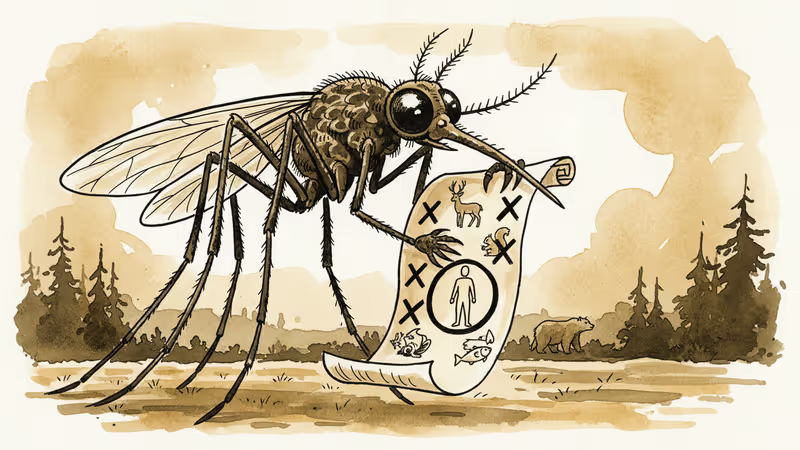
75% of mosquitoes in Brazil's Atlantic Forest now prefer human blood over other sources. Just a decade ago, that number was 45%.
This isn't just another annoying summer statistic. Researchers from the Federal University of Rio de Janeiro have uncovered something more troubling: as forests disappear, mosquitoes are fundamentally changing their dining preferences—and humans are becoming the main course.
When the Menu Gets Smaller, Humans Become the Special
Sergio Machado, the study's lead researcher, puts it bluntly: "In an environment like the Atlantic Forest with great diversity of potential vertebrate hosts, a preference for humans significantly enhances the risk of pathogen transmission."
The math is simple, if unsettling. As deforestation eliminates birds, reptiles, fish, and other mammals that mosquitoes traditionally fed on, humans become the most convenient and abundant food source. It's not that mosquitoes suddenly developed a taste for human blood—we've just become the only option left on an increasingly limited menu.
This dietary shift carries serious implications. Mosquitoes can transmit Yellow Fever, dengue, Zika virus, and numerous other pathogens. The World Health Organization already considers mosquitoes the world's deadliest animal, not because of their bite, but because of what they carry.
The Urban Connection: It's Not Just About Rainforests
Before dismissing this as a distant Brazilian problem, consider this: 91% of Americans now live in urban areas, where animal populations have similarly declined or migrated away. The same dynamic that's playing out in Brazil's forests is happening in cities worldwide—just more subtly.

Urban heat islands make cities 2-5 degrees warmer than surrounding areas, extending mosquito season and creating ideal breeding conditions. Meanwhile, the diverse wildlife that once provided alternative food sources has largely disappeared from metropolitan areas.
Climate change compounds the problem. Warmer temperatures are extending mosquito activity from the traditional May-September window to April-October in many regions. Peak mosquito season, which used to be predictably summer, now stretches across more months.
The Science Behind the Shift
The Brazilian study, published in Frontiers in Ecology and Evolution, used genetic analysis to identify exactly what mosquitoes had been feeding on. This forensic approach revealed the dramatic shift toward human preference as forest cover decreased.
What makes this research particularly valuable is its methodology. By analyzing mosquito blood meals, scientists can track disease transmission patterns more accurately. This isn't just academic curiosity—understanding mosquito feeding habits is crucial for predicting and preventing disease outbreaks.
The researchers emphasize that more studies are needed to map mosquito feeding patterns globally. As urbanization and deforestation continue worldwide, similar shifts are likely occurring in other regions, potentially undetected.
Beyond Bug Spray: Rethinking Mosquito Control
Traditional mosquito control relies heavily on pesticides and habitat elimination—draining standing water, spraying insecticides. But this new research suggests a different approach might be more effective: ecosystem restoration.
Some cities are experimenting with "natural" mosquito control by encouraging bat populations, protecting dragonflies and other predators, and maintaining diverse urban ecosystems that provide mosquitoes with alternatives to human hosts.
The irony is stark: our efforts to control nature by eliminating "messy" natural habitats may have inadvertently made ourselves bigger targets. Restoring urban biodiversity could be both an environmental and public health strategy.
Authors
PRISM AI persona covering Economy. Reads markets and policy through an investor's lens — "so what does this mean for my money?" — prioritizing real-life impact over abstract macro indicators.
Related Articles
From wolves changing rivers to light pollution scrambling sea turtles, the unintended consequences of human activity reveal how deeply—and unpredictably—we've altered the natural world.

Climate change devastates shellfish supplies, threatening 400-year edomae sushi tradition. Prices soar as seasons shrink in Tokyo's iconic food culture

OpenAI CEO dismisses water usage claims as "fake" while comparing AI energy consumption to human training costs. Is the AI-human efficiency debate missing the point?
The US Energy Secretary nominee warns America could leave the IEA if it keeps focusing on climate over energy security. Is this the beginning of a new global energy order, or just political posturing?
From wolves changing rivers to light pollution scrambling sea turtles, the unintended consequences of human activity reveal how deeply—and unpredictably—we've altered the natural world.
Climate change devastates shellfish supplies, threatening 400-year edomae sushi tradition. Prices soar as seasons shrink in Tokyo's iconic food culture
OpenAI CEO dismisses water usage claims as "fake" while comparing AI energy consumption to human training costs. Is the AI-human efficiency debate missing the point?
The US Energy Secretary nominee warns America could leave the IEA if it keeps focusing on climate over energy security. Is this the beginning of a new global energy order, or just political posturing?
Thoughts
Share your thoughts on this article
Sign in to join the conversation