
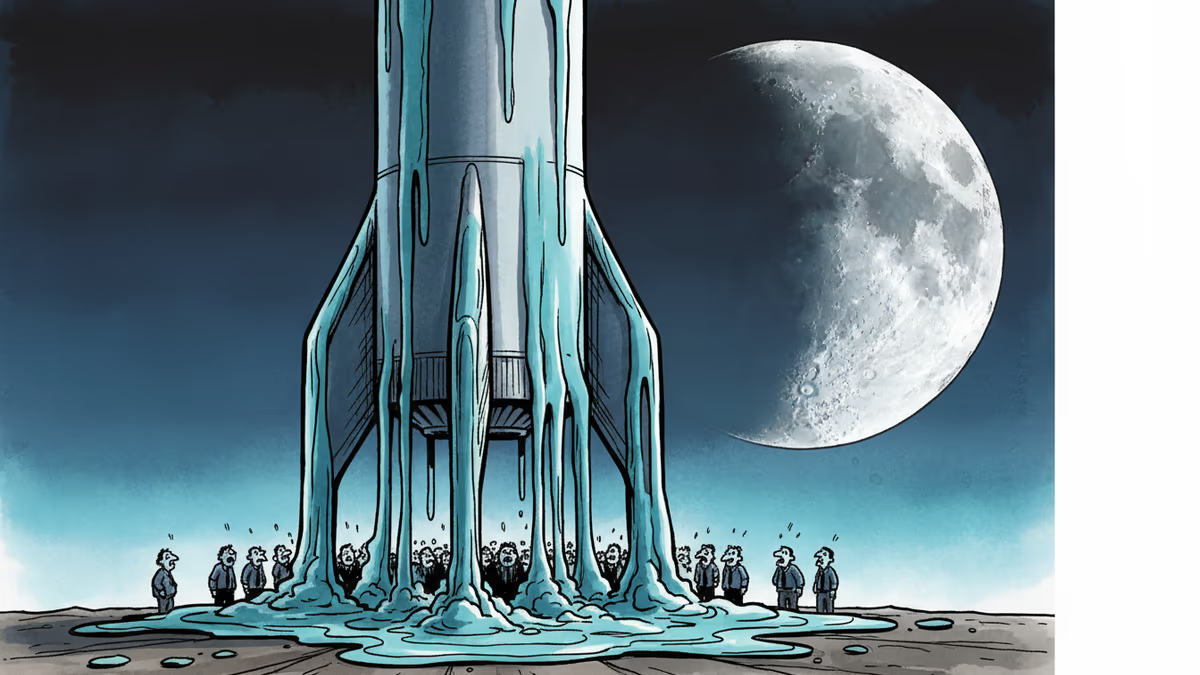
Moon Landing Returns After 50 Years, But the Fuel Keeps Leaking
NASA's Artemis III lunar landing faces fuel leak setbacks. Analyzing the technical challenges and commercial opportunities in modern space exploration.
Fifty years after Apollo, we're going back to the Moon. But NASA has a problem: the fuel won't stay put.
NASA Administrator Jared Isaacman's Saturday announcement was straightforward yet concerning. The agency is scrambling to fix fuel leak issues plaguing the Space Launch System (SLS) rocket before Artemis III—humanity's first lunar landing mission in over five decades.
Grounded by Hydrogen
The scene at Kennedy Space Center tells the story. Artemis II sits on the launch pad, having already missed its launch window earlier this month. The culprit? A hydrogen fuel leak discovered during a February 2nd practice countdown that cut the rehearsal short.
Artemis II represents the first crewed flight for both the SLS rocket and Orion spacecraft. Four astronauts are scheduled for a 10-day journey around the Moon's far side and back to Earth.
The Hydrogen Paradox
Here's the irony: this isn't a problem with cutting-edge technology—it's basic physics. Hydrogen is the universe's smallest atom. It escapes through microscopic gaps that would contain any other substance. The same challenge that plagued Apollo engineers in 1969 haunts Artemis engineers in 2026.
This explains why companies like SpaceX and Blue Origin chose different fuels. Methane and kerosene are far easier to handle. So why does NASA stick with hydrogen?

The answer is efficiency. Hydrogen delivers more thrust per pound than any other chemical fuel. When you're trying to reach the Moon, that difference matters.
Commercial Space's Advantage
The contrast is stark. While NASA struggles with fuel leaks, SpaceX launches Falcon Heavy missions with apparent ease. Private companies built their systems from scratch, learning from NASA's decades of experience while avoiding legacy constraints.
Blue Origin's New Glenn rocket, set to debut this year, uses methane—specifically to avoid hydrogen's complications. Jeff Bezos has called hydrogen "the fuel of the future, and always will be."
The $93 Billion Question
NASA's Artemis program carries a $93 billion price tag. Every delay adds millions to the cost and provides ammunition for critics. Congressional voices grow louder: "If private companies can do it, why can't NASA?"
The geopolitical stakes amplify the pressure. China aims for lunar landing by 2030. Each Artemis delay narrows America's lead in what many see as a new space race.
Technical Debt in Space
The SLS represents both NASA's greatest achievement and its biggest burden. Built using Space Shuttle technology, it carries forward decades of engineering decisions. The result is incredibly powerful but operationally complex.
Modern rockets like SpaceX's Starship or Blue Origin's New Glenn were designed for the reusable era. SLS was designed for the expendable era but built in the reusable era—an awkward timing that shows.
Authors
Related Articles
NASA's Artemis III has been redesigned as an Earth-orbit mission. SpaceX and Blue Origin say their landers won't be ready until late 2027. What does this mean for the future of lunar exploration?

Flying to Mars means navigating without trees, wind, or GPS. Here's the surprisingly elegant physics behind how spacecraft measure their own velocity in the void.

Artemis II splashed down successfully in the Pacific, marking humanity's first crewed deep space mission in over 50 years. But the harder question isn't whether we can go back — it's why we should.

NASA's Orion capsule splashed down safely after humanity's first crewed lunar voyage in 54 years. The mission succeeded. Now the harder questions begin.
NASA's Artemis III has been redesigned as an Earth-orbit mission. SpaceX and Blue Origin say their landers won't be ready until late 2027. What does this mean for the future of lunar exploration?
Flying to Mars means navigating without trees, wind, or GPS. Here's the surprisingly elegant physics behind how spacecraft measure their own velocity in the void.
Artemis II splashed down successfully in the Pacific, marking humanity's first crewed deep space mission in over 50 years. But the harder question isn't whether we can go back — it's why we should.
NASA's Orion capsule splashed down safely after humanity's first crewed lunar voyage in 54 years. The mission succeeded. Now the harder questions begin.
Thoughts
Share your thoughts on this article
Sign in to join the conversation