
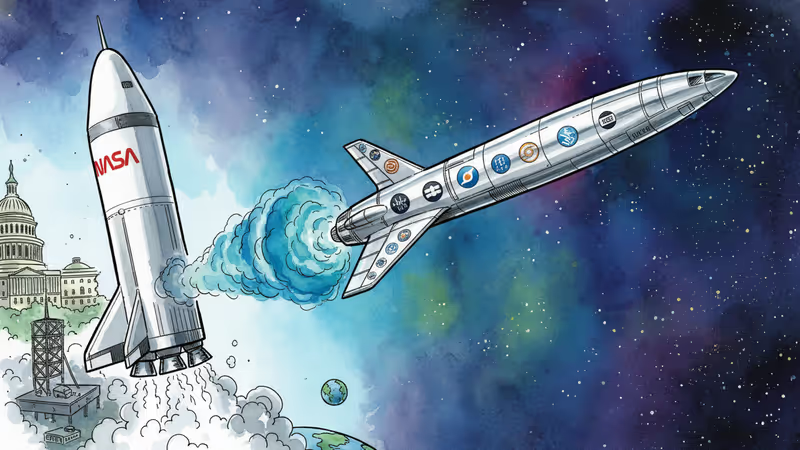
House Committee Greenlights NASA's Commercial Deep Space Future
The House Science Committee unanimously approved NASA's 2026 reauthorization bill, paving the way for private companies to lead deep space exploration missions.
The House Science, Space, and Technology Committee just rewrote the rules of American space exploration. In a unanimous vote Wednesday, lawmakers approved the NASA Reauthorization Act of 2026, complete with over 40 amendments that could fundamentally shift how America reaches for the stars.
From Government Ownership to Private Partnership
The bill's most significant provision authorizes NASA to pursue a "commercial" deep space program using privately owned rockets and spacecraft instead of government-built vehicles. This isn't just policy tweaking—it's a philosophical shift from the agency that put humans on the moon with government-designed Saturn V rockets.
Think SpaceX's Dragon capsules or Blue Origin's New Shepard, but for missions to Mars and beyond. The committee's markup process added dozens of amendments before the bill now heads to the full House for a floor vote, then the Senate, and finally President Trump's desk.
The Economics of Space Exploration
Why the pivot to private companies? The numbers tell the story. Traditional NASA programs often span decades with budgets reaching hundreds of billions. Meanwhile, companies like SpaceX have slashed launch costs by 90% and developed new spacecraft in a fraction of the time.

This shift reflects broader changes in how America approaches complex technological challenges. Just as the internet evolved from a government project to a commercial ecosystem, space exploration is following a similar path. The question isn't whether private companies can do the job—SpaceX already ferries astronauts to the International Space Station—but whether they should lead humanity's expansion into deep space.
Beyond American Borders
The implications extend far beyond U.S. policy. As America embraces commercial space partnerships, other nations face pressure to adapt or risk falling behind. China's state-led space program and Europe's government consortium model suddenly look less competitive against America's hybrid approach of public funding with private execution.
For emerging space nations, the message is clear: the future belongs to countries that can harness private sector innovation while maintaining strategic oversight. The traditional model of government-only space programs may become as obsolete as government-run telephone companies.
The Regulatory Balancing Act
Yet questions remain about oversight and accountability. When private companies control the vehicles that carry astronauts to Mars, who ensures safety standards? How do profit motives align with scientific discovery? The bill's 40+ amendments suggest lawmakers are grappling with these very issues.
The commercial space industry has largely proven itself reliable for Earth orbit operations, but deep space missions involve risks and timeframes that test the limits of corporate patience and quarterly earnings cycles.
Authors
Related Articles

NASA's Artemis III has been redesigned as an Earth-orbit mission. SpaceX and Blue Origin say their landers won't be ready until late 2027. What does this mean for the future of lunar exploration?

Artemis II splashed down successfully in the Pacific, marking humanity's first crewed deep space mission in over 50 years. But the harder question isn't whether we can go back — it's why we should.

NASA's Orion capsule splashed down safely after humanity's first crewed lunar voyage in 54 years. The mission succeeded. Now the harder questions begin.

Artemis II's four astronauts are returning to Earth Friday night. The splashdown off Southern California isn't the anticlimax it sounds—it's the most technically perilous moment of the entire lunar journey.
NASA's Artemis III has been redesigned as an Earth-orbit mission. SpaceX and Blue Origin say their landers won't be ready until late 2027. What does this mean for the future of lunar exploration?
Artemis II splashed down successfully in the Pacific, marking humanity's first crewed deep space mission in over 50 years. But the harder question isn't whether we can go back — it's why we should.
NASA's Orion capsule splashed down safely after humanity's first crewed lunar voyage in 54 years. The mission succeeded. Now the harder questions begin.
Artemis II's four astronauts are returning to Earth Friday night. The splashdown off Southern California isn't the anticlimax it sounds—it's the most technically perilous moment of the entire lunar journey.
Thoughts
Share your thoughts on this article
Sign in to join the conversation