
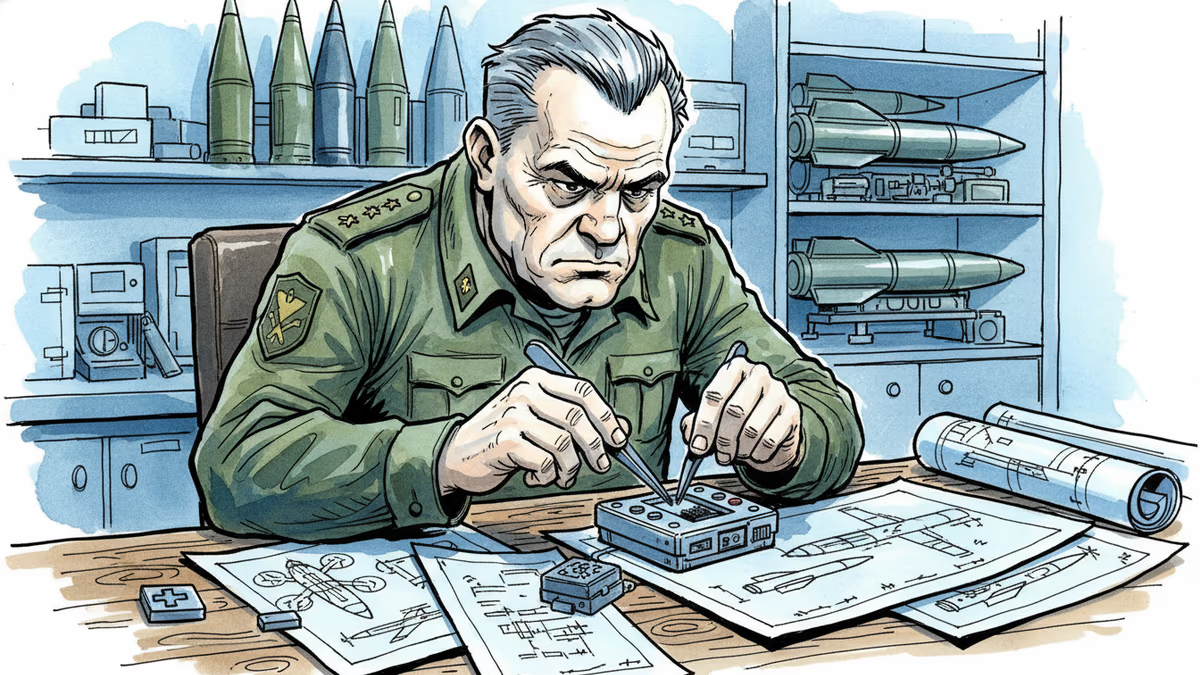
A Weapons Maker's $1B Game Boy Dream
Palmer Luckey's retro gaming startup ModRetro is seeking funding at a $1 billion valuation. What does it mean when the man building autonomous weapons also wants to make the perfect Game Boy?
"If Lockheed Martin made a Game Boy, would you buy one?"
That question, posed by The Verge's Sean Hollister in his review of the ModRetro Chromatic, cuts to the heart of one of the stranger stories in consumer tech right now. It's not rhetorical. It's a genuine ask — and the answer says a lot about how we think about the people behind the products we love.
The $1 Billion Game Boy
Palmer Luckey sold Oculus to Facebook for $2 billion, then founded Anduril Industries, a defense startup building autonomous weapons systems. He also spent 17 years, on and off, trying to build the perfect Game Boy. In 2024, through his retro gaming startup ModRetro, he finally shipped it.
The Chromatic runs original Game Boy cartridges on modern hardware — sharper screen, better battery, same soul. Hollister called it "the best version of the Game Boy ever made," even as he wrestled with what it meant to love a product made by someone building lethal autonomous systems.
Now, according to the Financial Times, ModRetro is in talks to raise funding at a $1 billion valuation. The company is reportedly working on additional devices, including one designed to replicate the Nintendo 64. Luckey himself described the Chromatic as the product of "hundreds of irrational decisions" — a love letter to an era of gaming rather than a calculated market play.
How a Retro Game Boy Becomes a Billion-Dollar Business

The valuation raises an obvious question: how does a niche hardware startup making Game Boy-style devices get to $1 billion?
The retro gaming hardware market is smaller than the mainstream gaming industry, but it's surprisingly durable. Players like Analogue have built loyal followings selling premium FPGA-based consoles at $200–$250 a unit — to customers who could emulate the same games for free. The willingness to pay isn't about access. It's about authenticity. Physical cartridges. Real hardware. The tactile experience of something that feels right.
ModRetro is betting that this market has room for a well-funded, design-obsessed player. And Luckey brings more than nostalgia to the table. His track record in hardware is legitimate — Oculus wasn't just a vision, it was a shipping product. His investor network, amplified by Anduril's ascent, is formidable. With the Trump administration reportedly embracing Luckey's vision for autonomous weapons, Anduril is now in talks for a new funding round at a $60 billion valuation. The name carries weight.
The Uncomfortable Duality
But the Lockheed Martin question doesn't go away.
For most consumer tech founders, the ethical profile of their other ventures is a footnote. For Luckey, it's the headline. Anduril doesn't make background noise — it makes weapons systems that could autonomously engage targets. The Trump administration's enthusiasm for that work makes it more visible, not less.
For investors, the two companies are legally separate. ModRetro's fundamentals stand on their own. But for consumers — particularly the gaming community, which skews younger and has historically been vocal about political and ethical issues — the equation is different. Buying the Chromatic is a transaction with a person, not just a product.
This tension isn't unique to ModRetro. Consumers navigate it constantly: the labor practices behind a phone, the environmental record of a car company, the political donations of a CEO. What's unusual here is how explicit the contrast is. The same hands that sign off on drone weapon designs also obsessed over the exact feel of a Game Boy's D-pad for nearly two decades.
The gaming community's reaction has been predictably split. Hardware enthusiasts who've held the Chromatic tend to be disarmed by how good it is. Critics argue that quality doesn't neutralize the broader context. Neither side is obviously wrong.
Authors
Related Articles
Lucra Sports CEO Dylan Robbins landed Cathie Wood's ARK Invest as a Series B lead without building AI. The story behind his unconventional fundraising playbook.

Indian venture capital has quietly displaced Silicon Valley in its own backyard. Only one American VC made India's top 10 investor list last year. Here's why that matters beyond India.
E-commerce fintech Parker filed for Chapter 7 bankruptcy on May 7, despite raising over $200M. The YC-backed startup's abrupt shutdown left small business customers scrambling—and exposed the fragility of vertical fintech models.
Factory just raised $150M at a $1.5B valuation to build AI coding agents for enterprises. In a market already crowded with Cursor, Claude Code, and Cognition, investors say there's still room. Here's why that bet might make sense — and why it might not.
Lucra Sports CEO Dylan Robbins landed Cathie Wood's ARK Invest as a Series B lead without building AI. The story behind his unconventional fundraising playbook.
Indian venture capital has quietly displaced Silicon Valley in its own backyard. Only one American VC made India's top 10 investor list last year. Here's why that matters beyond India.
E-commerce fintech Parker filed for Chapter 7 bankruptcy on May 7, despite raising over $200M. The YC-backed startup's abrupt shutdown left small business customers scrambling—and exposed the fragility of vertical fintech models.
Factory just raised $150M at a $1.5B valuation to build AI coding agents for enterprises. In a market already crowded with Cursor, Claude Code, and Cognition, investors say there's still room. Here's why that bet might make sense — and why it might not.
Thoughts
Share your thoughts on this article
Sign in to join the conversation