
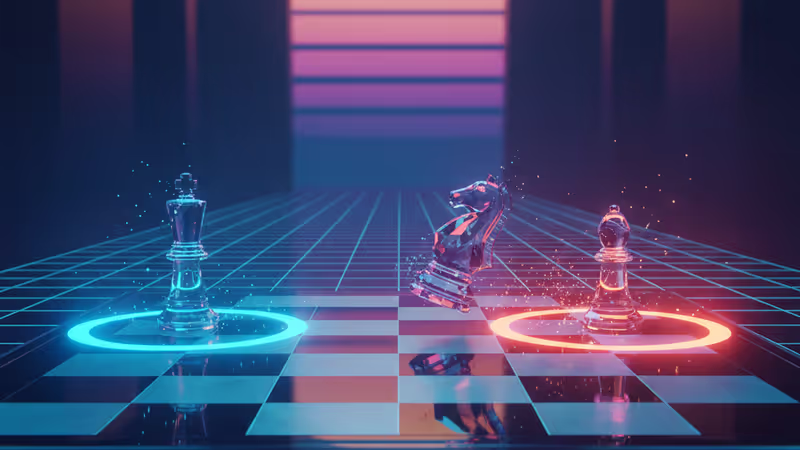
Mira Murati’s Thinking Machines Talent Drain: Co-founders Return to OpenAI
Mira Murati’s Thinking Machines faces a major talent drain as CTO Barret Zoph and co-founder Luke Metz return to OpenAI. Analysis of the $12B startup's crisis.
They’re shaking hands, but it’s clear the gloves are off. Mira Murati’s high-profile AI startup, Thinking Machines Lab, is facing a significant leadership crisis just months after its explosive debut. Two of its co-founders and a key technical staffer are deserting the $12 billion venture to return to their former employer: OpenAI.
On Wednesday, January 14, 2026, Murati announced that CTO Barret Zoph had parted ways with the company. While she quickly named Soumith Chintala as the new CTO, the narrative took a sharp turn when OpenAI’s Fidji Simo confirmed just 58 minutes later that Zoph, along with co-founder Luke Metz and Sam Schoenholz, were officially back on the OpenAI roster.
Thinking Machines Talent Drain: A Massive Setback

The departure of two co-founders in a single sweep is a massive blow for a company that closed a $2 billion seed round only six months ago. Led by Andreessen Horowitz with participation from Nvidia and AMD, the funding was predicated on the strength of its founding team—many of whom are now exiting. Reports from Wired suggest the split wasn't amicable, hinting at deep-seated friction within the leadership.
This isn't the first time Thinking Machines has lost talent. In October, co-founder Andrew Tulloch left for Meta. While the startup still boasts John Schulman as Chief Scientist, the rapid churn of founding members raises questions about the long-term stability of OpenAI spin-offs in an increasingly volatile talent market.
Authors
Related Articles

OpenAI has reorganized for the second time in a month, merging ChatGPT and Codex into a single agentic platform under president Greg Brockman's unified product leadership.
After two weeks of witnesses calling him a liar, OpenAI CEO Sam Altman testified in his own defense, claiming Elon Musk tried to kill the company twice.
Sam Nelson, 19, died after following ChatGPT's advice to mix Kratom and Xanax. His parents are suing OpenAI for wrongful death, raising urgent questions about AI trust, liability, and design.
OpenAI's new Daybreak initiative uses the Codex AI agent to find and patch security vulnerabilities before attackers do—putting it in direct competition with Anthropic's secretive Claude Mythos.
OpenAI has reorganized for the second time in a month, merging ChatGPT and Codex into a single agentic platform under president Greg Brockman's unified product leadership.
After two weeks of witnesses calling him a liar, OpenAI CEO Sam Altman testified in his own defense, claiming Elon Musk tried to kill the company twice.
Sam Nelson, 19, died after following ChatGPT's advice to mix Kratom and Xanax. His parents are suing OpenAI for wrongful death, raising urgent questions about AI trust, liability, and design.
OpenAI's new Daybreak initiative uses the Codex AI agent to find and patch security vulnerabilities before attackers do—putting it in direct competition with Anthropic's secretive Claude Mythos.
Thoughts
Share your thoughts on this article
Sign in to join the conversation