
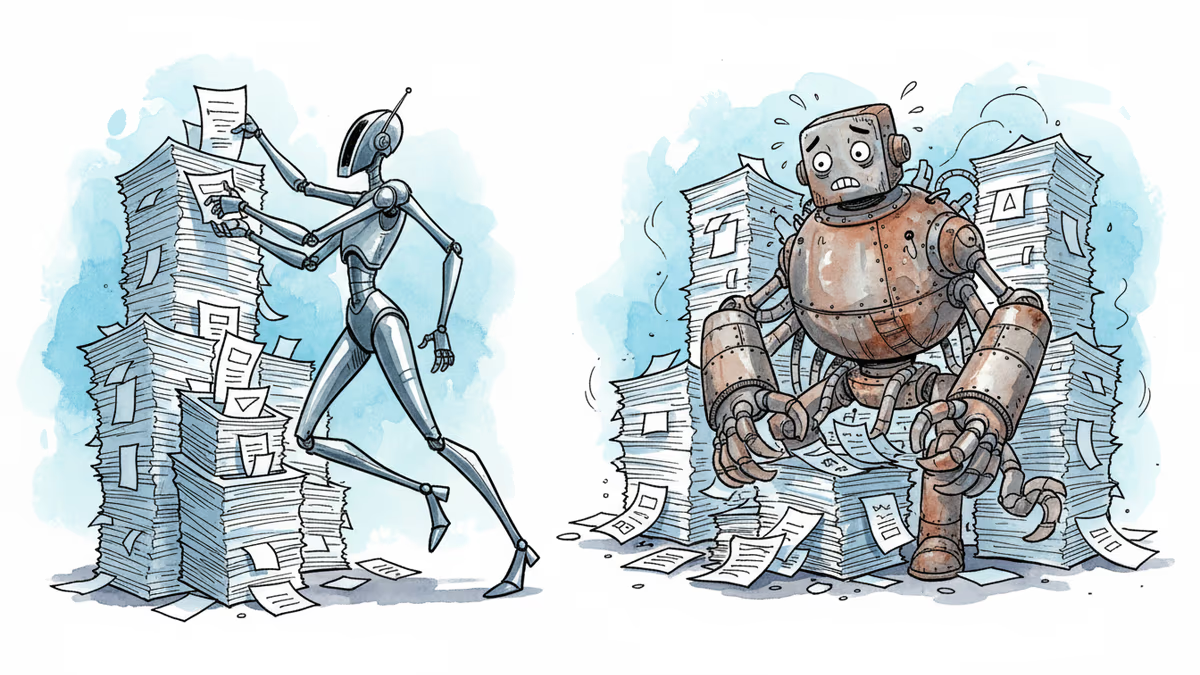
GPT-5.4 Rewrites AI Economics: When Efficiency Trumps Raw Power
OpenAI's GPT-5.4 shifts AI competition from pure performance to token efficiency. With 1M context window and 33% fewer errors, what changes for businesses and developers?
One million tokens. That's the headline number from OpenAI's Thursday release of GPT-5.4, representing a 10x increase in context window size. But the real story isn't about how much the model can remember—it's about how little it needs to get the job done.
The Great Efficiency Pivot
OpenAI didn't just build a bigger model; they built a smarter one. GPT-5.4 solves the same problems as its predecessor using "significantly fewer tokens," while cutting individual claim errors by 33% and overall response errors by 18%. This isn't incremental improvement—it's a fundamental shift in how AI models compete.
The new Tool Search system exemplifies this philosophy. Previously, AI models had to load definitions for every available tool when making API calls, creating a token tax that scaled with complexity. Now, models look up only what they need, when they need it. The result? Faster, cheaper requests for systems with extensive tool libraries.
Mercor CEO Brendan Foody captured the implications perfectly: GPT-5.4 "excels at creating long-horizon deliverables such as slide decks, financial models, and legal analysis," while "running faster and at a lower cost than competitive frontier models."
Enterprise Math Gets Simpler
For businesses, token efficiency translates directly to ROI calculations. A 10x improvement in context handling combined with reduced token consumption means companies can deploy AI at scale without proportional cost increases. This is particularly crucial for industries like legal services, financial analysis, and consulting, where GPT-5.4 achieved record scores on professional benchmarks.

Startups that previously couldn't afford extensive AI integration now have a path forward. Enterprise customers who've been cautious about AI costs can justify more aggressive deployments. The efficiency gains don't just reduce expenses—they expand the universe of economically viable AI applications.
The Transparency Experiment
Perhaps most intriguingly, OpenAI introduced new safety evaluations specifically for GPT-5.4 Thinking, their reasoning model variant. The company tested whether the model could "misrepresent its chain-of-thought"—essentially, whether it might deceive users about its reasoning process.
The results were cautiously optimistic. GPT-5.4 showed lower likelihood of deceptive reasoning, "suggesting that the model lacks the ability to hide its reasoning and that CoT monitoring remains an effective safety tool." But OpenAI acknowledged that deception "can happen under the right circumstances."
This transparency push reflects growing industry awareness that raw capability improvements must be matched by interpretability advances. As AI models become more powerful, understanding their decision-making processes becomes increasingly critical.
The Competitive Response
OpenAI's efficiency focus puts pressure on competitors to rethink their strategies. Anthropic, Google, and other frontier model developers now face a choice: match OpenAI's efficiency gains or find alternative competitive advantages.
The timing is significant. As AI model training costs continue to rise, efficiency improvements offer a more sustainable path to better performance than simply scaling up compute. Companies that master token efficiency first may gain lasting advantages in the enterprise market.
Authors
Related Articles

OpenAI has reorganized for the second time in a month, merging ChatGPT and Codex into a single agentic platform under president Greg Brockman's unified product leadership.

After two weeks of witnesses calling him a liar, OpenAI CEO Sam Altman testified in his own defense, claiming Elon Musk tried to kill the company twice.

Sam Nelson, 19, died after following ChatGPT's advice to mix Kratom and Xanax. His parents are suing OpenAI for wrongful death, raising urgent questions about AI trust, liability, and design.

OpenAI's new Daybreak initiative uses the Codex AI agent to find and patch security vulnerabilities before attackers do—putting it in direct competition with Anthropic's secretive Claude Mythos.
OpenAI has reorganized for the second time in a month, merging ChatGPT and Codex into a single agentic platform under president Greg Brockman's unified product leadership.
After two weeks of witnesses calling him a liar, OpenAI CEO Sam Altman testified in his own defense, claiming Elon Musk tried to kill the company twice.
Sam Nelson, 19, died after following ChatGPT's advice to mix Kratom and Xanax. His parents are suing OpenAI for wrongful death, raising urgent questions about AI trust, liability, and design.
OpenAI's new Daybreak initiative uses the Codex AI agent to find and patch security vulnerabilities before attackers do—putting it in direct competition with Anthropic's secretive Claude Mythos.
Thoughts
Share your thoughts on this article
Sign in to join the conversation