
100 Atoms Walk Into a Lab. Can They Cure Cancer?
A $7M quantum computing competition is testing whether today's noisy, limited quantum machines can actually help human health—before the powerful ones we've been promised ever arrive.
The most consequential computer in medicine right now might fit in your backpack.
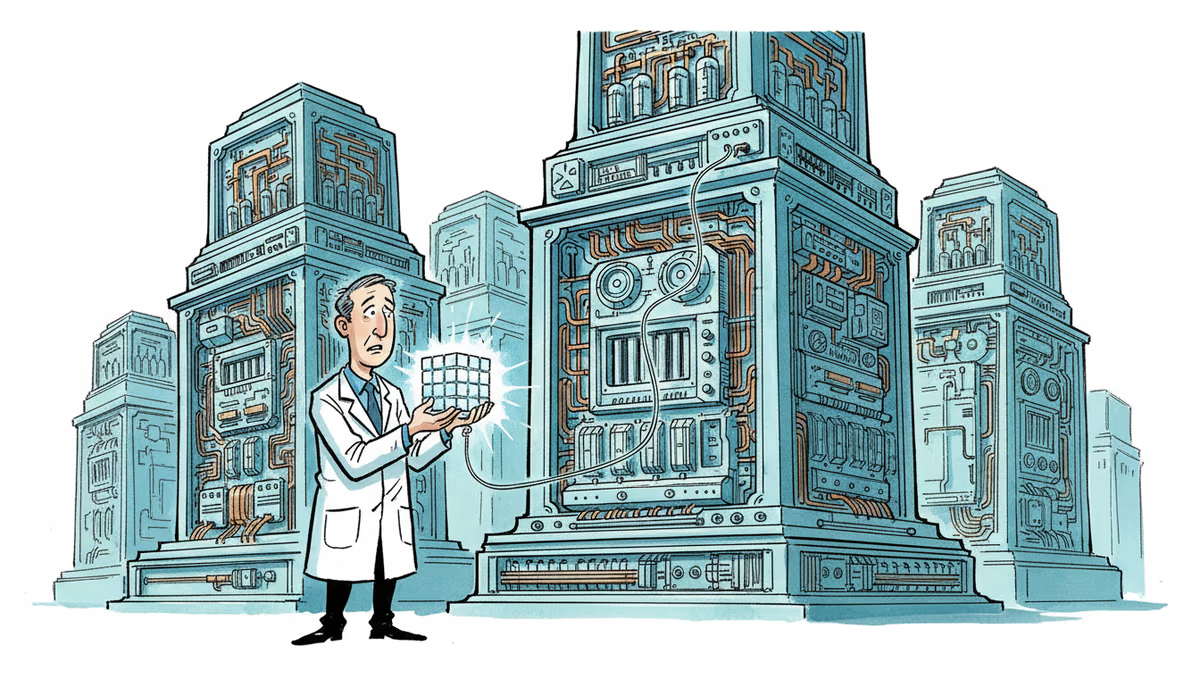
At the UK's National Quantum Computing Centre near Oxford, a device no bigger than a Rubik's Cube suspends 100 cesium atoms in midair using a laser beam. The company that built it, Colorado-based Infleqtion, is flying it to Marina del Rey, California next week to compete for $5 million. If it wins, it won't just be a payday. It would be the clearest proof yet that quantum computers—still noisy, still error-prone, still nowhere near the all-powerful machines we've been promised—can actually do something useful for human health.
That's a much harder bar to clear than it sounds.
The Competition Nobody Expected to Be This Close
Wellcome Leap, a nonprofit, launched the Quantum for Bio (Q4Bio) competition in 2024, handing $1.5 million in research funding each to 12 teams. The mission: prove that today's quantum computers—not the theoretical future ones—can meaningfully advance healthcare. Six teams made it to the final.
The prize structure is deliberately tiered. A $2 million award goes to any team running a significantly useful healthcare algorithm on a machine with 50 or more qubits. The $5 million grand prize demands more: 100+ qubits, a real-world health problem solved, and—the killer criterion—results that classical computers simply cannot replicate.
The competitors are serious. Stanford University's Grant Rotskoff, whose team is studying the quantum properties of ATP (the molecule that powers every cell in your body), says they're "very firmly within the criteria" for the $2 million prize. Jonathan Hirst of the University of Nottingham, whose group has quantum-computed a potential drug for the most common adult-onset form of muscular dystrophy, says, "I think we're in with a good shout."
The grand prize? "This is really at the very edge of doable," Rotskoff admits.
What They're Actually Building
The six finalists have attacked wildly different problems—and arrived at the same unexpected solution.

Helsinki-based Algorithmiq, working with Cleveland Clinic, used an IBM superconducting quantum computer to simulate a light-activated cancer drug. The therapy is elegant in concept: you take the drug, it spreads through your body doing nothing, and then a targeted beam of light at a specific wavelength activates it—attacking only the tumor at that precise location. It's currently in Phase II clinical trials for bladder cancer. The problem is that for decades, the drug's mechanism was too complex to simulate classically, which is why it remained a niche treatment. Algorithmiq's quantum-computed simulation could finally unlock its redesign for other conditions.
Infleqtion's cesium-atom machine is hunting for cancer signatures buried in massive genomic datasets like the Cancer Genome Atlas. When a cancer metastasizes, knowing its origin dramatically changes treatment decisions. But the patterns that reveal that origin are hidden in data so large it overwhelms classical solvers. Infleqtion's approach: use the quantum processor to find correlations that shrink the problem, then hand the reduced version back to a classical computer. "I'm basically trying to use the best of my quantum and my classical resources," says project lead Teague Tomesh.
At Oxford University, Sergii Strelchuk's team is mapping genetic diversity among humans and pathogens using quantum-assisted graph structures—potentially exposing hidden treatment pathways that classical genomics tools miss at scale. The Nottingham team, meanwhile, includes David Brook, who helped identify the gene behind myotonic dystrophy back in 1992. More than 30 years later, his team has used quantum computing to calculate how drugs can chemically block the protein that triggers the disease.
The Plot Twist: Quantum Computers Aren't Doing This Alone
Here's what makes Q4Bio genuinely interesting—and a little humbling for quantum evangelists.
Every single finalist is running a hybrid quantum-classical system. The quantum processor handles only the narrow slice of each problem where classical methods break down at scale. Everything else runs on conventional computers, often powered by newly developed classical algorithms that are, in many cases, better than anything that existed before the competition started.
This wasn't the original dream. The quantum computing pitch has always been about machines that replace classical computers for certain tasks. What Q4Bio is revealing is something more pragmatic: quantum processors as specialized accelerators, tightly coupled to classical systems, solving problems neither could crack alone.
Q4Bio program director Shihan Sajeed calls these hybrid developments "transformational"—even as he tempers expectations about the grand prize. "It is very difficult to achieve something with a noisy quantum computer that a classical machine can't do," he says flatly. Insiders suggest the $5 million may go unclaimed.
Three Ways to Read This
For investors: The quantum computing sector has weathered years of hype cycles and skepticism. Q4Bio offers something rare—a structured, third-party evaluation of real-world performance. Whether or not prize money changes hands, the competition is generating publishable benchmarks and validated use cases that could sharpen investment theses. The hybrid model, in particular, suggests near-term commercial opportunity doesn't require waiting for fault-tolerant quantum machines.
For the pharmaceutical industry: Drug simulation has always been limited by what classical computers can model. If Algorithmiq's light-activated cancer drug work holds up under judging, it signals that an entire category of therapeutics—compounds too complex to simulate classically—may be newly accessible. That's not a marginal improvement. It's a different kind of drug discovery pipeline.
For quantum skeptics: The fact that the grand prize criteria may go unmet is actually informative. It sets a real, documented baseline for what current quantum hardware can and cannot do—far more useful than press releases. And Sajeed's parting thought is worth sitting with: if a team's algorithm fails the competition, it doesn't mean the algorithm is wrong. "It just means the machine you need doesn't exist yet."
The winner, or winners, will be announced in mid-April.
Authors
Related Articles

French quantum computing company Pasqal joins the exodus to US markets with a $2B SPAC deal. What's driving European tech champions away from home?

From 24/7 cuffless monitoring to Apple Watch notifications, home blood pressure management is undergoing a revolution. Here's what's changing and why it matters for your health.

The Aktiia Hilo band promises 24/7 blood pressure monitoring without the squeeze. As it heads to US market, we explore what continuous BP tracking really means for healthcare.

Quantonation raises €220M second fund despite quantum computing being years from industrial scale. Why investors are doubling down on unproven tech.
French quantum computing company Pasqal joins the exodus to US markets with a $2B SPAC deal. What's driving European tech champions away from home?
From 24/7 cuffless monitoring to Apple Watch notifications, home blood pressure management is undergoing a revolution. Here's what's changing and why it matters for your health.
The Aktiia Hilo band promises 24/7 blood pressure monitoring without the squeeze. As it heads to US market, we explore what continuous BP tracking really means for healthcare.
Quantonation raises €220M second fund despite quantum computing being years from industrial scale. Why investors are doubling down on unproven tech.
Thoughts
Share your thoughts on this article
Sign in to join the conversation