
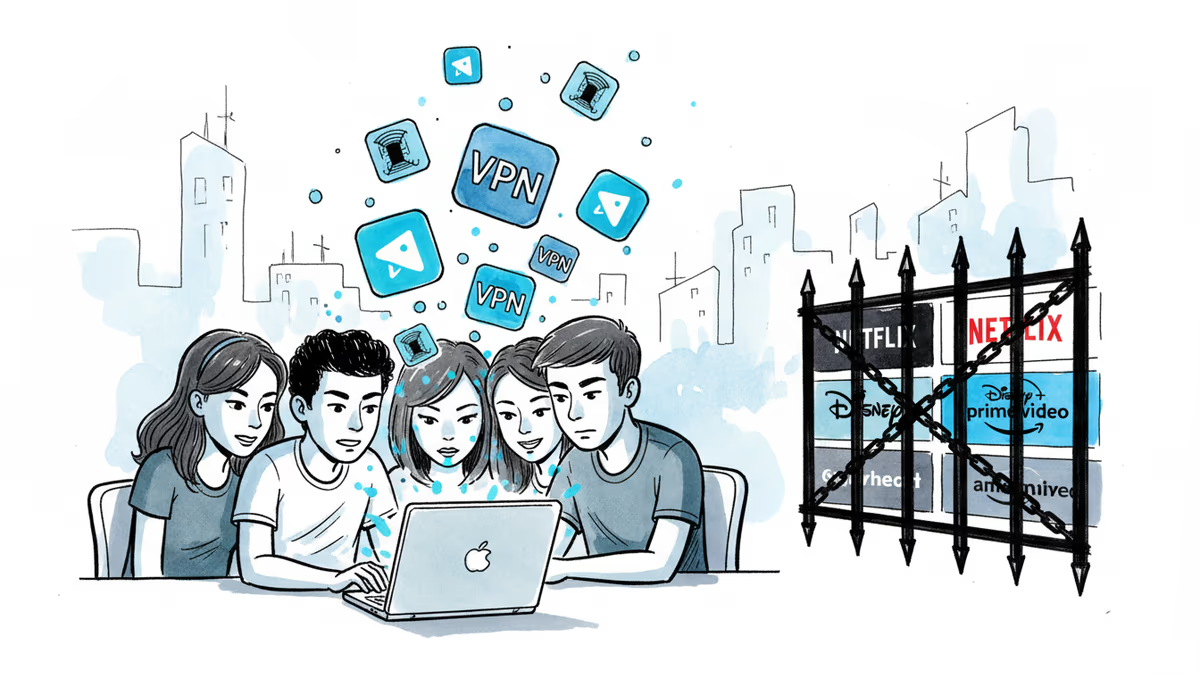
Why Middle Eastern Youth Choose Telegram Over Netflix
Sanctions and financial crises block streaming access across MENA, making piracy the default for young consumers. 23% rely on illegal IPTV services in a region where legal access often doesn't exist.
23% of Users in One Region Choose Piracy by Default
In most of the world, streaming means click, pay, watch. In the Middle East and North Africa, 23% of users access illegal IPTV services instead. It's not rebellion—it's necessity.
For Mira, a student in Beirut, the math is simple: "My banking card doesn't work online, and even if it did, more than half of the movies aren't available here." Since Lebanon's financial crisis began in 2019, accessing dollar-denominated streaming services has become nearly impossible for many.
This isn't just about money. It's about a digital divide that sanctions, banking restrictions, and fragmented licensing deals have created across the region.
When Legal Access Simply Doesn't Exist
In Syria, the barriers are more fundamental. US sanctions on the Assad regime prevent many international platforms from operating there entirely. Laith, a student in Damascus, explains: "Some services don't operate here at all. That's why you'd need a VPN, which you also have to pay for. As a simpler solution, most people just download directly."
The irony is stark: young people who want to pay for content legally often can't, while sophisticated piracy networks offer Netflix-quality experiences with better regional content availability.
Jean-Pierre Andreaux, head of content protection at StarzPlay, notes that organized IPTV operations have become "increasingly sophisticated, designing services that closely mimic legitimate streaming platforms." The user experience gap between legal and illegal options has narrowed dramatically.
A Generation That Sees Workarounds as Normal

What's striking is how normalized these workarounds have become. In Egypt, Hussein describes how "Telegram groups upload new episodes within hours." In Algeria, students share external hard drives loaded with TV series. In Lebanon, streaming passwords circulate across extended families.
"We grew up solving problems online," says Mira. "When something is blocked, you find a way around it. It's a fundamental human instinct."
Abed Kataya from SMEX, a Beirut-based digital rights organization, argues this isn't cultural: "I see that piracy in MENA is not a cultural choice; rather, it has multiple layers." Many users are unbanked, lack access to online payments, or don't trust digital transactions.
The Industry Fights Back—and Adapts
Streaming platforms aren't ignoring these challenges. StarzPlay has invested in "flexible subscription models and alternative payment methods, including telecom-led billing options." Saudi platform Shahid is expanding regionally, while Netflix has created dedicated packages for the region.
The Alliance for Creativity and Entertainment, a coalition including Netflix and regional player OSN Group, targets illegal distribution networks. But enforcement remains difficult across platforms like Telegram's vast network of public and private channels.
Andreaux warns that piracy "exposes consumers to malware and insecure payment channels" while "weakening investment in local content by depriving creators of revenue."
The Ethical Dilemma
Young consumers aren't oblivious to the moral complexity. Amine, a 23-year-old film student in Tunis, captures the tension: "We want to support artists. But if we can't access their work through official channels, we have to find another way."
Currency devaluations in Egypt and Lebanon have made dollar-priced subscriptions increasingly unaffordable, even when payment systems work. The choice often isn't between legal and illegal—it's between access and no access at all.
Authors
Related Articles
From a niche experiment in 2018 to a mainstream disruption in 2026, AI-generated music is forcing the industry to rethink creativity, copyright, and compensation.
Qatar's gas production halt threatens global semiconductor supply chains as the Middle East conflict disrupts critical materials. Samsung and SK Hynix face potential production slowdowns in a market already stretched by AI demand.
FCC Chairman supports Paramount-WBD merger while Netflix deal faced regulatory hurdles. A new regulatory playbook for streaming consolidation emerges.
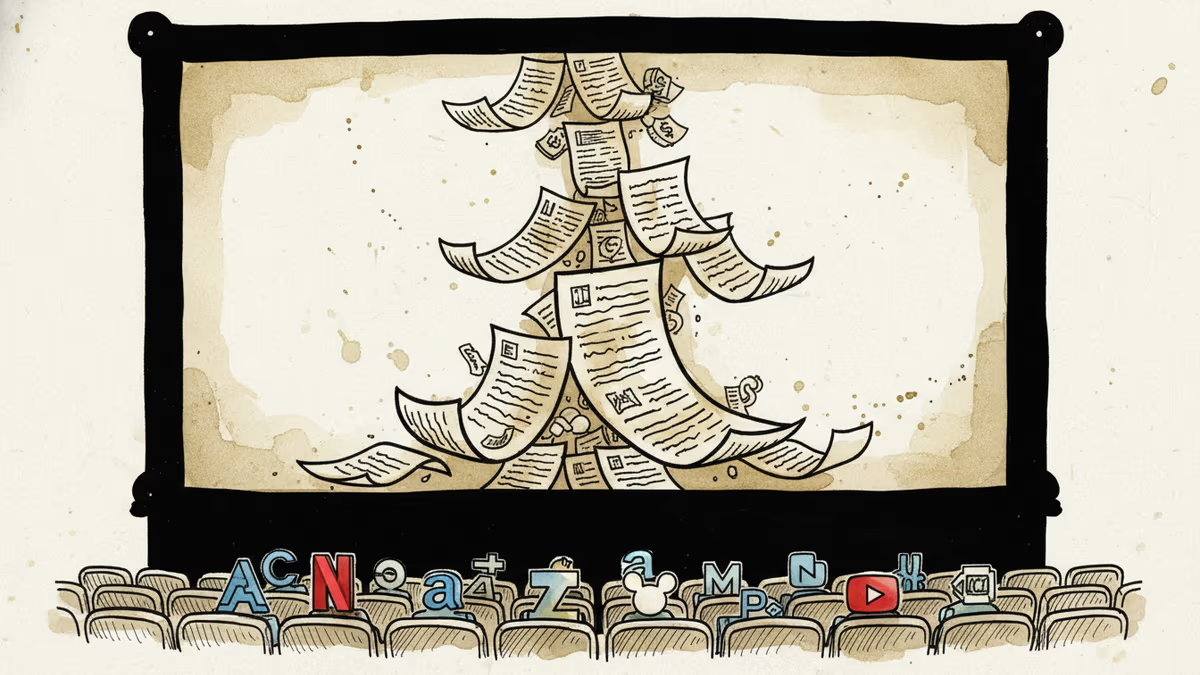
Paramount-Warner merger creates streaming giant with 200M+ subscribers after Netflix abandoned WBD deal. What this mega-consolidation means for content and competition.
From a niche experiment in 2018 to a mainstream disruption in 2026, AI-generated music is forcing the industry to rethink creativity, copyright, and compensation.
Qatar's gas production halt threatens global semiconductor supply chains as the Middle East conflict disrupts critical materials. Samsung and SK Hynix face potential production slowdowns in a market already stretched by AI demand.
FCC Chairman supports Paramount-WBD merger while Netflix deal faced regulatory hurdles. A new regulatory playbook for streaming consolidation emerges.
Paramount-Warner merger creates streaming giant with 200M+ subscribers after Netflix abandoned WBD deal. What this mega-consolidation means for content and competition.
Thoughts
Share your thoughts on this article
Sign in to join the conversation