
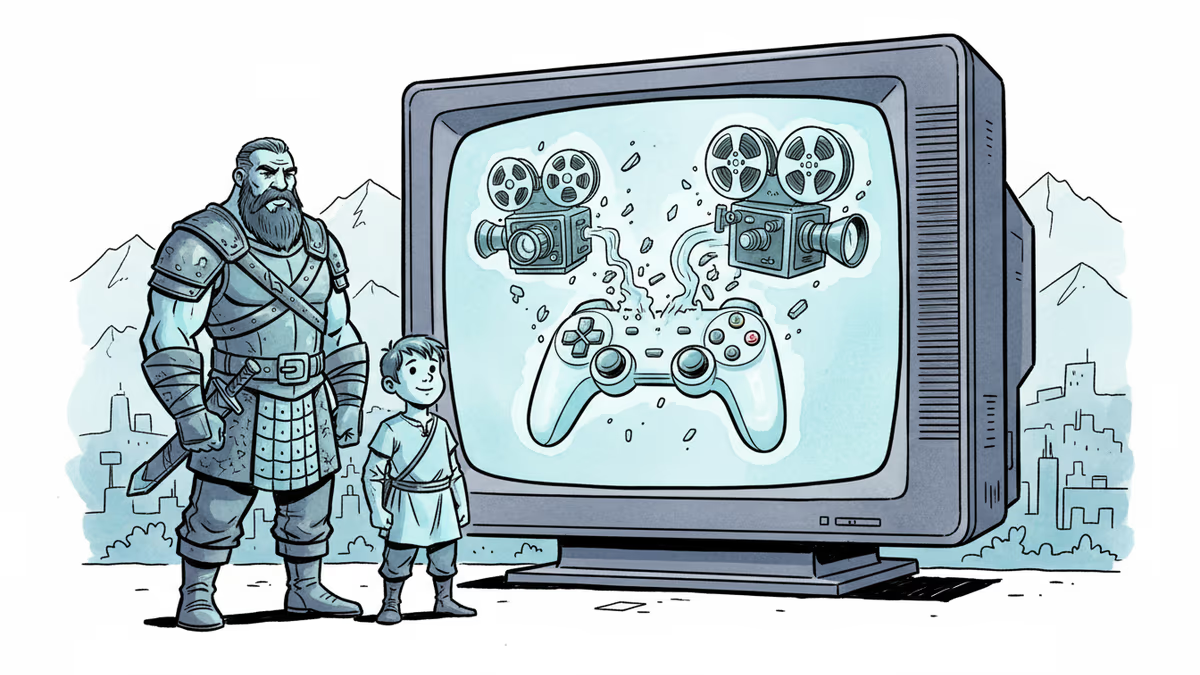
God of War Goes Live-Action: Can Game Adaptations Finally Break the Curse?
Amazon reveals first look at God of War series. Exploring whether game-to-screen adaptations can overcome their troubled history.
Kratos's axe gleams. Atreus draws his bowstring. Amazon's first official image from its God of War live-action series shows Ryan Hurst and Callum Vinson as the iconic father-son duo, and they look remarkably faithful to their digital counterparts.
But here's the real question: Can a video game adaptation actually work this time?
Breaking Decades of Failure
Game-to-screen adaptations have a notorious track record. From the Super Mario Bros. disaster (1993) to Assassin's Creed's critical flop (2016), Hollywood has struggled to translate interactive entertainment into passive viewing. The core problem? Games derive their power from player agency—something inherently lost when audiences become spectators.
God of War might be different. The 2018 reboot shifted from mindless button-mashing to emotional storytelling. It's fundamentally about Kratos learning to be a father while grappling with his violent past. That's inherently cinematic.
Amazon's official description reinforces this approach: the series follows "father and son Kratos and Atreus as they embark on a journey to spread the ashes of their wife and mother, Faye." It's staying true to the game's emotional core rather than just its action sequences.
The Streaming Wars' New Battlefield
This isn't happening in isolation. Netflix's Arcane (2021) proved game adaptations could work, earning critical acclaim and massive viewership. HBO's The Last of Us became 2023's breakout hit. Streaming platforms are finally cracking the code.

The numbers explain why. Gaming is a $221 billion industry as of 2025—over five times larger than theatrical films ($42 billion). These franchises come with built-in audiences and decades of character development. For streaming services burning through content budgets, it's low-hanging fruit.
But not all games are created equal. Story-driven titles like God of War have natural narrative arcs. Puzzle games like Tetris or multiplayer shooters? Much harder to adapt.
What Gamers Really Want
The gaming community remains skeptical—and for good reason. They've been burned before. The key difference with recent successes? Respect for source material. The Last of Us succeeded because it understood the game's themes of survival and human connection, not just its zombie apocalypse setting.
God of War faces a unique challenge. The original trilogy was pure power fantasy—Kratos literally killed gods. The reboot added emotional depth but retained the mythological scale. Can live-action capture both the intimate father-son moments and the epic Norse mythology battles without looking ridiculous?
Early fan reactions to the casting photos are cautiously optimistic. Hurst's imposing physical presence matches Kratos's intimidating stature, while Vinson captures Atreus's youthful determination.
The Bigger Picture for Entertainment
This represents a fundamental shift in how entertainment IP flows. Traditionally, successful movies spawned video games (usually poorly). Now it's reversing. Games are becoming the source material for premium television.
This matters for the entire entertainment ecosystem. Game studios are increasingly thinking cinematically during development. Meanwhile, streaming platforms are competing not just with each other, but with interactive entertainment for audience attention and time.
The financial stakes are enormous. A successful God of War series could spawn sequels, spin-offs, merchandise, and potentially boost sales of future games. Sony, which owns the God of War IP, stands to benefit across multiple revenue streams.
Authors
Related Articles
From a niche experiment in 2018 to a mainstream disruption in 2026, AI-generated music is forcing the industry to rethink creativity, copyright, and compensation.
Sony and Microsoft are pulling back from multi-platform strategies, signaling a return to console exclusives. What this means for gamers and the industry.
FCC Chairman supports Paramount-WBD merger while Netflix deal faced regulatory hurdles. A new regulatory playbook for streaming consolidation emerges.
EA introduces creator marketplace in The Sims 4 with new in-game currency 'Moola.' A bold experiment in virtual economies that could reshape gaming monetization.
From a niche experiment in 2018 to a mainstream disruption in 2026, AI-generated music is forcing the industry to rethink creativity, copyright, and compensation.
Sony and Microsoft are pulling back from multi-platform strategies, signaling a return to console exclusives. What this means for gamers and the industry.
FCC Chairman supports Paramount-WBD merger while Netflix deal faced regulatory hurdles. A new regulatory playbook for streaming consolidation emerges.
EA introduces creator marketplace in The Sims 4 with new in-game currency 'Moola.' A bold experiment in virtual economies that could reshape gaming monetization.
Thoughts
Share your thoughts on this article
Sign in to join the conversation