
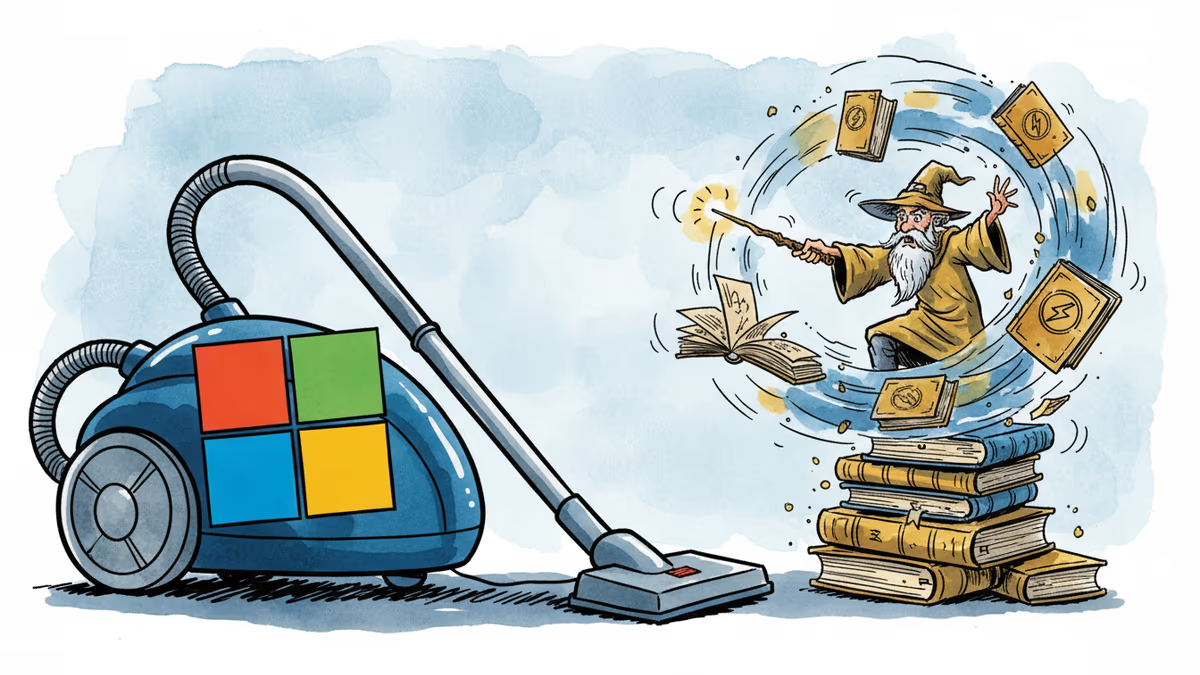
Microsoft Told Developers to Pirate Harry Potter, Then Quietly Deleted the Post
Microsoft published then deleted a blog post suggesting developers use pirated Harry Potter books for AI training, exposing the industry's data ethics dilemma.
48 hours. That's how long Microsoft's blog post survived online before vanishing into the digital ether. In those brief two days, it managed to expose one of AI's dirtiest secrets.
What Actually Happened
Last November, Pooja Kamath, a senior product manager who's been at Microsoft for over a decade, published what seemed like a routine technical blog post. She was promoting a new feature that would let developers "add generative AI features to your own applications with just a few lines of code using Azure SQL DB, LangChain, and LLMs."
The problem wasn't the technology—it was the example. To demonstrate "engaging and relatable examples" that would "resonate with a wide audience," Kamath suggested using a "well-known dataset" like the Harry Potter books.
The Hacker News community spotted it first. The backlash was swift and brutal. Critics accused Microsoft of encouraging developers to pirate copyrighted material, then use it to create what they called "AI slop"—low-quality, AI-generated content.
Microsoft quietly deleted the post. No explanation. No apology. Just gone.
The Developer's Dilemma
For AI developers, this scenario isn't unusual—it's Tuesday. Everyone needs good training data, but getting it legally? That's the trillion-dollar question.
"Harry Potter would be perfect training data," admits one AI startup developer who requested anonymity. "It's literary, consistent, massive in scope. But good luck getting J.K. Rowling and Warner Bros to sign off on that."
Many developers operate in what they call the "gray zone." Publicly, they claim to use only legally obtained data. Privately, they experiment with whatever works—copyrighted or not.

The Corporate Calculation
Microsoft's blunder wasn't just a communication mishap. It revealed the complex calculations AI companies make behind closed doors.
Speed matters most. With AI model competition intensifying, the mantra is "build first, ask permission later." Copyright review comes second to shipping features.
Legal ambiguity helps. There's no clear legal precedent for AI training data usage. Companies push boundaries, claiming "fair use" while testing how far they can go.
Competition pressure is real. If OpenAI, Google, and Anthropic are all potentially using similar data, falling behind isn't an option.
The Content Owners Fight Back
But content creators aren't sitting idle. The New York Times sued OpenAI. Multiple publishers are preparing class-action lawsuits. The battle lines are drawn.
Warner Bros, which owns Harry Potter IP, is particularly aggressive about protection. They monitor fan sites obsessively—they're certainly not going to ignore AI training usage.
"We're tracking all unauthorized uses," a Warner Bros legal representative confirmed.
The Bigger Picture
This incident highlights a fundamental paradox in AI development: the best training data is often the most legally protected. Public domain works are free but limited. High-quality, contemporary content comes with strings attached.
Some companies are taking different approaches. Adobe built their AI models exclusively on licensed content. Shutterstock created AI tools using only their own stock imagery. But these approaches are expensive and limit capabilities.
Meanwhile, others play legal roulette, hoping that by the time lawsuits resolve, they'll have enough market dominance to weather the financial penalties.
Authors
Related Articles

GitHub confirmed hackers stole data from 3,800 internal repositories via a poisoned VS Code extension. Here's why developer tools are now the most dangerous attack surface in tech.

Emails revealed in the Musk v. Altman trial show Microsoft executives were deeply skeptical of OpenAI in 2017–2018. What actually changed their minds?

Xbox hardware revenue dropped 33% in Q1 2026, yet Microsoft posted $82.9B in total revenue. What this tells us about the future of gaming—and who actually loses.
Palantir has become the tech backbone of Trump's immigration enforcement. Former employees are calling it a 'descent into fascism.' What happens when the people who build surveillance tools start asking uncomfortable questions?
GitHub confirmed hackers stole data from 3,800 internal repositories via a poisoned VS Code extension. Here's why developer tools are now the most dangerous attack surface in tech.
Emails revealed in the Musk v. Altman trial show Microsoft executives were deeply skeptical of OpenAI in 2017–2018. What actually changed their minds?
Xbox hardware revenue dropped 33% in Q1 2026, yet Microsoft posted $82.9B in total revenue. What this tells us about the future of gaming—and who actually loses.
Palantir has become the tech backbone of Trump's immigration enforcement. Former employees are calling it a 'descent into fascism.' What happens when the people who build surveillance tools start asking uncomfortable questions?
Thoughts
Share your thoughts on this article
Sign in to join the conversation