
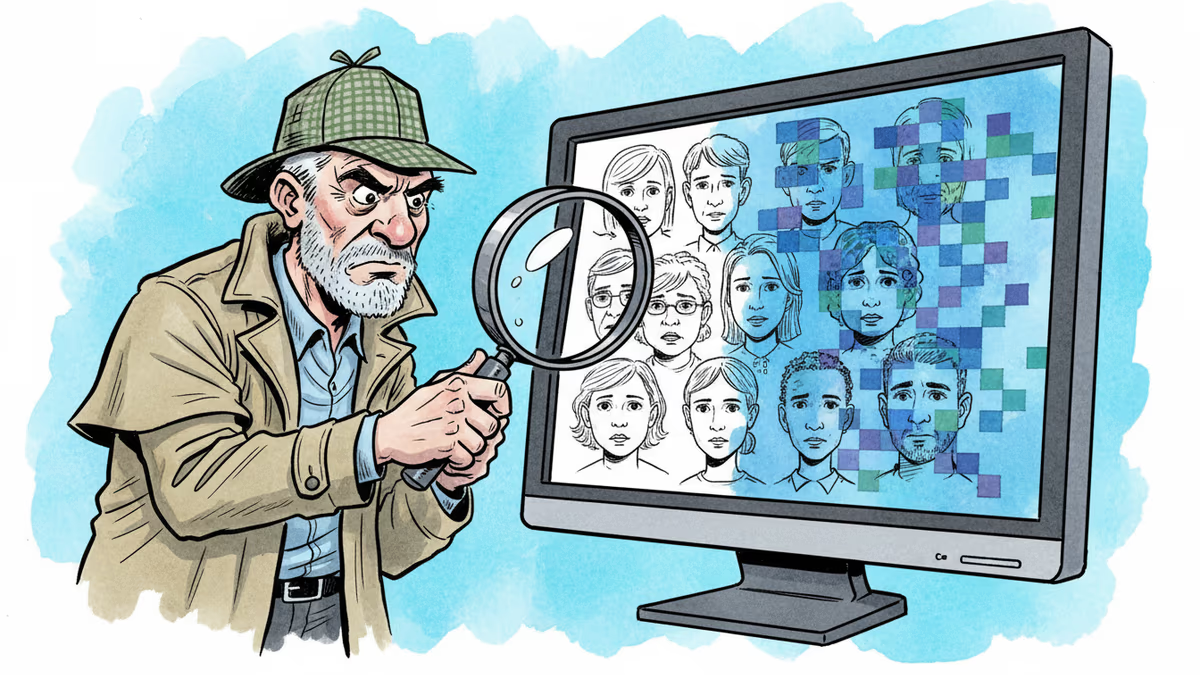
Microsoft's Blueprint for Truth in the Age of AI Deception
Microsoft proposes technical standards to verify digital content authenticity as AI-generated misinformation proliferates online. But can technology alone solve the truth crisis?
When Even the White House Gets Fooled
White House officials recently shared a manipulated protest image, then mocked those who questioned it. Russian influence campaigns are spreading AI-generated videos to discourage Ukrainian enlistment. AI-enabled deception now permeates our online lives, slipping quietly into social feeds and racking up views.
Into this chaos, Microsoft has thrown a lifeline: a comprehensive blueprint for proving what's real online. Shared exclusively with MIT Technology Review, the tech giant's research evaluates 60 different combinations of content verification methods against today's most sophisticated AI threats.
The Rembrandt Standard for Digital Content
Microsoft's approach mirrors art authentication. To verify a Rembrandt, experts document its provenance, apply invisible-but-machine-readable watermarks, and create digital fingerprints based on brush strokes. Skeptical museum visitors can then examine these proofs to confirm authenticity.
The same logic applies to digital content. Microsoft's team tested combinations of provenance tracking, watermarking, and digital signatures across various failure scenarios—from stripped metadata to deliberate manipulation. They mapped which combinations produce reliable results and which create more confusion than clarity.
Eric Horvitz, Microsoft's chief scientific officer, says the work responds to legislation like California's AI Transparency Act and AI's rapid evolution in combining video and voice with "striking fidelity."
The Limits of Digital Truth-Telling
But these tools have inherent boundaries. Just as art authentication doesn't tell you what a Rembrandt means, these systems only reveal if content has been manipulated—not whether it's accurate.
"It's not about making decisions about what's true and not true," Horvitz explains. "It's about coming up with labels that tell folks where stuff came from."

Hany Farid, a UC Berkeley digital forensics expert, believes widespread adoption would make public deception "meaningfully more difficult." While sophisticated actors can bypass such tools, they'd eliminate a significant portion of misleading material. "I don't think it solves the problem, but it takes a nice big chunk out of it."
The Platform Problem: Engagement vs. Truth
Implementation remains the challenge. Google started watermarking AI-generated content in 2023. Some platforms use C2PA, a provenance standard Microsoft helped launch in 2021. But an audit by Indicator found only 30% of test posts across Instagram, LinkedIn, Pinterest, TikTok, and YouTube were correctly labeled as AI-generated.
Farid points to the core tension: "If the Mark Zuckerbergs and Elon Musks think that putting 'AI generated' labels will reduce engagement, then of course they're incentivized not to do it."
Even Microsoft, despite creating this blueprint, wouldn't commit to implementing its own recommendations across its vast ecosystem—which includes Copilot, Azure, LinkedIn, and its OpenAI stake.
When Truth Labels Backfire
Microsoft's research reveals a troubling paradox: rushed or inconsistent labeling systems could backfire entirely. If people lose trust in verification tools, the whole effort collapses.
The researchers identify "sociotechnical attacks" as a new threat. Imagine someone takes a real political image and uses AI to change just a few pixels. When shared, it might be misleadingly classified as "AI-manipulated." But combining provenance and watermark tools could clarify that content was only partially AI-generated and show exactly where changes were made.
The Regulatory Reality Check
California's AI Transparency Act will be the first major US test of these tools, taking effect in August. But enforcement faces challenges from President Trump's executive order seeking to curtail "burdensome" state AI regulations. The administration has also canceled grants related to misinformation research.
Ironically, government channels themselves share AI-manipulated content. MIT Technology Review found that the Department of Homeland Security uses video generators from Google and Adobe for public communications.
When asked if government-sourced fake content concerns him, Horvitz initially declined comment, then noted: "Governments have not been outside the sectors that have been behind various kinds of manipulative disinformation, and this is worldwide."
Authors
Related Articles
Samsung and SK unveiled a chip and AI investment package worth thousands of trillions of won on June 29. The headline number swings wildly by outlet, but the real contest isn't capital — it's water and power.
Viral videos show 2026 graduates jeering executives who praise AI at commencement ceremonies. It's not just rudeness — it's a signal about who pays for technological optimism.
GitHub confirmed hackers stole data from 3,800 internal repositories via a poisoned VS Code extension. Here's why developer tools are now the most dangerous attack surface in tech.
Filipino virtual assistants using AI to ghost-manage LinkedIn profiles for executives is now a structured industry. 30 comments a day, fake engagement rings, and a platform struggling to tell real from fabricated.
Samsung and SK unveiled a chip and AI investment package worth thousands of trillions of won on June 29. The headline number swings wildly by outlet, but the real contest isn't capital — it's water and power.
Viral videos show 2026 graduates jeering executives who praise AI at commencement ceremonies. It's not just rudeness — it's a signal about who pays for technological optimism.
GitHub confirmed hackers stole data from 3,800 internal repositories via a poisoned VS Code extension. Here's why developer tools are now the most dangerous attack surface in tech.
Filipino virtual assistants using AI to ghost-manage LinkedIn profiles for executives is now a structured industry. 30 comments a day, fake engagement rings, and a platform struggling to tell real from fabricated.
Thoughts
Share your thoughts on this article
Sign in to join the conversation