
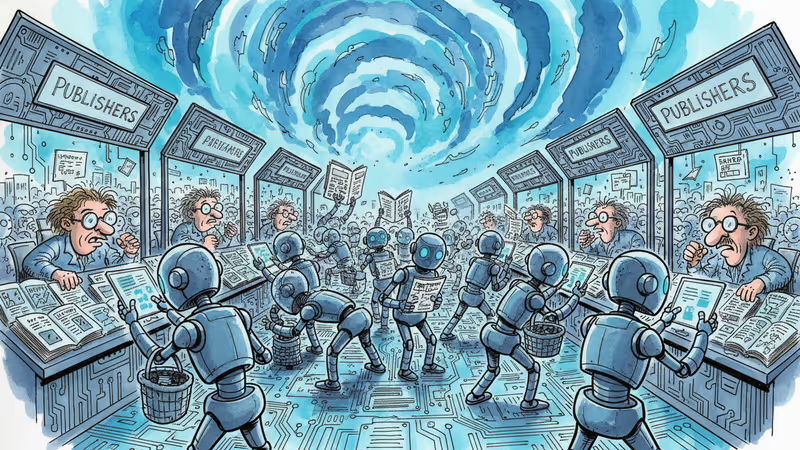
Microsoft's AI Content Marketplace Could Reshape Publishing Economics
Microsoft is building a licensing hub connecting AI companies with publishers. Will this platform solve the content crisis or just formalize what's already happening?
Microsoft is building what could become the Amazon of AI content licensing. The Publisher Content Marketplace (PCM) promises to connect AI companies with publishers through a standardized platform where content owners set their terms and AI firms can shop for licensing deals.
The tech giant says it's co-designing PCM with major publishers including Vox Media (The Verge's parent company), The Associated Press, Condé Nast, and People. The platform specifically targets "grounding" use cases—when AI models need to reference real-time information—and includes usage-based reporting to help publishers set appropriate pricing.
The End of the Free Lunch Era
The AI boom has been largely built on unpaid content. Companies like OpenAI, Google, and Anthropic scraped vast amounts of web content to train their models, rarely asking permission or paying creators. This approach worked when AI was primarily about pattern recognition, but it's becoming unsustainable as models need fresh, reliable information.
The backlash was inevitable. The New York Times sued OpenAI and Microsoft for copyright infringement. Dozens of other publishers have followed with similar lawsuits. Meanwhile, some major publishers have struck individual licensing deals—The Associated Press with OpenAI, The Atlantic with Google—but these negotiations favored large organizations with legal resources.
Microsoft's PCM could democratize this process. Instead of publishers needing to negotiate one-off deals with each AI company, they could list their content with standardized terms on a single platform.
Why Microsoft Is Playing Matchmaker
Microsoft isn't building this platform out of altruism. As AI capabilities advance, access to high-quality, legally cleared content is becoming a competitive advantage. The company's Copilot and other AI products increasingly rely on grounding—the ability to cite and reference current information—rather than just generating text from training data.

This shift changes the economics entirely. While training data might be scraped once and used indefinitely, grounding requires ongoing access to fresh content. Publishers hold the keys to this treasure trove, and they're no longer willing to give it away for free.
Regulatory pressure is also mounting. The EU's AI Act includes provisions about training data rights, and similar legislation is being considered elsewhere. Companies that proactively establish legitimate content sourcing may have an advantage as regulations tighten.
The Platform Play's Hidden Risks
While PCM could solve immediate licensing headaches, it also raises deeper questions about information flow in the AI age. If Microsoft controls a major content licensing hub, does that give the company too much influence over which information AI systems can access?
There's also the commoditization risk. By standardizing content licensing, PCM might drive down prices as publishers compete on a transparent marketplace. The publishers co-designing the platform today might find themselves squeezed by its very efficiency tomorrow.
For smaller publishers and independent creators, the platform could be either a lifeline or another layer of intermediation that reduces their bargaining power. The details of how PCM structures its marketplace—commission rates, discovery algorithms, minimum pricing—will determine which outcome emerges.
Beyond the Licensing Wars
PCM represents more than just a solution to copyright disputes. It's a bet on a future where AI companies and publishers collaborate rather than fight. But this collaboration comes with trade-offs.
Publishers gain new revenue streams but risk training their own competition. Every article licensed for grounding helps AI systems become better at generating similar content. Meanwhile, readers might increasingly encounter AI-synthesized information rather than original reporting, even when that synthesis is properly licensed.
The platform also highlights how AI is reshaping media economics. Publishers are being asked to monetize their content as raw material for AI systems, not just as direct reading experiences. This could fundamentally change what gets published and how.
Authors
Related Articles
Samsung Electronics' union branch revealed that 84% of survey respondents oppose the government's roughly $290 billion (₩400 trillion) semiconductor megaproject in Gwangju. Government, management, the union and shareholders are all reading the same national project in sharply different ways.
Nvidia shipped roughly a billion RISC-V cores in 2024, then announced it would run CUDA on the open standard. We break down how royalty-free instruction sets and open software stacks are trying to route around CUDA's lock-in. Part 2 of the Semiconductor Sovereignty series.

US AI-chip export controls split into three layers in the first half of 2026 — January easing, a May crackdown on circumvention, and a pending bill. Nvidia erased China from its guidance and still posted a record $81.6 billion quarter. A look at the export policy that both shields and cages it.

AMD's MI325X matches or beats Nvidia on memory and bandwidth — yet Nvidia's 86-92% share holds. The real moat is CUDA, 20 years in the making. Part 1 of 4.
Samsung Electronics' union branch revealed that 84% of survey respondents oppose the government's roughly $290 billion (₩400 trillion) semiconductor megaproject in Gwangju. Government, management, the union and shareholders are all reading the same national project in sharply different ways.
Nvidia shipped roughly a billion RISC-V cores in 2024, then announced it would run CUDA on the open standard. We break down how royalty-free instruction sets and open software stacks are trying to route around CUDA's lock-in. Part 2 of the Semiconductor Sovereignty series.
US AI-chip export controls split into three layers in the first half of 2026 — January easing, a May crackdown on circumvention, and a pending bill. Nvidia erased China from its guidance and still posted a record $81.6 billion quarter. A look at the export policy that both shields and cages it.
AMD's MI325X matches or beats Nvidia on memory and bandwidth — yet Nvidia's 86-92% share holds. The real moat is CUDA, 20 years in the making. Part 1 of 4.
Thoughts
Share your thoughts on this article
Sign in to join the conversation