
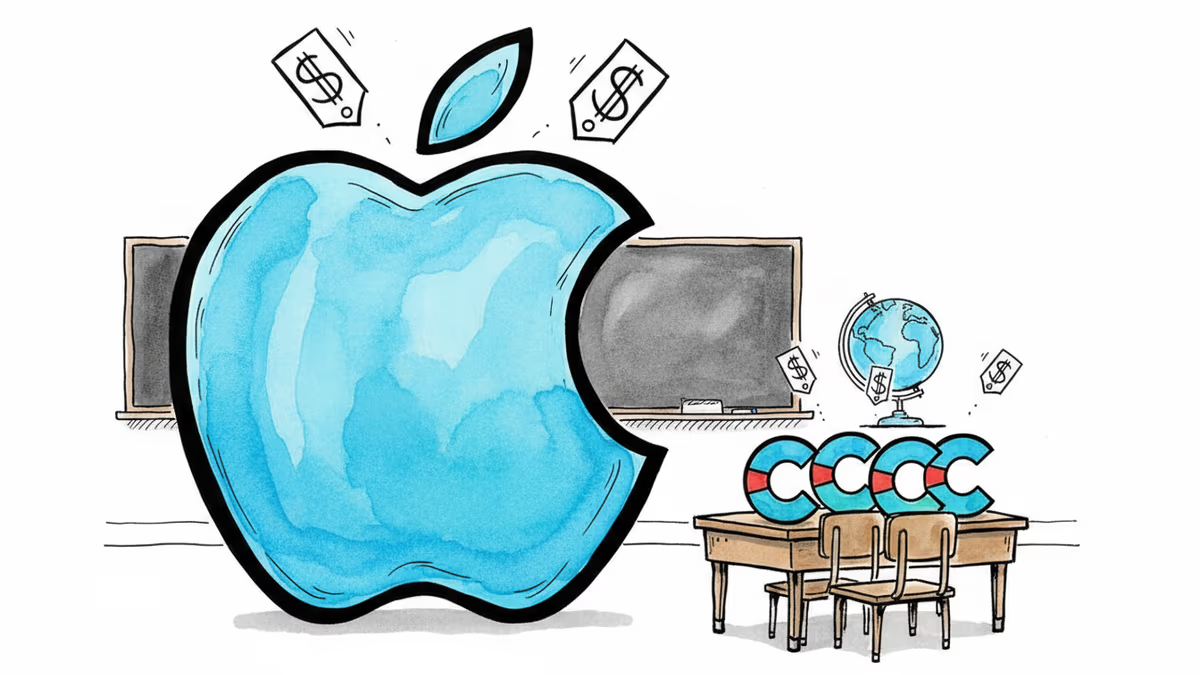
Apple's $599 MacBook Neo Isn't Really About Students
Apple launched the MacBook Neo at $599, targeting Chromebook territory. But the real strategy behind this budget laptop reveals Apple's broader ambitions in a changing market.
Apple Just Built Its Cheapest Laptop Ever—But Why Now?
Apple dropped a $599 laptop on Wednesday, and the tech world is scratching its head. The MacBook Neo isn't just cheap by Apple standards—it's cheaper than most iPads. But here's the thing: this isn't really about helping students afford their first Mac.
The 13-inch MacBook Neo comes in four colors and runs on the A18 Pro chip from the iPhone 16 Pro, not the more powerful M5 chip in the MacBook Air. Apple claims it's 50% faster for everyday tasks and 3x faster for AI workloads compared to Intel's latest chips. The base model includes 256GB storage, with a $699 variant offering 512GB and Touch ID.
The Chromebook Problem Apple Can't Ignore
Let's talk numbers. In the U.S. K-12 education market, Google Chromebooks command a staggering 65% market share. Apple? A measly 8%. That's not just embarrassing—it's a strategic disaster for a company that built its reputation in schools during the 1980s.
Education buyers have been clear about what they want: cheap, durable, and simple. Chromebooks deliver all three at around $300-400. Apple's previous cheapest option, the MacBook Air at $1,099, was simply out of reach for most school districts.
But educators' reactions to the Neo are mixed. "It's still twice the price of a decent Chromebook," notes Sarah Chen, IT director at a California school district. "We'd need to see significant educational software advantages to justify the cost difference."
The Real Strategy: Market Expansion

Here's where it gets interesting. Apple isn't just chasing schools—they're after a much bigger prize. Recent RAM shortages have pushed MacBook Pro prices up by $400, creating a gap in Apple's lineup that budget-conscious consumers can't bridge.
The choice of the A18 Pro chip is particularly telling. This isn't a laptop chip—it's a mobile processor. By using iPhone silicon, Apple achieves two goals: cost reduction and ecosystem integration. Your MacBook Neo can run the same apps with similar performance as your iPhone.
Market analysts see this as Apple's belated entry into tiered pricing. "Apple is finally admitting that not everyone can afford premium," says tech analyst Marcus Rivera. "This is their Android moment—expanding the addressable market instead of just milking existing customers."
What This Means for PC Makers
Windows laptop manufacturers should be worried. The $500-800 segment is their bread and butter, especially for students and budget-conscious professionals. A MacBook at $599 doesn't just compete on price—it brings the entire Apple ecosystem along.
Consider the value proposition: for $100 more than a mid-range Windows laptop, you get macOS, seamless iPhone integration, and access to Apple's software ecosystem. That's a compelling offer for anyone already using an iPhone—which is about 60% of U.S. smartphone users.
PC manufacturers are already responding. Dell and HP have reportedly accelerated their premium Chromebook development, while Lenovo is rumored to be working on a $499 premium Windows laptop specifically to counter the Neo.
The Risks Apple Is Taking
But Apple's budget move comes with risks. The company has spent decades building a premium brand image. Will a $599 MacBook dilute that cachet? History suggests mixed results—the iPhone SE maintained Apple's premium image while expanding market reach, but the colorful iPhone 5c was widely seen as a misstep.
There's also the cannibalization question. Why buy a $1,099 MacBook Air when the $599 Neo handles most tasks just fine? Apple's betting that expanding the market will offset any internal competition, but that's not guaranteed.
Authors
Related Articles
After 15 years of fragmented mobile messaging, Apple and Google are rolling out end-to-end encrypted RCS messaging between iPhones and Android devices. Here's what changed, why it took so long, and what it means for your privacy.
Apple agreed to pay $250 million to settle claims it misled iPhone 16 buyers about Apple Intelligence features. What this means for consumers, Big Tech marketing, and the AI industry.
Apple quietly removed the entry-level $599 Mac Mini, raising the starting price to $799 — just one day after Tim Cook warned of chip supply constraints on the earnings call.

Apple names John Ternus, its hardware engineering chief, as the next CEO. The shift from operator to product person signals where Apple thinks its next decade of growth will come from — and raises real questions about what comes next.
After 15 years of fragmented mobile messaging, Apple and Google are rolling out end-to-end encrypted RCS messaging between iPhones and Android devices. Here's what changed, why it took so long, and what it means for your privacy.
Apple agreed to pay $250 million to settle claims it misled iPhone 16 buyers about Apple Intelligence features. What this means for consumers, Big Tech marketing, and the AI industry.
Apple quietly removed the entry-level $599 Mac Mini, raising the starting price to $799 — just one day after Tim Cook warned of chip supply constraints on the earnings call.
Apple names John Ternus, its hardware engineering chief, as the next CEO. The shift from operator to product person signals where Apple thinks its next decade of growth will come from — and raises real questions about what comes next.
Thoughts
Share your thoughts on this article
Sign in to join the conversation