
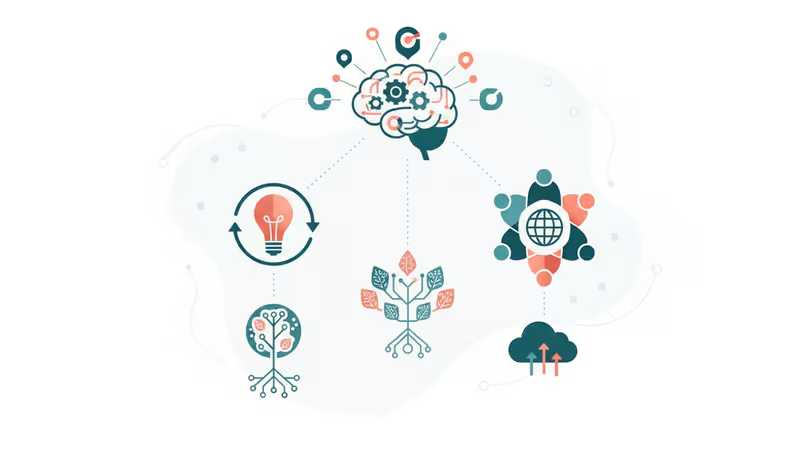
When AI Moves Into Your Apps
Anthropic's Claude can now work directly inside Slack, Canva, and other apps without tab-switching. This isn't just convenience—it's a fundamental shift in how we interact with software. What does this mean for productivity?
The era of endless tab-switching and copy-pasting is coming to an end. Anthropic'sClaude AI can now work directly inside apps like Slack, Canva, Figma, and Asana, turning what used to be a text-based assistant into an interactive workspace companion.
As of today, these tools "open as interactive apps right inside of chat," according to Anthropic. Instead of asking Claude to draft a Slack message and getting a text response back, you can now see the actual Slack interface appear in your chat window, format your message in real-time, and send it without ever leaving Claude.
This shift is powered by an extension to MCP (Model Context Protocol), the open-source standard that allows AI agents to access tools and data across the internet. But this isn't just about accessing data anymore—it's about direct manipulation.
From Text Responses to Real Interaction
The difference is profound. Previously, connecting Claude to external tools meant getting confirmations like "I've posted your message to Slack" or "I've created a task in Asana." You had to trust the AI got it right and switch tabs to verify.
Now, when you ask Claude to "create a presentation for tomorrow's client meeting," Canva's interface materializes inside your chat. You can see the slides being built, suggest changes, adjust colors, and add images—all without opening a new browser tab. It's like having Canva embedded directly in your AI conversation.
This represents a fundamental shift in human-computer interaction. Instead of learning each app's unique interface and workflow, you can now describe what you want in natural language and watch it happen in real-time.
The Context-Switching Problem
Why does this matter now? The average knowledge worker switches between 9-10 different applications throughout their workday. Email to Slack to Figma to Asana to Google Docs and back again. Each switch costs more than just time—research shows it takes an average of 23 minutes to fully refocus after a context switch.
Multiply that by dozens of daily app switches, and you've got a productivity crisis hiding in plain sight. We spend more time navigating between tools than actually using them creatively.
Claude's new approach attacks this problem head-on. Instead of you adapting to multiple interfaces, the AI becomes your single interface to everything else. You stay in one conversation while Claude handles the complexity of jumping between different systems.

The Bigger Picture: Software Eating Software
This development fits into a larger trend that's quietly reshaping the software industry. Traditional SaaS companies built their moats around user interface complexity and switching costs. Learning Photoshop or mastering Excel took months or years, creating natural barriers to competition.
But when AI can operate any interface on your behalf, those barriers start crumbling. Suddenly, the specific features of each tool matter less than how well they integrate with AI agents. Companies that built their competitive advantage on complex but powerful interfaces might find themselves vulnerable to simpler tools that play nicely with AI.
Microsoft seems to understand this shift, deeply integrating Copilot across their Office suite. Google is following suit with Gemini in Workspace. The race isn't just about having the best AI—it's about creating the most AI-friendly ecosystem.
Enterprise Implications
For businesses, this could represent a massive shift in software procurement decisions. Instead of evaluating individual tools based on their standalone capabilities, IT departments might start prioritizing integration-friendly platforms that work well with AI agents.
This could be particularly disruptive for specialized software companies. Why pay for expensive, feature-rich tools if an AI can accomplish the same tasks using simpler, cheaper alternatives? The value proposition shifts from "what can this software do?" to "how well does this software work with AI?"
Security teams, meanwhile, are probably having nightmares. Giving AI agents the ability to directly manipulate multiple business-critical applications raises obvious concerns about access control, audit trails, and potential misuse. The convenience comes with significant risk management challenges.
The Skills Question
Perhaps the most interesting implication is what this means for professional skills. If AI can handle the mechanical aspects of using complex software, what should humans focus on learning?
The answer might be shifting from tool mastery to prompt engineering and AI collaboration. Instead of becoming an Excel expert, you might need to become an expert at explaining to AI what kind of analysis you need. Instead of mastering Photoshop shortcuts, you might focus on clearly communicating your creative vision.
This mirrors historical technology shifts. When calculators became ubiquitous, arithmetic skills became less valuable while mathematical reasoning became more important. When word processors replaced typewriters, typing speed mattered less than writing quality.
Regulatory and Competitive Responses
Regulators are likely watching these developments closely. When AI agents can seamlessly operate across multiple platforms, traditional boundaries between services start to blur. This could raise antitrust questions, especially if certain AI providers become gatekeepers to entire software ecosystems.
Competitors aren't standing still either. OpenAI has been working on similar capabilities, and we can expect Google, Microsoft, and others to respond quickly. The question isn't whether this kind of integration will become standard—it's who will control the most valuable integrations.
Authors
Related Articles
Anthropic shipped Claude Sonnet 5, its mid-tier agent model, on June 30. Behind the 'Opus-class power, budget price' headline sits a tokenizer catch and a three-horse race that's only half real. Here's what developers should actually run the numbers on.
Samsung and SK unveiled a chip and AI investment package worth thousands of trillions of won on June 29. The headline number swings wildly by outlet, but the real contest isn't capital — it's water and power.
A small but growing group of developers has gone all-in on AI coding agents like Claude Code and OpenClaw. History suggests the rest of us won't be far behind.
Viral videos show 2026 graduates jeering executives who praise AI at commencement ceremonies. It's not just rudeness — it's a signal about who pays for technological optimism.
Anthropic shipped Claude Sonnet 5, its mid-tier agent model, on June 30. Behind the 'Opus-class power, budget price' headline sits a tokenizer catch and a three-horse race that's only half real. Here's what developers should actually run the numbers on.
Samsung and SK unveiled a chip and AI investment package worth thousands of trillions of won on June 29. The headline number swings wildly by outlet, but the real contest isn't capital — it's water and power.
A small but growing group of developers has gone all-in on AI coding agents like Claude Code and OpenClaw. History suggests the rest of us won't be far behind.
Viral videos show 2026 graduates jeering executives who praise AI at commencement ceremonies. It's not just rudeness — it's a signal about who pays for technological optimism.
Thoughts
Share your thoughts on this article
Sign in to join the conversation