
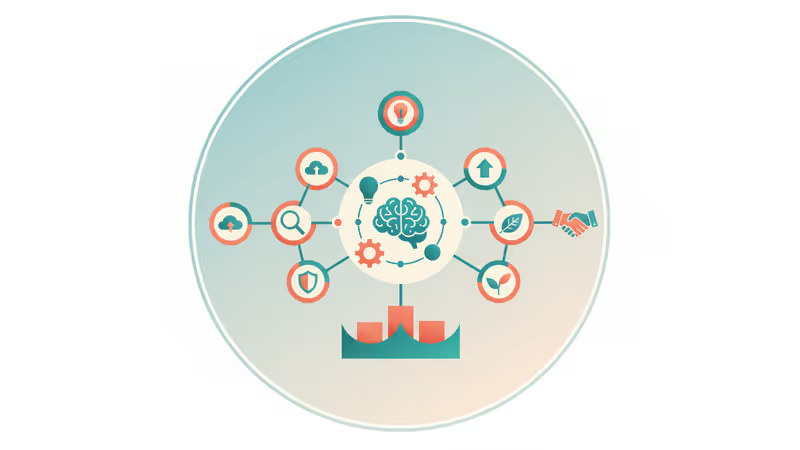
Who Really Controls Your Credit Score in the AI Era?
Experian's CEO reveals how AI is reshaping credit decisions. As algorithms judge our financial lives, are consumers gaining power or losing it?
Every time you apply for a loan or credit card, invisible AI systems are making judgments about your financial life. According to Alex Lintner, CEO of Technology and Software at Experian, more than 200 AI agents are already embedded in credit reporting systems, quietly shaping decisions that affect millions of Americans.
Experian holds data on 247 million Americans — essentially every adult participating in the economy. Now AI is analyzing this vast database in real-time, fundamentally changing how financial decisions get made. But as these systems become more powerful, a critical question emerges: who's really in control?
The Invisible AI Judges
Lintner describes AI as "a platform capability, not a feature" — technology that underpins entire systems rather than adding isolated functions. Experian's AI deployment is more extensive than most realize.
Take "model drift" detection. When banks create loan products, they predict default rates for specific credit score ranges. But real-world performance often diverges from predictions. AI now monitors these patterns continuously, identifying not just when models drift off-course, but pinpointing exactly which variables are causing problems.
"What used to require armies of analysts working with delayed data, AI now does in real-time with greater accuracy," Lintner explains. The efficiency gains are undeniable. The power dynamics, however, are more complex.
The Inescapable System
Experian insists consumers can opt out anytime. Privacy laws technically allow it. But try navigating modern life without a credit score — renting an apartment, buying a car, even getting certain jobs becomes nearly impossible.
Lintner knows this personally. As a German immigrant 30 years ago, he spent years commuting 90 minutes each way by public transit because he couldn't get a car loan without credit history. "Life's really hard" without access to credit, he admits.
This experience led Experian to create Experian Boost, a free service that factors utility bills, streaming subscriptions, and phone payments into credit scores. Unlike competitors who only consider loan history, Experian built real-time infrastructure that updates scores instantly when you add payment data.
It's a clever solution to a problem the system itself creates. But it also deepens dependence on the very infrastructure consumers might want to escape.

AI's Double-Edged Promise
The technology isn't without flaws. Lintner candidly admits that large language models "are much better at text than they are at math" — a concerning limitation for systems handling financial calculations.
Experian addresses this by requiring data scientists to review all AI outputs before deployment. "We're too early in the journey to let it run on its own," Lintner says. "Nothing goes into production without going through that process."
Multiple AI tools have been rejected during testing for inadequate performance. But this human oversight creates its own bottleneck in systems designed for scale and speed.
The real concern isn't just accuracy — it's bias. AI systems can perpetuate or amplify discriminatory patterns hidden in historical data. While Experian emphasizes that its models focus on behavior rather than demographics, the line between the two isn't always clear in practice.
The Security Arms Race
Of Experian's23,000 employees, 11,000 work in technology, with significant resources devoted to security. "Security is the first dollar we spend," Lintner states. "If we don't do that well, we don't have a reason for existing."
The stakes are existential. When competitor Equifax suffered a massive breach, they hired Experian to protect affected consumers — a backhanded compliment to Experian's security capabilities.
But AI cuts both ways. As Experian uses AI for better governance and fraud detection, bad actors deploy AI for more sophisticated attacks. The company recently acquired Neuro-ID to better detect automated bot attacks, acknowledging that traditional security measures aren't keeping pace.
The Trust Deficit
When pressed about public perception, Lintner's response was telling: "We're not Palantir." Setting the bar at "we're not a surveillance company" reveals how low expectations have fallen for data-driven businesses.
Experian points to net promoter scores from direct-to-consumer customers who voluntarily share data. But the broader population — those who encounter Experian through denied loans or identity theft alerts — may feel differently about a company that wields such influence over their financial lives.
The fundamental tension remains: Experian provides tools that enable others to make decisions about you, using data you can't fully control, through systems you can't fully understand.
Authors
Related Articles

Samsung and SK unveiled a chip and AI investment package worth thousands of trillions of won on June 29. The headline number swings wildly by outlet, but the real contest isn't capital — it's water and power.
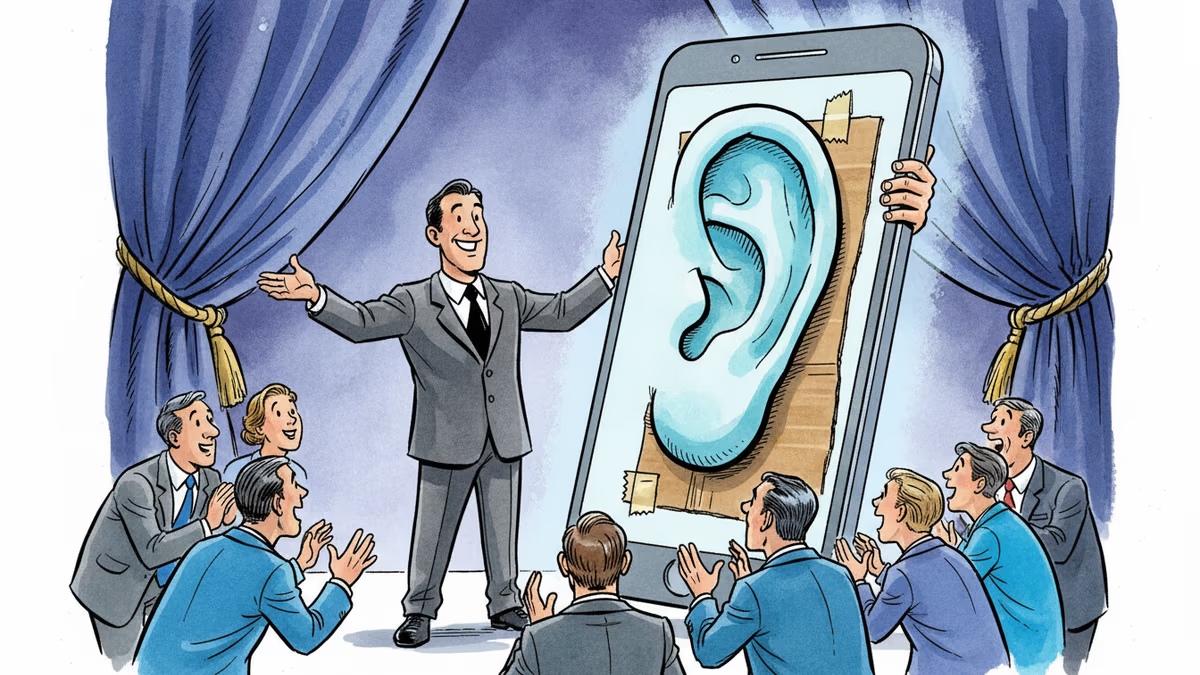
The FTC fined Cox Media and two ad firms $930,000 — not for actually eavesdropping on users, but for falsely claiming they could. The case raises uncomfortable questions about surveillance capitalism.

Viral videos show 2026 graduates jeering executives who praise AI at commencement ceremonies. It's not just rudeness — it's a signal about who pays for technological optimism.
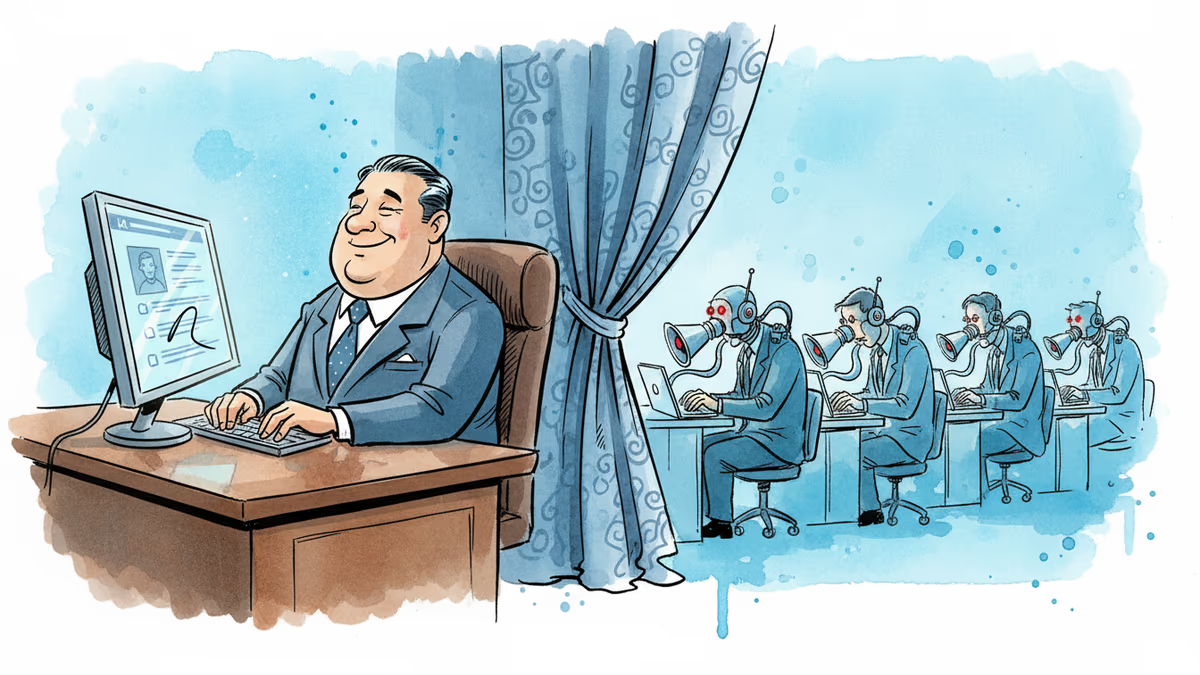
Filipino virtual assistants using AI to ghost-manage LinkedIn profiles for executives is now a structured industry. 30 comments a day, fake engagement rings, and a platform struggling to tell real from fabricated.
Samsung and SK unveiled a chip and AI investment package worth thousands of trillions of won on June 29. The headline number swings wildly by outlet, but the real contest isn't capital — it's water and power.
The FTC fined Cox Media and two ad firms $930,000 — not for actually eavesdropping on users, but for falsely claiming they could. The case raises uncomfortable questions about surveillance capitalism.
Viral videos show 2026 graduates jeering executives who praise AI at commencement ceremonies. It's not just rudeness — it's a signal about who pays for technological optimism.
Filipino virtual assistants using AI to ghost-manage LinkedIn profiles for executives is now a structured industry. 30 comments a day, fake engagement rings, and a platform struggling to tell real from fabricated.
Thoughts
Share your thoughts on this article
Sign in to join the conversation