

Your Contracts Never Leave Your Laptop with This AI
SpotDraft raised $8M from Qualcomm to scale on-device contract AI that works completely offline. Could privacy-first enterprise AI reshape how sensitive documents are processed?
Every time legal teams review contracts with AI, there's an uncomfortable question: Is it really safe to send sensitive deal terms through someone else's cloud?
SpotDraft just raised $8 million from Qualcomm Ventures with a simple answer: don't send them at all. Their VerifAI system processes contract reviews entirely offline, keeping documents locked on the user's device.
The strategic Series B extension values the company at around $380 million — nearly double its $190 million valuation from February last year. That's not just growth; it's validation of a fundamentally different approach to enterprise AI.
Privacy Concerns Are Driving Innovation
Across regulated industries, the promise of generative AI has collided with the reality of compliance requirements. Defense contractors can't route classified agreements through external servers. Pharmaceutical companies face data residency rules. Law firms handle privileged information that simply cannot leave their premises.
"The future of enterprise AI has to be close to the document," said Shashank Bijapur, SpotDraft's co-founder and CEO. "Privacy critical, latency sensitive, legally sensitive — those are the things that will move on device."
At Qualcomm's Snapdragon Summit, SpotDraft demonstrated VerifAI running end-to-end on laptop hardware, executing contract review, risk scoring, and redlining without any internet connection. The document never leaves the local machine.
The Performance Gap Is Closing Fast

What makes this shift possible is how quickly on-device models have caught up to their cloud-based cousins. Co-founder and CTO Madhav Bhagat told TechCrunch that the performance difference between frontier cloud models and fine-tuned on-device versions is now just 5%. Speed has actually improved — newer chips deliver response times that are one-third of cloud processing.
This isn't just about generating summaries. VerifAI applies complex playbooks and recommendations directly inside Microsoft Word, comparing contracts against guidelines and prior policies where legal teams already work.
Market Validation Speaks Volumes
SpotDraft has grown from around 400 customers in February last year to over 700 today. The platform now processes more than 1 million contracts annually, with contract volumes growing 173% year-over-year and nearly 50,000 monthly active users.
The company expects 100% revenue growth in 2026, following 169% growth in 2024 and similar rates in 2025. While they didn't share specific revenue figures, that trajectory suggests the market is ready for privacy-first enterprise AI.
Customers include Apollo.io, Panasonic, Zeplin, and Whatfix — companies that clearly see value in keeping sensitive business logic local.
The Broader Implications
This shift toward on-device processing could reshape enterprise software beyond legal tech. If AI can deliver cloud-level performance while keeping data local, why accept the privacy trade-offs of server-based processing?
The timing aligns with growing regulatory pressure on data handling. European GDPR requirements, U.S. state privacy laws, and industry-specific compliance standards are making data residency a competitive advantage, not just a nice-to-have feature.
SpotDraft's on-device capability is currently available to limited customers, expanding as AI PC hardware becomes more widespread. The Bengaluru and New York-based company employs over 300 people and has raised $92 million to date, including investments from Vertex Growth Singapore, Trident Growth Partners, and Prosus Ventures.
Authors
Related Articles

Samsung and SK unveiled a chip and AI investment package worth thousands of trillions of won on June 29. The headline number swings wildly by outlet, but the real contest isn't capital — it's water and power.

Viral videos show 2026 graduates jeering executives who praise AI at commencement ceremonies. It's not just rudeness — it's a signal about who pays for technological optimism.
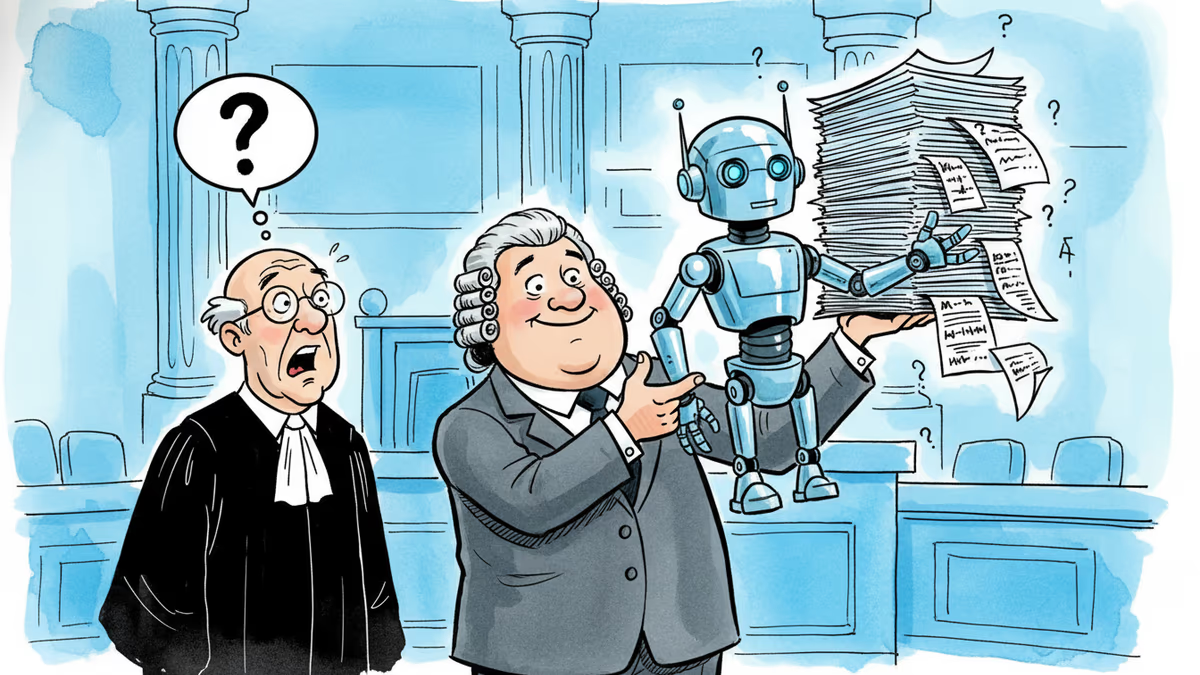
A law firm marketing itself on AI-powered legal success submitted fake citations in a federal appeal. Now its lawyers face sanctions — and the broader AI legal industry faces a credibility crisis.

Filipino virtual assistants using AI to ghost-manage LinkedIn profiles for executives is now a structured industry. 30 comments a day, fake engagement rings, and a platform struggling to tell real from fabricated.
Samsung and SK unveiled a chip and AI investment package worth thousands of trillions of won on June 29. The headline number swings wildly by outlet, but the real contest isn't capital — it's water and power.
Viral videos show 2026 graduates jeering executives who praise AI at commencement ceremonies. It's not just rudeness — it's a signal about who pays for technological optimism.
A law firm marketing itself on AI-powered legal success submitted fake citations in a federal appeal. Now its lawyers face sanctions — and the broader AI legal industry faces a credibility crisis.
Filipino virtual assistants using AI to ghost-manage LinkedIn profiles for executives is now a structured industry. 30 comments a day, fake engagement rings, and a platform struggling to tell real from fabricated.
Thoughts
Share your thoughts on this article
Sign in to join the conversation