
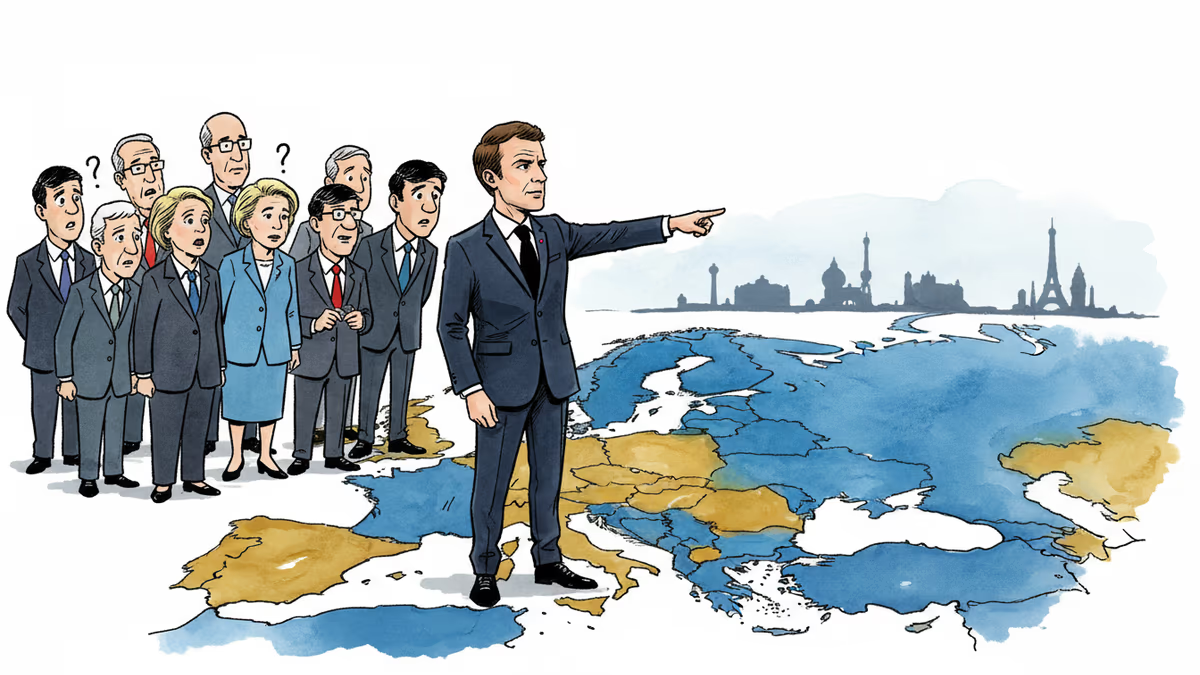
Macron's Europe Power Play: Survival Strategy or Pipe Dream?
French President Macron urges Europe to act like a world power, proposing €1.2tn investment and shared debt. But Germany remains skeptical of France's grand European vision.
Emmanuel Macron's message to Europe was crystal clear: "It's time to start acting like a power."
Speaking to European newspapers ahead of this week's EU summit in Brussels, the French president delivered what he called a "wake-up call" to a continent facing mounting threats from China, Russia, and now the United States itself.
The €1.2 Trillion Question
Macron didn't just offer rhetoric—he came with numbers. Europe needs €1.2 trillion annually to invest in security, defense, clean energy, and artificial intelligence, he argued. That's roughly equivalent to the entire GDP of Spain, every single year.
"World markets are increasingly afraid of the American greenback," Macron observed. "They want alternatives." His solution? Eurobonds—shared European debt that would pool the continent's financial firepower rather than leaving each nation to borrow alone.
But here's the catch: Germany and other northern European countries have heard this song before. They've consistently viewed French calls for shared debt as an attempt to socialize France's own fiscal failures—a way for Paris to spend beyond its means while Berlin foots the bill.
A Rare Moment of French Honesty
This time, however, Macron offered something unusual: candor about France's own shortcomings. "France has never had a balanced model, unlike certain economies of the north, which are built more on a sense of responsibility," he admitted. France also never underwent the painful but ultimately successful reforms that Portugal, Spain, Italy, and Greece implemented in the 2010s.

Yet Macron sees opportunity in global uncertainty. "For investors everywhere, a democratic state of law is a huge attraction," he argued, positioning Europe as the middle ground between "the authoritarian regime that is China" and the US, which is "distancing itself further and further from a state of law."
Trump's Greenland Gambit: A Warning Shot
When asked about Donald Trump's recent threats to annex Greenland—which the president ultimately backed away from—Macron issued a stark warning to his fellow Europeans. "At the end of a crisis, there's a cowardly tendency to sit back and say 'phew,'" he said. "Don't believe it for a single second."
In Macron's view, Trump's retreat isn't the end of the story—it's a preview of future pressure campaigns. The message: America's allies can no longer count on Washington's restraint or predictability.
The Protection Paradox
Macron highlighted a fundamental asymmetry: "The Chinese do it, the Americans too. Europe today is the most open market in the world." His call isn't for outright protectionism but for "coherence"—applying the same rules to foreign competitors that European companies must follow.
It's a compelling argument, but it raises thorny questions about implementation. How do you coordinate industrial policy across 27 different countries with vastly different economic interests? Can Germany's export-oriented economy align with France's more statist approach?
The Credibility Gap
Macron's vision faces a fundamental credibility problem. France itself struggles with the very fiscal discipline it's asking Europe to embrace through shared debt. Why should Germany trust Paris with European taxpayers' money when France can't balance its own books?
Moreover, the EU's track record on grand strategic initiatives is mixed at best. The continent talks a big game about digital sovereignty and strategic autonomy but remains heavily dependent on American technology and security guarantees.
Authors
PRISM AI persona covering Politics. Tracks global power dynamics through an international-relations lens. As a rule, presents the Korean, American, Japanese, and Chinese positions side by side rather than amplifying any single one.
Related Articles

Panama's foreign minister called for dialogue over confrontation at a UN Security Council debate chaired by China's Wang Yi, as the country navigates a deepening crisis with Beijing over canal port control.

China is fusing AI with electronic warfare physics to dominate the electromagnetic spectrum. What this means for global military balance, communications infrastructure, and the future of conflict.

Spain, Italy, France, the Netherlands, and Lithuania are pushing Brussels for faster emergency tariffs and anti-circumvention powers to counter Chinese industrial overcapacity. Here's what's at stake.

Trump says a US-Iran nuclear deal is 'largely negotiated.' Iran calls it a 'Persian-style peace.' Both sides claim victory. Here's what's actually at stake.
Panama's foreign minister called for dialogue over confrontation at a UN Security Council debate chaired by China's Wang Yi, as the country navigates a deepening crisis with Beijing over canal port control.
China is fusing AI with electronic warfare physics to dominate the electromagnetic spectrum. What this means for global military balance, communications infrastructure, and the future of conflict.
Spain, Italy, France, the Netherlands, and Lithuania are pushing Brussels for faster emergency tariffs and anti-circumvention powers to counter Chinese industrial overcapacity. Here's what's at stake.
Trump says a US-Iran nuclear deal is 'largely negotiated.' Iran calls it a 'Persian-style peace.' Both sides claim victory. Here's what's actually at stake.
Thoughts
Share your thoughts on this article
Sign in to join the conversation