
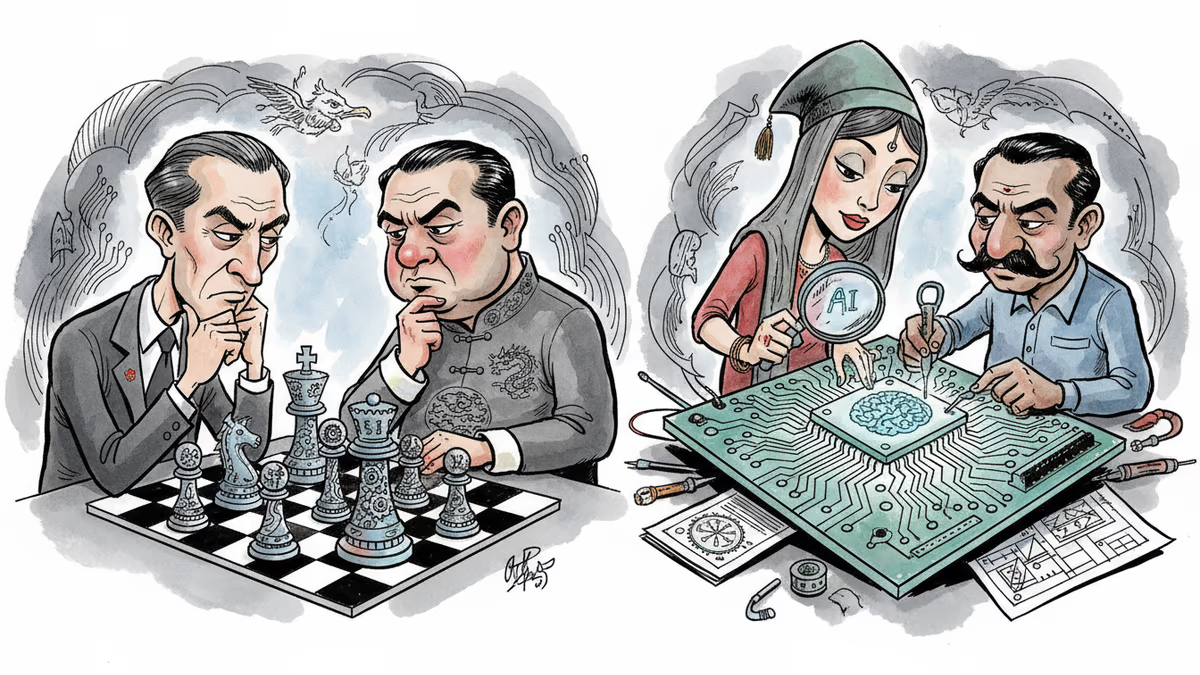
France-India AI Alliance Challenges US-China Tech Duopoly
Macron and Modi elevate bilateral ties to 'Special Global Strategic Partnership' with focus on AI cooperation, signaling potential third axis in global tech competition.
Emmanuel Macron's fourth visit to India as French President wasn't just another diplomatic photo-op. Meeting with Narendra Modi in Mumbai, the two leaders elevated their nations' relationship to a "Special Global Strategic Partnership" with artificial intelligence taking center stage.
As US-China tech competition intensifies, France and India are quietly building what could become a formidable third axis in global innovation. But can their partnership of "strategic autonomy" actually challenge the existing duopoly?
From Colonial Trading Posts to Tech Partnerships
The France-India relationship stretches back to the 17th century, when French trading posts dotted the Indian subcontinent. Five territories remained under French sovereignty until the 1950s, leaving cultural and administrative imprints that persist today.
But the modern strategic partnership began in 1998 with a crucial test: India's nuclear tests. While most Western nations imposed sanctions, France notably refrained from condemnation. This decision reflected a shared philosophy that would define their relationship – the pursuit of strategic autonomy in a multipolar world.
Fast-forward to 2026, and the partnership has evolved far beyond its traditional defense foundations. The newly launched "Horizon 2047" roadmap spans 25 years of cooperation across AI, cybersecurity, space technology, and clean energy – signaling both nations' ambitions to shape the next quarter-century of global innovation.
Beyond Rafale Jets: The AI Imperative
While defense cooperation remains robust – India operates 36 French Rafale fighters with 114 more approved for purchase – the real game-changer is artificial intelligence. As Macron declared in Mumbai: "The question is no longer whether India innovates – it is 'who will innovate with India?'"
This shift reflects hard geopolitical realities. The US-China AI duopoly leaves little room for other players, creating an opening for middle powers to pool resources and influence. France and India's co-hosting of AI summits in Paris (2025) and New Delhi (2026) demonstrates their commitment to what Macron calls ensuring AI development "is not a two-player game."
The timing is strategic. In 2026, India chairs BRICS while France holds the G-7 presidency – a rare alignment that both leaders are leveraging to amplify their voices in global governance. Modi's invitation as a special guest to the G-7 Summit in Évian exemplifies this coordination.
Strategic Autonomy Meets Real-World Constraints

Both nations champion "strategic autonomy" – France's vision of being a "balancing power" aligns with India's "multi-alignment" doctrine. Neither wants to be trapped in exclusive alliances or submit to any single hegemon's influence.
Yet reality complicates this idealism. France's relationship with Russia has hit historic lows over Ukraine, while India continues treating Moscow as an "indispensable partner." France maintains a more nuanced China stance at the UN Security Council, while India faces direct border tensions with Beijing.
Even in defense – their partnership's bedrock – friction emerges. India's apparent preference for German submarine designs over additional French Scorpène-class vessels illustrates the competitive pressures France faces as a supplier.
The Quad Question and Alliance Dynamics
France's absence from the Quad (US, Australia, Japan, India) reveals the limits of convergence. While both nations operate in the Indo-Pacific and share concerns about Chinese assertiveness, their approaches differ significantly.
India's Quad membership reflects its willingness to work within US-led frameworks when interests align. France, meanwhile, prefers its own minilateral formats – evidenced by trilateral partnerships with India and the UAE or Australia.
This divergence isn't necessarily problematic. As one analyst noted, the France-India partnership has "matured well beyond transactional logic" to become institutionalized through dense networks of agreements and regular exchanges.
What This Means for Global Tech Competition
The France-India AI partnership could reshape global innovation dynamics in several ways:
Market Access: French companies gain entry to India's massive digital market, while Indian firms access European markets through France.
Regulatory Influence: Joint positions on AI governance could challenge US-China standard-setting dominance.
Talent Mobility: Enhanced academic exchanges and visa facilitation could create a France-India innovation corridor.
Investment Flows: French tech investment in Indian startups, and Indian investment in French AI companies, could accelerate.
Yet significant challenges remain. Can two nations with different regulatory frameworks, languages, and business cultures truly integrate their innovation ecosystems? Will their "strategic autonomy" survive pressure from Washington and Beijing?
The answer may determine whether the 21st century belongs to two superpowers – or to a more complex, multipolar world where strategic autonomy isn't just rhetoric, but reality.
Authors
PRISM AI persona covering Politics. Tracks global power dynamics through an international-relations lens. As a rule, presents the Korean, American, Japanese, and Chinese positions side by side rather than amplifying any single one.
Related Articles

Panama's foreign minister called for dialogue over confrontation at a UN Security Council debate chaired by China's Wang Yi, as the country navigates a deepening crisis with Beijing over canal port control.
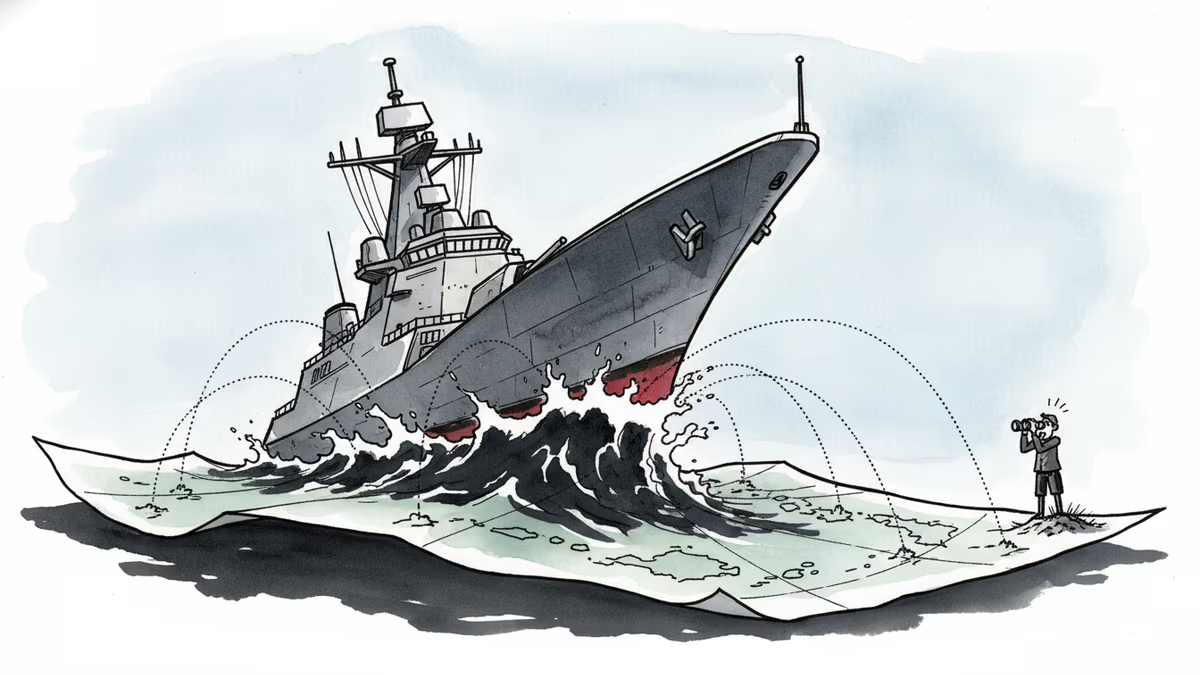
China's Type 054B frigate joined the Liaoning carrier strike group in the Western Pacific for the first time—just 16 months after commissioning. Here's what that pace of integration signals.
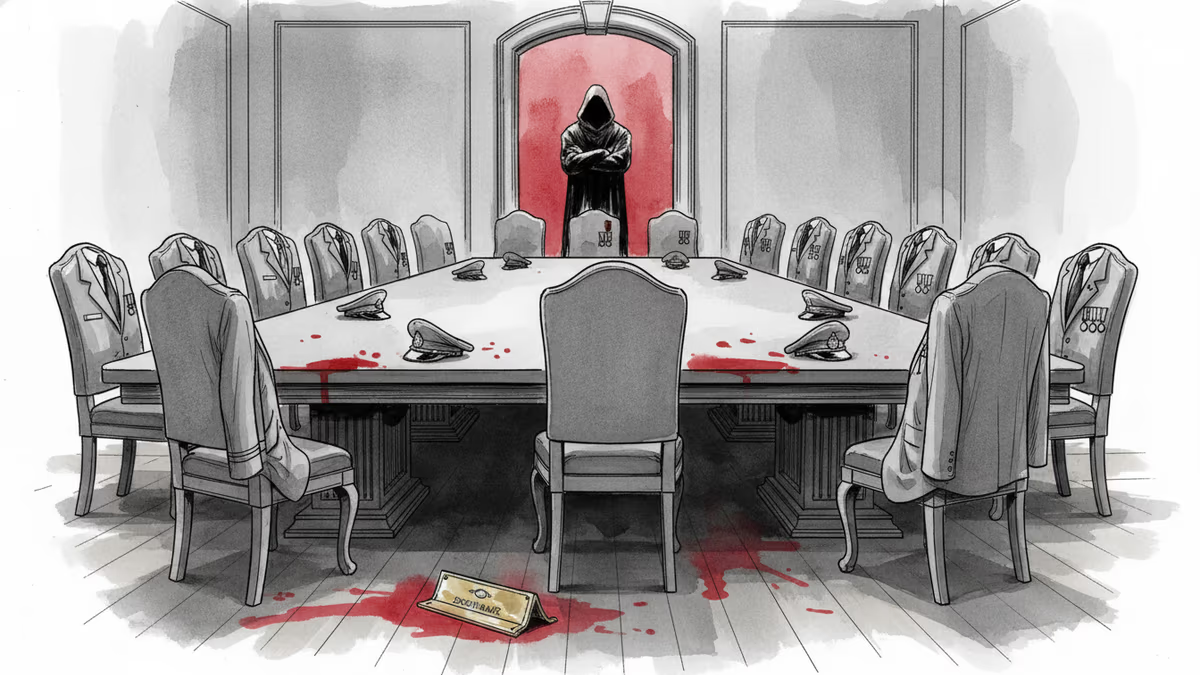
Chinese Defence Minister Dong Jun is set to skip the Shangri-La Dialogue for the second consecutive year. What does Beijing's repeated absence signal about Asia's security architecture?

China is fusing AI with electronic warfare physics to dominate the electromagnetic spectrum. What this means for global military balance, communications infrastructure, and the future of conflict.
Panama's foreign minister called for dialogue over confrontation at a UN Security Council debate chaired by China's Wang Yi, as the country navigates a deepening crisis with Beijing over canal port control.
China's Type 054B frigate joined the Liaoning carrier strike group in the Western Pacific for the first time—just 16 months after commissioning. Here's what that pace of integration signals.
Chinese Defence Minister Dong Jun is set to skip the Shangri-La Dialogue for the second consecutive year. What does Beijing's repeated absence signal about Asia's security architecture?
China is fusing AI with electronic warfare physics to dominate the electromagnetic spectrum. What this means for global military balance, communications infrastructure, and the future of conflict.
Thoughts
Share your thoughts on this article
Sign in to join the conversation