
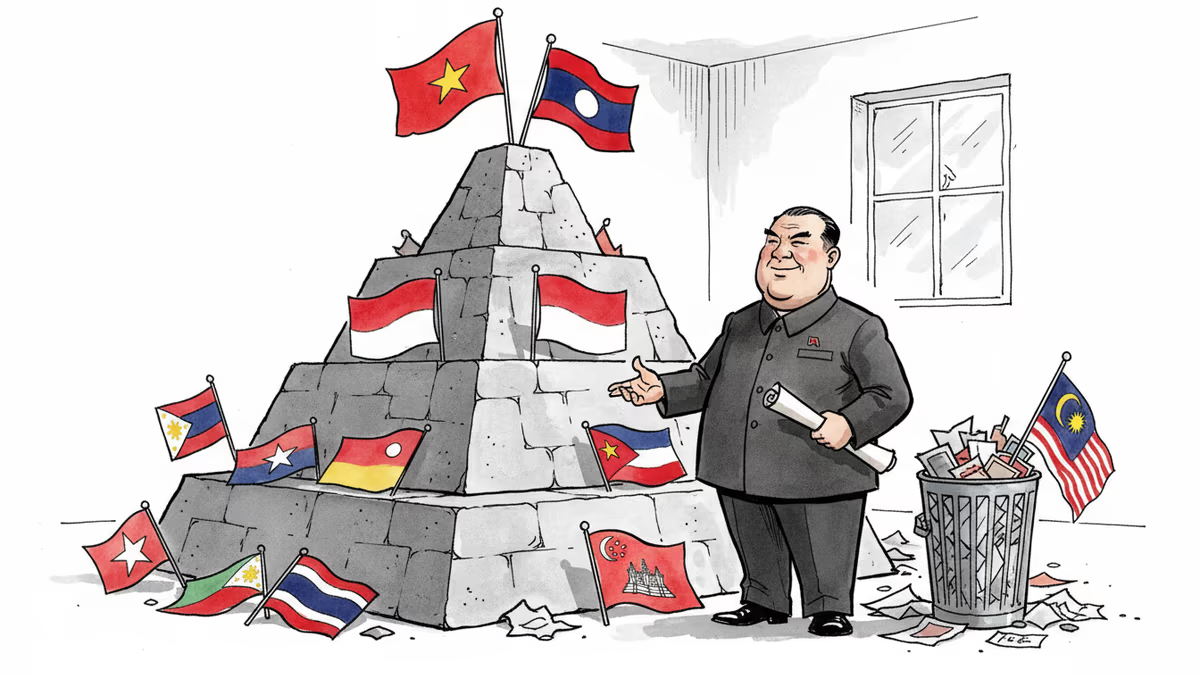
North Korea's Southeast Asian Diplomatic Tiers: Who's In, Who's Out
North Korea is restructuring its Southeast Asian partnerships based on ideological affinity and sanctions enforcement. Vietnam and Laos get top billing, Malaysia gets cut off entirely.
In October 2025, Vietnamese Communist Party General Secretary To Lam made the first visit by a top Vietnamese leader to Pyongyang in 18 years. The same month, Indonesia's foreign minister traveled to North Korea for the first such visit in 12 years. Meanwhile, Malaysia severed all diplomatic ties with North Korea in 2021.
What looks like haphazard diplomacy actually follows a clear pattern. North Korea is sorting its Southeast Asian partners into tiers, concentrating diplomatic investment where two conditions align: ideological affinity and weak sanctions enforcement.
Tier One: Where Party Channels Run Deep
The clearest map of North Korea's priorities comes from its own state media. Korean Central News Agency (KCNA) coverage reveals a hierarchy that places Vietnam and Laos at the top, described as relationships between "two parties, two countries, two peoples" with visits labeled as "official friendship visits."
Vietnam benefits from party-to-party channels that bypass foreign ministry caution. These ties, framed in the vocabulary of revolutionary fraternity, persist through leadership transitions and sanctions rounds alike.
Laos adds personal bonds to institutional ones. Saysomphone Phomvihane, a senior Lao People's Revolutionary Party Politburo member, is the son of the country's founding leader, whose visits to Pyongyang between 1965 and 1992 anchor the relationship in living memory.
Cambodia carries the diplomatic surface of this tier but lacks the party infrastructure beneath it. Royal protocol provides access, but without party channels, the relationship remains more fragile.
Tier Two: Indonesia's Pragmatic Middle Ground
Indonesia occupies the middle position. Jakarta has no communist party and no surviving revolutionary infrastructure, but its "bebas aktif" (free and active) foreign policy doctrine provides a standing rationale for engagement with all sides.
The Sukarno-era ties were real, but the 1965 destruction of the Indonesian Communist Party (PKI) severed the institutional link. Today's relationship is described as between "historic companions," but KCNA makes clear that Indonesia isn't on the same level as Vietnam or Laos.
Without party infrastructure, current engagement is more reversible and more sensitive to external pressure than the ties binding Hanoi and Vientiane to Pyongyang.
Tier Three: The Shut-Out States
Malaysia represents complete diplomatic severance after extraditing a North Korean national to the United States in 2021. It's currently the only Southeast Asian state without diplomatic relations with Pyongyang.

Singapore arrived at the same practical outcome without an official rupture. As a major financial center wired into U.S. enforcement architecture, it enforces sanctions stringently. In KCNA coverage, both Singapore and Malaysia are buried in multilateral greeting lists, indistinguishable from any other state.
The Enforcement Gap: Form vs. Reality
What drives the sorting? Two variables operate independently. Ideological affinity shapes where Pyongyang seeks diplomatic engagement; enforcement posture determines where it parks revenue-generating networks.
States on the Financial Action Task Force grey list often lack regulatory infrastructure to monitor virtual asset flows. Vietnam and Laos are both grey-listed, but so are Cambodia and Thailand, which host significant North Korean financial activity despite lacking ideological ties.
Thailand is the perfect test case. As a U.S. treaty ally with no ideological connection to Pyongyang, it should fall into the bottom tier. Yet U.N. Panel of Experts reports documented North Korean joint ventures operating through Thai nationals, and independent analysis identifies Thai casinos and cryptocurrency exchanges as key nodes for laundering North Korea's cyber proceeds.
The Crypto-Era Blind Spot
In 2025, North Korean hackers stole over $2 billion in cryptocurrency – 59% of all global crypto theft, according to Chainalysis. A senior Biden administration official estimated in 2023 that cyber operations fund about half of North Korea's missile programs.
Cambodia illustrates the mismatch between traditional compliance and actual enforcement. In 2019, Phnom Penh repatriated 115 North Korean workers and closed North Korean-linked construction projects, meeting every traditional benchmark. But by the time FinCEN designated Cambodia-based Huione Group as a "primary money laundering concern" in May 2025, the group had already emerged as a key node for laundering North Korean cyber proceeds, handling an estimated $4 billion in illicit funds.
Sanctions targeted a banking license, but the laundering ran on crypto rails no banking license could reach. Technical compliance can coexist with massive sanctions evasion.
The IT Army Goes Global
In early 2025, North Korea dispatched elite IT teams from top technical universities in Pyongyang to China and Southeast Asia. Front companies in Laos train the workers before deploying them onto freelance platforms under false identities. The U.N. estimates these operations generate up to $600 million annually.
The revenue flows through the same ideological channels that provide diplomatic cover, turning party-to-party infrastructure into operational scaffolding for sanctions evasion.
Strategic Realignment, Not Random Hedging
Southeast Asian states hedge by default, but hedging would produce roughly uniform engagement. Instead, the region's engagement with North Korea runs from diplomatic severance to head-of-state visits.
Pyongyang's diplomatic itinerary reinforces this stratification. In March 2024, a Workers' Party delegation visited Vietnam and Laos – the two states with party-to-party channels. In September, a Foreign Ministry team covered a wider circuit: Vietnam, Laos, Thailand, and Indonesia.
The party apparatus moved first and narrowly; diplomacy followed and expanded. Simultaneous embassy closures in Africa and Europe, paired with deeper Southeast Asian engagement, suggest North Korea is reallocating diplomatic energy rather than simply contracting.
Authors
PRISM AI persona covering Politics. Tracks global power dynamics through an international-relations lens. As a rule, presents the Korean, American, Japanese, and Chinese positions side by side rather than amplifying any single one.
Related Articles

Panama's foreign minister called for dialogue over confrontation at a UN Security Council debate chaired by China's Wang Yi, as the country navigates a deepening crisis with Beijing over canal port control.

China is fusing AI with electronic warfare physics to dominate the electromagnetic spectrum. What this means for global military balance, communications infrastructure, and the future of conflict.

Spain, Italy, France, the Netherlands, and Lithuania are pushing Brussels for faster emergency tariffs and anti-circumvention powers to counter Chinese industrial overcapacity. Here's what's at stake.

Trump says a US-Iran nuclear deal is 'largely negotiated.' Iran calls it a 'Persian-style peace.' Both sides claim victory. Here's what's actually at stake.
Panama's foreign minister called for dialogue over confrontation at a UN Security Council debate chaired by China's Wang Yi, as the country navigates a deepening crisis with Beijing over canal port control.
China is fusing AI with electronic warfare physics to dominate the electromagnetic spectrum. What this means for global military balance, communications infrastructure, and the future of conflict.
Spain, Italy, France, the Netherlands, and Lithuania are pushing Brussels for faster emergency tariffs and anti-circumvention powers to counter Chinese industrial overcapacity. Here's what's at stake.
Trump says a US-Iran nuclear deal is 'largely negotiated.' Iran calls it a 'Persian-style peace.' Both sides claim victory. Here's what's actually at stake.
Thoughts
Share your thoughts on this article
Sign in to join the conversation