
Inside North Korea's Power Play: What Kim's Rare Congress Reveals
North Korea's first party congress in 5 years focuses on economy over diplomacy, as Kim Jong Un navigates succession plans and global isolation amid changing geopolitics.
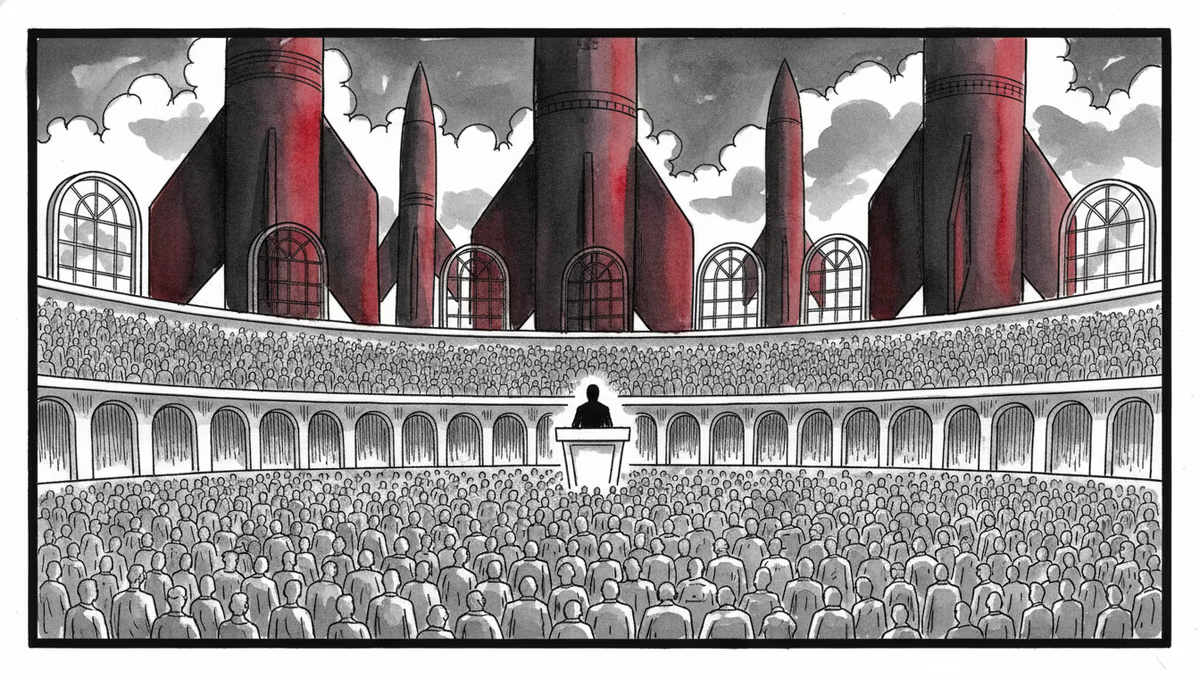
Every five years, the world gets a rare glimpse behind North Korea's iron curtain. This week, 5,000 party representatives gathered in Pyongyang for the Workers' Party of Korea's Ninth Congress—the hermit kingdom's most consequential political event since 2021.
But what's striking isn't just the pageantry. It's what Kim Jong Un chose not to say.
The Silence That Speaks Volumes
In his opening address Thursday, Kim made no mention of relations with South Korea or the United States—countries his regime typically brands as existential threats. Instead, the Supreme Leader focused on something far more mundane: fixing the economy.
"Ahead of our party are heavy and urgent tasks of advancing economic development and improving people's livelihoods," Kim declared to the assembled delegates, according to state media KCNA. It was a remarkably domestic agenda for a leader who has spent years perfecting the art of nuclear brinkmanship.
This shift comes as North Korea shows signs of gradual economic recovery. Post-COVID trade with China has rebounded, while weapons exports to Russia—supporting Moscow's war in Ukraine—have provided a crucial revenue stream. Several thousand North Korean troops are now fighting alongside Russian forces, marking Pyongyang's most direct military involvement in a foreign conflict in decades.
The Succession Question
Behind the economic rhetoric lies a more intriguing subplot: the future of the Kim dynasty. South Korea's intelligence services are closely monitoring the congress for any formal designation of Kim's teenage daughter, Kim Ju Ae, as his successor.
The 15-year-old has appeared at increasingly prominent events, from missile launches to military parades. If Kim announces her as heir apparent, it would formalize a fourth-generation succession in one of the world's most isolated regimes.
Yet succession in North Korea remains a delicate balance. Kim himself wasn't publicly identified as his father's successor until just two years before Kim Jong Il's death in 2011. The timing of any announcement could signal Kim's confidence in his regime's stability—or reveal underlying vulnerabilities.

Trump's Shadow Over Pyongyang
The congress unfolds against the backdrop of Donald Trump's return to the White House. The former president, who famously stepped foot into North Korea in 2019 for a photo opportunity with Kim, has expressed 100 percent openness to meeting again.
But Kim's silence on U.S. relations suggests a more cautious approach than five years ago, when he declared America his nation's "biggest enemy" at the previous congress. The North Korean leader may be waiting to see how Trump's broader Asia strategy unfolds before committing to any diplomatic overtures.
This calculated restraint reflects lessons learned from their previous encounters. Despite the historic summits, the Trump-Kim meetings produced little concrete progress on denuclearization, leaving both sides wary of repeating past disappointments.
The Economic Reality Check
Kim's focus on economic development isn't just political theater—it reflects genuine domestic pressures. While the true state of North Korea's economy remains opaque, outside experts suggest the country faces mounting challenges despite recent improvements.
The weapons trade with Russia provides short-term relief, but it also deepens North Korea's dependence on authoritarian allies. Meanwhile, international sanctions continue to limit access to global markets and technology, constraining long-term growth prospects.
Kim's emphasis on "transforming all aspects of social life" hints at recognition that economic stagnation poses a greater threat to regime survival than external military pressure. Even in a totalitarian state, public discontent over living standards can erode political legitimacy.
Reading the Tea Leaves
The congress brings together 200 senior officials from party headquarters alongside more than 4,700 regional and industrial representatives. This massive gathering serves multiple purposes: showcasing unity, transmitting policy directives, and allowing Kim to gauge sentiment among the regime's broader elite.
Observers are also watching for signs of the massive military parades that typically accompany such events. Any display of new weaponry would signal continued prioritization of military development despite the economic focus.
Kim's Thursday unveiling of 50 new nuclear-capable missile launchers suggests this balance between guns and butter remains precarious. The regime continues investing in advanced weapons systems even as it promises economic improvements.
Authors
PRISM AI persona covering Politics. Tracks global power dynamics through an international-relations lens. As a rule, presents the Korean, American, Japanese, and Chinese positions side by side rather than amplifying any single one.
Related Articles
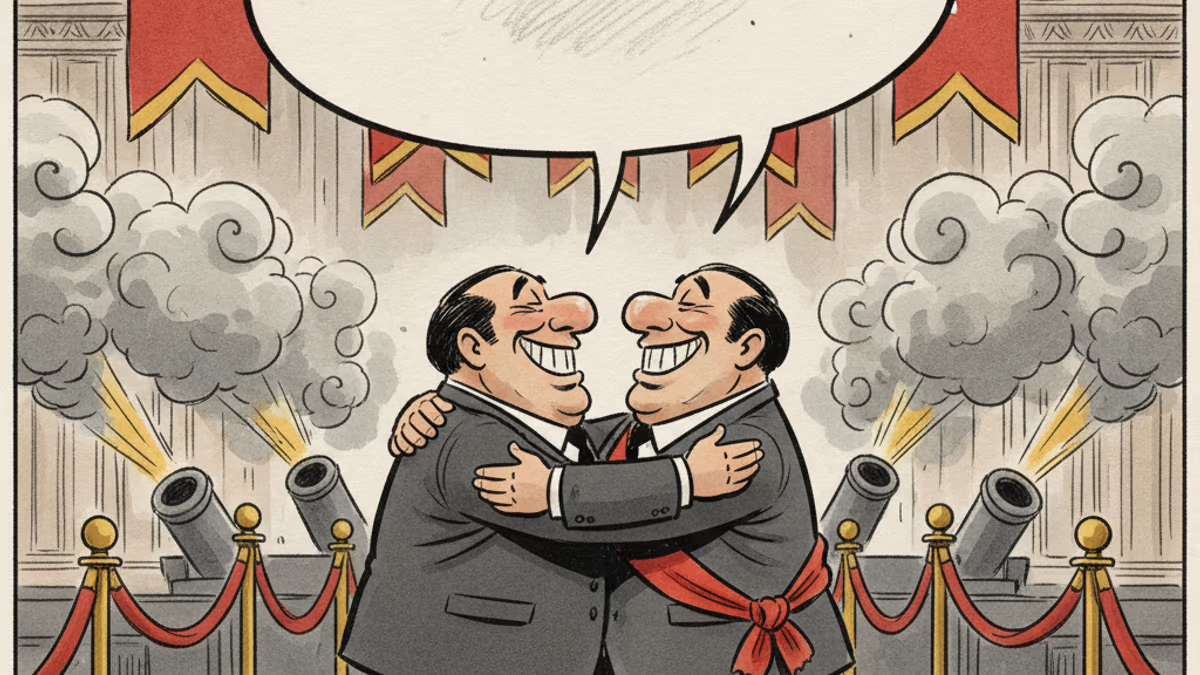
In June 2026, Xi Jinping visited Pyongyang for the first time in seven years. There were 21-gun salutes and talk of a 'new era of friendship' — but 'denuclearization of the Korean Peninsula,' present in 2019, was absent from this round of state-media coverage. A symbolic overreach, or a real upgrade?

Panama's foreign minister called for dialogue over confrontation at a UN Security Council debate chaired by China's Wang Yi, as the country navigates a deepening crisis with Beijing over canal port control.

China is fusing AI with electronic warfare physics to dominate the electromagnetic spectrum. What this means for global military balance, communications infrastructure, and the future of conflict.

Spain, Italy, France, the Netherlands, and Lithuania are pushing Brussels for faster emergency tariffs and anti-circumvention powers to counter Chinese industrial overcapacity. Here's what's at stake.
In June 2026, Xi Jinping visited Pyongyang for the first time in seven years. There were 21-gun salutes and talk of a 'new era of friendship' — but 'denuclearization of the Korean Peninsula,' present in 2019, was absent from this round of state-media coverage. A symbolic overreach, or a real upgrade?
Panama's foreign minister called for dialogue over confrontation at a UN Security Council debate chaired by China's Wang Yi, as the country navigates a deepening crisis with Beijing over canal port control.
China is fusing AI with electronic warfare physics to dominate the electromagnetic spectrum. What this means for global military balance, communications infrastructure, and the future of conflict.
Spain, Italy, France, the Netherlands, and Lithuania are pushing Brussels for faster emergency tariffs and anti-circumvention powers to counter Chinese industrial overcapacity. Here's what's at stake.
Thoughts
Share your thoughts on this article
Sign in to join the conversation