
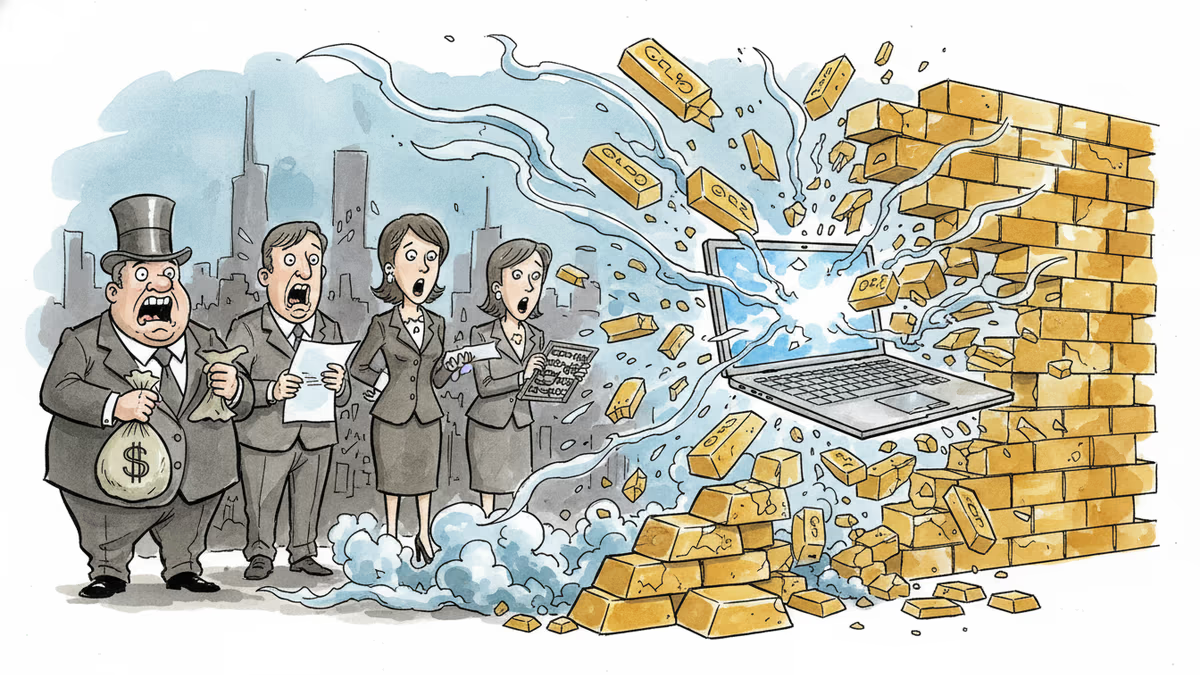
Apple Finally Breaks Its $1,000 Laptop Barrier
MacBook Neo starts at $599, ending Apple's 20-year pricing tradition. What this strategic shift means for the laptop market and Apple's ecosystem play.
For 20 years, Apple held the line. No matter what they called it—iBook, MacBook, MacBook Air—the company's entry-level laptops started at or near $1,000. Sure, there was that quiet Walmart experiment with discounted M1 MacBook Airs, first at $699, then $599. But those felt like market tests, not strategy.
The MacBook Neo changes everything. Starting at $599 for 256GB storage (no Touch ID) and $699 with Touch ID and 512GB storage, Apple has officially entered budget laptop territory. Educational customers get another $100 off each configuration.
What You Give Up, What You Get
The base MacBook Neo makes compromises. 256GB of storage feels tight in 2026, and losing Touch ID on the entry model stings. Compared to discounted M3 or M4 MacBook Airs you might find elsewhere, the spec sheet has gaps.
But here's the thing: it still feels like an Apple laptop. The build quality, the trackpad, the keyboard—the fundamentals that make a MacBook a MacBook are intact. At $400-500 less than previous entry points, those compromises start feeling reasonable rather than painful.
The Chromebook Killer Strategy
This isn't really about competing with premium Windows laptops. Apple is going after the education market that Google has dominated with Chromebooks. At $499 with educational pricing, the MacBook Neo directly challenges the $300-400 Chromebook ecosystem.

For schools already invested in iPads, having a laptop that seamlessly integrates with their existing Apple infrastructure becomes compelling. Students who start with a MacBook Neo in college might stick with Apple for their next upgrade—and the one after that.
The Ecosystem Entry Point
Apple's playbook here mirrors the $329 iPad and $429 iPhone SE strategy. Get people into the ecosystem at a lower price point, then capture them for life. A MacBook Neo buyer might add AirPods, an iPhone, maybe an iPad for their next purchase.
The lifetime customer value calculation makes taking a hit on hardware margins worthwhile. Apple isn't just selling a laptop; they're selling a 10-year relationship.
Microsoft's Windows Problem
This puts serious pressure on Microsoft's OEM partners. How do you compete with Apple's vertical integration when they can afford to subsidize hardware with services revenue? Dell, HP, and Lenovo have been fighting a race to the bottom in budget laptops. Now they're fighting Apple's race to the ecosystem.
Windows laptops at similar price points often feel compromised in ways that matter—cheap trackpads, mediocre displays, poor battery life. The MacBook Neo might not be perfect, but it's consistently good at the fundamentals.
Authors
Related Articles
After 15 years of fragmented mobile messaging, Apple and Google are rolling out end-to-end encrypted RCS messaging between iPhones and Android devices. Here's what changed, why it took so long, and what it means for your privacy.
Apple agreed to pay $250 million to settle claims it misled iPhone 16 buyers about Apple Intelligence features. What this means for consumers, Big Tech marketing, and the AI industry.
Apple quietly removed the entry-level $599 Mac Mini, raising the starting price to $799 — just one day after Tim Cook warned of chip supply constraints on the earnings call.
Apple names John Ternus, its hardware engineering chief, as the next CEO. The shift from operator to product person signals where Apple thinks its next decade of growth will come from — and raises real questions about what comes next.
After 15 years of fragmented mobile messaging, Apple and Google are rolling out end-to-end encrypted RCS messaging between iPhones and Android devices. Here's what changed, why it took so long, and what it means for your privacy.
Apple agreed to pay $250 million to settle claims it misled iPhone 16 buyers about Apple Intelligence features. What this means for consumers, Big Tech marketing, and the AI industry.
Apple quietly removed the entry-level $599 Mac Mini, raising the starting price to $799 — just one day after Tim Cook warned of chip supply constraints on the earnings call.
Apple names John Ternus, its hardware engineering chief, as the next CEO. The shift from operator to product person signals where Apple thinks its next decade of growth will come from — and raises real questions about what comes next.
Thoughts
Share your thoughts on this article
Sign in to join the conversation